The divorce process in Bangalore runs through the Bengaluru Family Courts: you file a petition, attend compulsory counselling or mediation, and then either complete two motions (mutual consent) or go through a full trial (contested) before the court grants a decree. This guide explains each stage as it actually works in Bengaluru, what to expect at the court complex, and how to keep your case moving.
Where divorce cases are heard in Bengaluru
Matrimonial cases in Bengaluru are heard by the Family Courts, which sit in the Family Courts complex near Lalbagh Main Gate, on Siddaiah Road. There are several Family Courts in the city, headed by a Principal Judge, and new cases are allotted among them. Appeals from their decisions go to the Karnataka High Court.
You can file in Bengaluru if the marriage took place here, your spouse currently lives here, you last lived together here, or, if you are the wife filing, you live here. These rules come from the personal law that applies to you, and our guide on how to file for divorce in India covers them, along with the choice of law, in more detail.
Before you file: three decisions
- Route. If your spouse agrees and you have lived apart for at least a year, mutual consent is faster, cheaper and less stressful. If not, you need a ground such as cruelty or desertion and must be ready to prove it.
- Interim needs. Decide early whether you need interim maintenance, custody or protection orders. These can be sought as soon as the case is filed.
- Settlement terms. Even in a contested case, it helps to know what outcome on alimony, the children and property you could accept, because the court will push for settlement at the outset.
Mutual consent divorce process in Bangalore
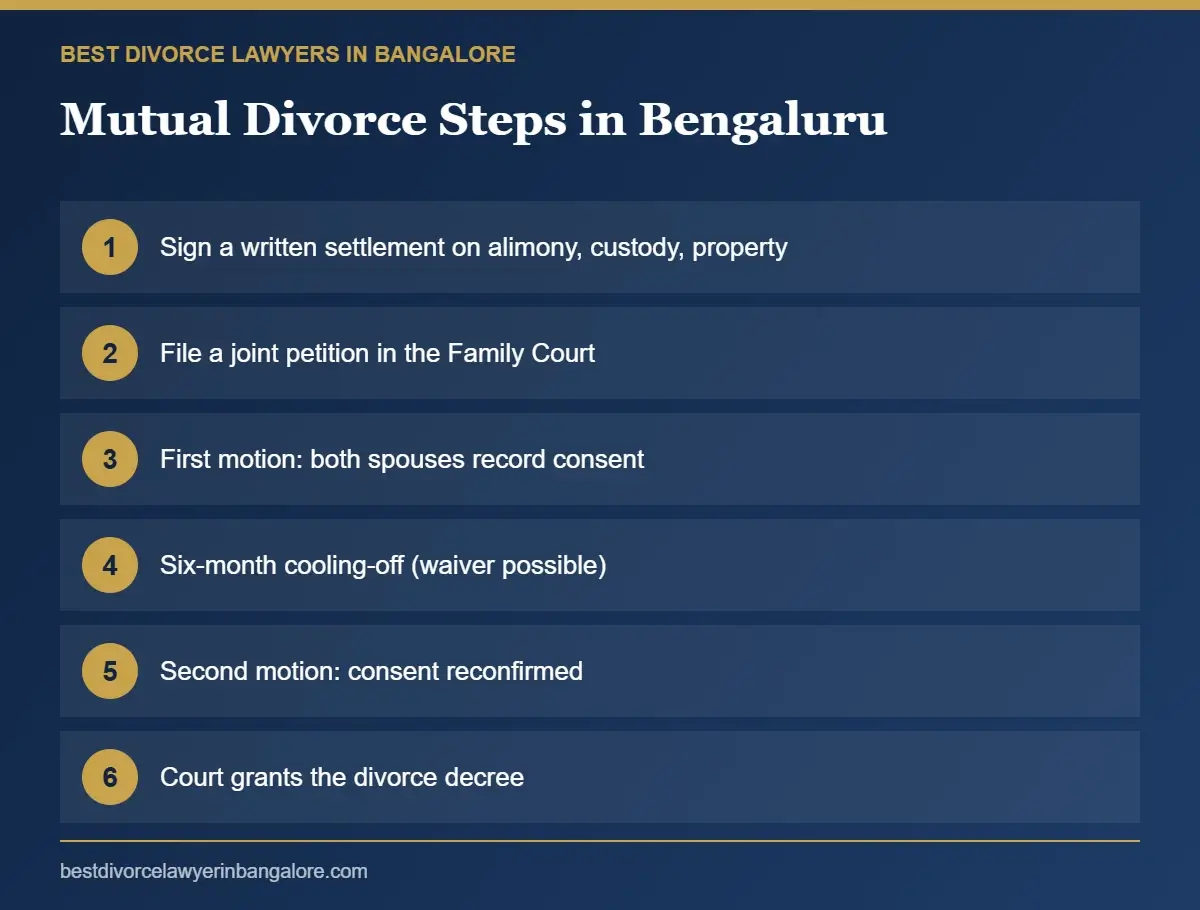
- Settlement agreement. The spouses agree in writing on permanent alimony (lump sum or instalments), custody and visitation, return of stridhan and gifts, joint property and loans, and withdrawal of any pending cases.
- Joint petition. A joint petition under Section 13B of the Hindu Marriage Act (or the equivalent provision of your law) is drafted with supporting affidavits and filed with the Family Court.
- First motion. Both spouses appear before the judge, confirm their consent and have their statements recorded. Matters are often referred to a counsellor at this stage.
- Cooling-off period. The law provides a six-month gap before the second motion. Where the parties have already been separated for a long time and settled everything, they can apply to waive it, following the Supreme Court’s 2017 ruling in Amardeep Singh v. Harveen Kaur.
- Second motion and decree. Both spouses appear again, reconfirm their consent, and the court grants the decree. Any alimony payment is usually exchanged at or before this hearing.
Both spouses must normally appear in person at both motions. If one of you lives abroad, courts can, at their discretion, allow appearance by video conferencing for certain steps, so raise it with your lawyer early.
Contested divorce process in Bangalore
Filing and notice
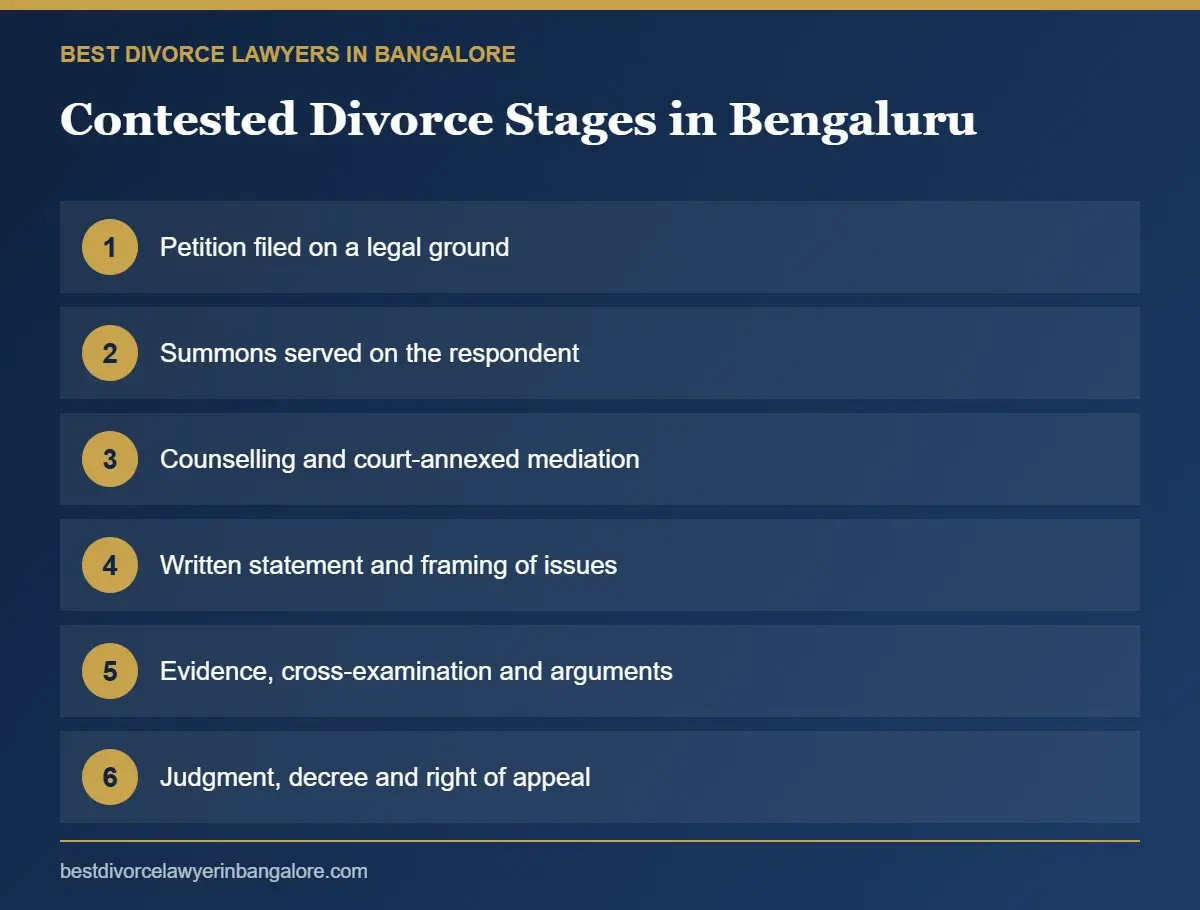
The petitioner files a petition setting out the ground, the facts relied on, and the reliefs claimed. The court issues summons to the respondent, by court process and often also by registered post or courier. If the respondent cannot be traced, the court may allow substituted service, such as publication in a newspaper.
Counselling and mediation
Section 9 of the Family Courts Act, 1984 obliges the court to try to bring about a settlement first. In Bengaluru, couples are usually sent to the court’s counsellors or to court-annexed mediation. Mediation is confidential, and many contested cases end as mutual consent divorces at this stage. If it fails, the case returns to the judge.
Written statement, evidence and arguments
The respondent files a written statement answering the petition, and may file a counter-claim. The court then frames the issues to be decided. Each side leads evidence, usually through an affidavit (examination-in-chief) followed by cross-examination in court, and produces documents such as messages, medical records or police complaints. After final arguments, the judge delivers a judgment and a decree is drawn up.
Interim applications along the way
- Maintenance and litigation costs during the case under Section 24 of the Hindu Marriage Act
- Interim custody and visitation for children
- Maintenance under Section 144 of the Bharatiya Nagarik Suraksha Sanhita, 2023 (formerly Section 125 CrPC)
- Protection, residence and monetary orders under the Protection of Women from Domestic Violence Act, 2005
Since Rajnesh v. Neha (2020), both parties in a maintenance claim must file a sworn affidavit of their assets, income and liabilities, so organise your financial records early.
How long the divorce process in Bangalore takes
| Type of case | Typical duration in Bengaluru | What drives it |
|---|---|---|
| Mutual consent, cooling-off waived | A few weeks to a few months | Court accepting the waiver, listing dates |
| Mutual consent, standard | Around 6 to 18 months | Six-month gap, scheduling of the second motion |
| Contested | Often 2 to 5 years or more | Service delays, number of witnesses, adjournments, interim fights |
These ranges are general and not guarantees. A contested case that settles in mediation can finish quickly, and a mutual case can stall if one spouse withdraws consent before the second motion.
Documents to keep ready
Bengaluru Family Courts follow the same documentary basics as courts elsewhere in Karnataka. Keep these ready before your first appointment with a lawyer:
- Marriage certificate, or wedding photographs and the invitation card
- Aadhaar, passport or other ID and address proof for both spouses
- Proof of your current address in Bengaluru, which supports the court’s jurisdiction
- Salary slips, income tax returns and recent bank statements
- Children’s birth certificates and school fee receipts
- Any FIRs, domestic violence complaints or earlier court orders
After the decree
Once the decree is passed, apply to the court’s copying section for a certified copy. You will need it to update your marital status and name with banks, employers and the passport office, to claim alimony instalments or enforce custody terms, and to remarry. If the other side does not comply with the decree’s terms on maintenance or custody, you can file an execution petition before the same Family Court. Do not remarry until the time for appeal has passed or any appeal has been decided.
Practical tips for the Bengaluru Family Courts
- Arrive early. The complex is busy, and cause lists are called in order. Missing your turn can cost you a date that may be weeks away.
- Carry originals and copies. Keep ID, the marriage certificate and settlement papers with you at the motions.
- Track your case online. Case status, next hearing dates and orders are available on the eCourts services portal and app using your case number or CNR.
- Language. Proceedings may be conducted in Kannada or English. If you are not comfortable in Kannada, tell your lawyer so documents and testimony can be handled appropriately.
- Use legal aid if needed. Women, children and people below the income limit are entitled to free legal services through the Karnataka State Legal Services Authority and the District Legal Services Authority for Bengaluru.
Official notices and court information for Karnataka are published on the Karnataka Judiciary website. For a wider view of the grounds, rights and options available under each personal law, see our overview of divorce laws in India.
Frequently Asked Questions
Can I get a divorce in Bangalore without going to court?
No. In India a marriage under the Hindu Marriage Act, Special Marriage Act or Christian and Parsi laws can only be dissolved by a court decree. A private agreement or notarised deed does not end the marriage, though a settlement can be placed before the court in a mutual petition.
Is counselling compulsory at the Bengaluru Family Courts?
Family Courts are required by law to attempt reconciliation or settlement, so most couples are referred to a counsellor or mediator. Attending is expected. If settlement fails, the case simply returns to the judge.
Can one spouse withdraw consent in a mutual divorce?
Yes. Either spouse can withdraw consent at any time before the decree. The court cannot grant a mutual divorce without consent at the second motion, and the other spouse would then have to file a contested petition.
What if my spouse lives in another city?
You can still file in Bengaluru if you last lived together here or, if you are the wife, you live here now. Your spouse will be served summons at their address, and either side can ask the Supreme Court to transfer the case in appropriate circumstances.
How do I check the status of my divorce case in Bangalore?
Use the eCourts services website or mobile app and search by your case number, party name or CNR number. It shows the next hearing date, the stage of the case and any orders uploaded by the court.
The process is far easier with someone who knows the Bengaluru Family Courts well. If your spouse is contesting, or you expect a dispute over alimony or the children, consult experienced contested divorce lawyers in Bangalore, or compare the top divorce lawyers in Bangalore to find the right fit for your case.