To file for divorce in India, you file a petition in the Family Court that has jurisdiction over your marriage, under the personal law that governs it, either jointly with your spouse (mutual consent) or alone on a legal ground (contested). This guide on how to file for divorce in India walks you through choosing the right law and court, preparing the petition, and what happens from the first hearing to the final decree.
Which law applies to your divorce?
India has no single divorce code. The law that applies depends on your religion and how the marriage was solemnised, and it decides the grounds you can rely on and the waiting periods you face. Understanding the broader framework of divorce laws in India before you file saves time and avoids a petition being returned.
| Marriage | Governing law | Contested divorce | Mutual consent |
|---|---|---|---|
| Hindus, Buddhists, Jains, Sikhs | Hindu Marriage Act, 1955 | Section 13 | Section 13B |
| Civil or inter-faith marriages | Special Marriage Act, 1954 | Section 27 | Section 28 |
| Christians | Divorce Act, 1869 | Section 10 | Section 10A |
| Parsis | Parsi Marriage and Divorce Act, 1936 | Section 32 | Section 32B |
| Muslims | Muslim personal law and the Dissolution of Muslim Marriages Act, 1939 | Court decree for the wife under the 1939 Act | Khula or mubarat |
If you are Hindu and married under Hindu rites, you are almost always under the Hindu Marriage Act. If you registered your marriage under the Special Marriage Act, that Act governs, whatever your religion. The full text of the Hindu Marriage Act is available on India Code, the government’s official legislation portal.
Mutual consent or contested: choose your route
The single biggest decision is whether your spouse will agree. The two routes are very different in effort, cost and time.
Mutual consent divorce
Both spouses file one joint petition stating that they have lived separately for at least one year, cannot live together, and have agreed to end the marriage. Under the Hindu Marriage Act the court records the first motion, and the second motion can be moved after six months and within eighteen months of filing. In Amardeep Singh v. Harveen Kaur (2017), the Supreme Court held that this six-month cooling-off period is not mandatory and can be waived where the court is satisfied that there is no chance of reconciliation and all issues are settled. Alimony, child custody, return of stridhan and pending cases are all settled in writing beforehand.
Contested divorce
One spouse files alone and must prove a ground recognised by law. Under Section 13 of the Hindu Marriage Act these include cruelty, desertion for at least two years, adultery, conversion to another religion, serious and incurable mental disorder, venereal disease in a communicable form, renunciation of the world, and the spouse not being heard of as alive for seven years. A wife has some additional grounds under Section 13(2). Because the other side can oppose every allegation, contested cases take much longer and depend heavily on evidence.
Note that, under Section 14 of the Hindu Marriage Act, a divorce petition generally cannot be filed within one year of the marriage unless the court permits it on grounds of exceptional hardship or depravity.
Which court should you file in?
Divorce petitions are heard by the Family Court where one exists, and by the principal civil court of the district elsewhere. Under Section 19 of the Hindu Marriage Act, you can file where:
- the marriage was solemnised;
- the respondent lives at the time of filing;
- the couple last lived together; or
- the wife lives, if she is the one filing.
So a couple who married in Mysuru but last lived together in Whitefield can usually file in the Bengaluru Family Courts. The local steps, counselling and listing practices are covered in our guide to the divorce process in Bangalore.
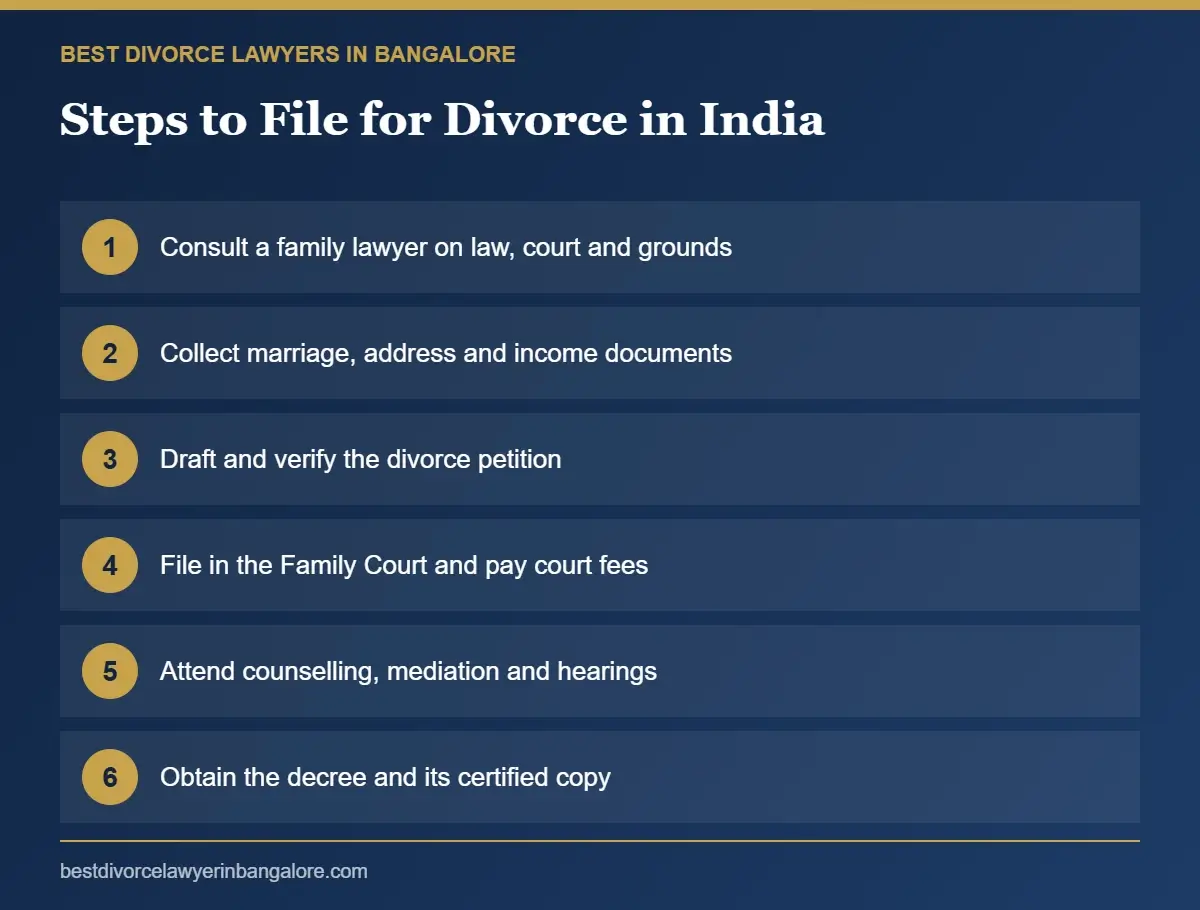
How to file for divorce in India: step by step
- Get advice early. A family lawyer will confirm the applicable law, the right court and whether you have a provable ground. A short consultation often reveals whether a mutual settlement is realistic.
- Gather your documents. Collect proof of marriage, address, separation and finances (see the checklist below) before drafting starts.
- Draft the petition. The petition sets out the marriage details, children, the ground or the mutual agreement, the reliefs you seek (divorce, maintenance, custody, return of articles) and the court’s jurisdiction. It is verified and supported by an affidavit.
- File and pay court fees. The petition is filed in the Family Court’s filing section with the prescribed court fee and copies for the other side. It is then numbered and listed before a judge.
- Service of notice. In a contested case, the court issues summons to the respondent. In a mutual case, both spouses appear together at the first motion.
- Counselling and mediation. Family Courts are required by law to attempt settlement first, so most matrimonial cases are referred to a counsellor or the court’s mediation centre.
- Trial or second motion. A contested case moves to the written statement, framing of issues, evidence and arguments. A mutual case moves to the second motion, where both spouses confirm their consent.
- Decree. The court pronounces judgment and a decree of divorce is drawn up. Apply for a certified copy, because you will need it for every later formality.
Documents you will need
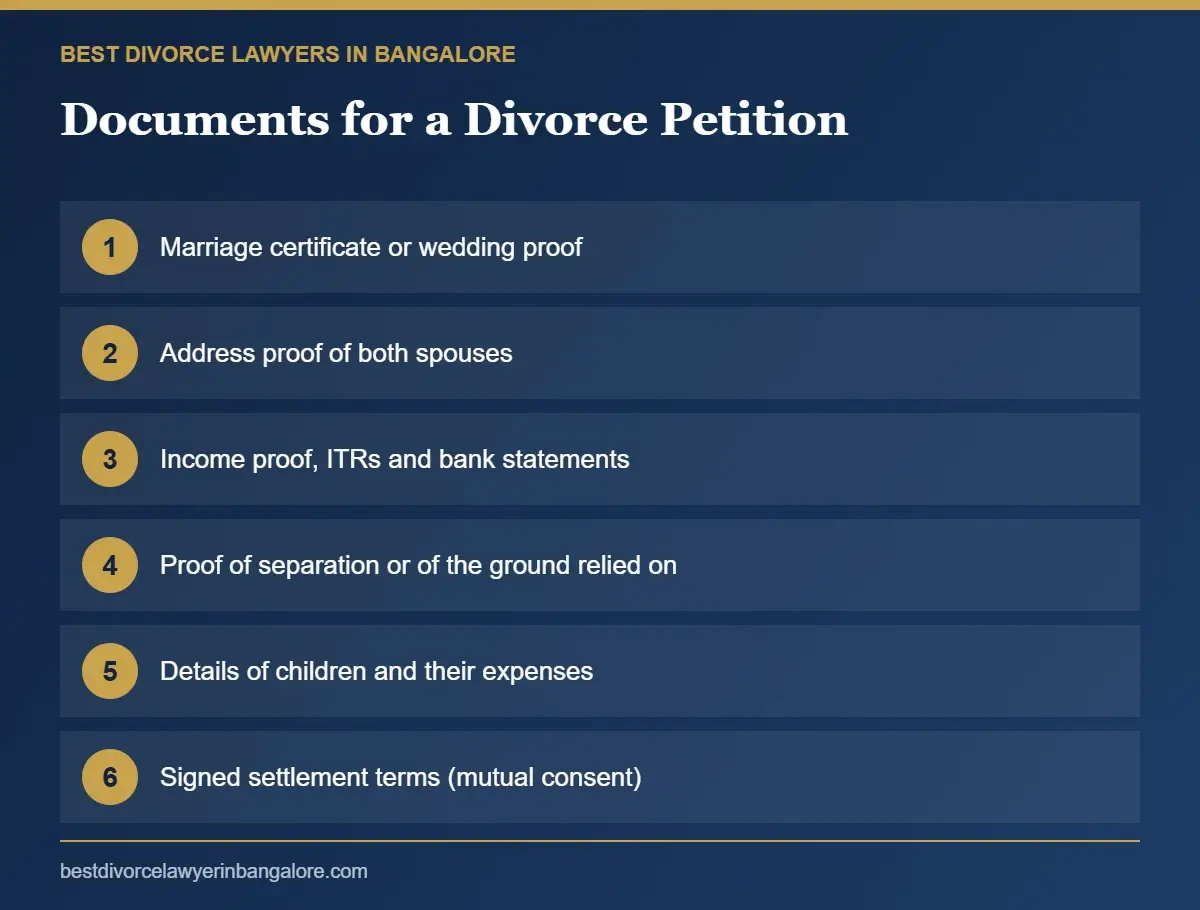
- Marriage certificate, or wedding invitation and photographs if the marriage was not registered
- Address proof of both spouses (Aadhaar, passport, rental agreement or utility bills)
- Recent passport-size photographs
- Proof of separation, such as a separate lease or correspondence, especially for mutual consent
- Income proof: salary slips, Form 16 or ITRs, and bank statements, which also support any maintenance claim
- Details of children, their schooling and expenses
- Evidence of the ground in a contested case: medical records, police complaints, messages, emails or witness details
- For a mutual petition, the signed terms of settlement on alimony, custody and property
Since 2020, the Supreme Court’s directions in Rajnesh v. Neha require both parties in maintenance proceedings to file an affidavit disclosing their assets and liabilities, so keep your financial records ready even if maintenance is not your main concern.
What happens after the petition is filed
Interim relief while the case is pending
Either spouse who lacks independent income can ask for maintenance and litigation expenses during the case under Section 24 of the Hindu Marriage Act. Interim custody and visitation can also be sought. A wife can separately claim maintenance under Section 144 of the Bharatiya Nagarik Suraksha Sanhita, 2023 (which replaced Section 125 CrPC from 1 July 2024) and relief under the Protection of Women from Domestic Violence Act, 2005.
The trial in a contested case
After the respondent files a written statement, the court frames the issues. The petitioner then leads evidence, usually by an affidavit followed by cross-examination, and the respondent does the same. Final arguments follow, and the court gives its judgment. Adjournments are common, so consistent attendance and organised evidence make a real difference.
Appeal and remarriage
A Family Court decree can be appealed to the High Court. Courts have differed on whether the 30-day limit in Section 19 of the Family Courts Act, 1984 or the 90-day limit in Section 28 of the Hindu Marriage Act applies, so the safe course is to act within 30 days. Under Section 15, either party may remarry once the time for appeal has passed without an appeal, or once any appeal is dismissed. In a mutual divorce, both sides usually confirm that they will not appeal.
How long and how much?
A mutual consent divorce in a city like Bengaluru commonly takes around six to eighteen months, and less if the cooling-off period is waived. A contested divorce often runs for several years, depending on the court’s workload and how hard the case is fought. Costs vary just as widely. Court fees are modest, but legal fees depend on the lawyer’s experience and the number of hearings, so ask for a written fee structure at the start. If you cannot afford a lawyer, women are entitled to free legal aid under the Legal Services Authorities Act, 1987, through the Karnataka State Legal Services Authority and its district units.
Frequently Asked Questions
Can I file for divorce online in India?
Many courts, including Karnataka courts, support e-filing through the eCourts system, but you will still need to appear in person for counselling, the motions in a mutual case, and evidence in a contested case. Most people file through a lawyer, who handles the filing formalities.
Can I file for divorce without a lawyer?
Yes. You can appear in person as a party-in-person, and Family Courts are meant to be accessible. However, drafting the petition, choosing the right ground and leading evidence are technical tasks, so independent legal advice is strongly recommended, even if only for drafting.
Do I need a registered marriage to file for divorce?
No. Registration is proof of marriage, not a condition for it. If your marriage was not registered, wedding photographs, invitations, witnesses and the officiating priest’s certificate can prove it.
What if my spouse does not respond to the summons?
If the respondent is properly served and still does not appear, the court can proceed ex parte, hear your evidence and pass a decree. Courts insist on proof of valid service before doing so.
Can I file for divorce in Bangalore if I married in another state?
Yes, if you and your spouse last lived together in Bengaluru, your spouse lives there now, or, if you are the wife filing, you live there. The place of the wedding is only one of several options for jurisdiction.
Every marriage and every case is different, and a well-drafted petition sets the tone for everything that follows. If you are ready to take the next step, speak to one of the best divorce lawyers in Bangalore for advice on your specific situation, or explore our mutual divorce lawyers in Bangalore if you and your spouse have already agreed to part ways.