If you and your spouse have both agreed to end the marriage, the best mutual divorce lawyers in Bangalore can take your joint petition from settlement to decree with as few court visits and as little friction as possible. Below are four experienced Bengaluru advocates who handle mutual consent divorce, followed by a clear guide to the law, the Family Court process, documents, timelines and fees.
4 advocates · 20+ years’ experience · 2 women advocates · Free first consultation
Best Mutual Divorce Lawyers in Bangalore

Advocate Varun Papireddy – Mutual Divorce Lawyer in Bangalore (20+ Years)
- Name: Advocate Varun Papireddy
- Experience: 20+ years
- Specialisation: Mutual and contested divorce, cruelty and domestic violence cases, child custody
- Known for: Careful case preparation and strong courtroom advocacy
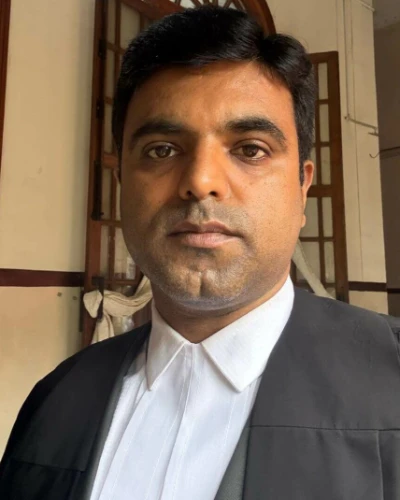
Advocate Kiran Kumar B.M – Mutual Divorce Advocate in Bangalore (20+ Years)
- Name: Advocate Kiran Kumar B.M
- Experience: 20+ years
- Specialisation: Mutual and contested divorce, domestic violence, child custody, matrimonial property
- Known for: Discreet handling of complex disputes for both men and women
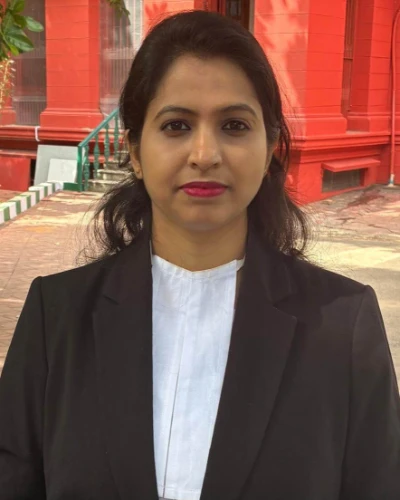
Advocate Poojashree – Female Mutual Divorce Lawyer in Bangalore
- Name: Advocate Poojashree
- Specialisation: Mutual and contested divorce, domestic violence, child custody, women’s rights
- Known for: A safe, respectful space where women can speak openly
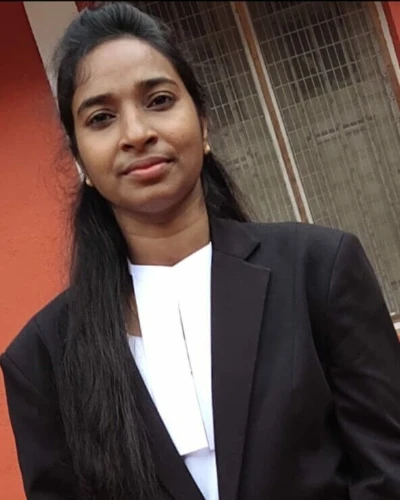
Advocate Esther Balakrishna – Lady Divorce Lawyer in Bangalore
- Name: Advocate Esther Balakrishna
- Specialisation: Divorce, matrimonial disputes and other family law matters
- Known for: Protecting clients’ rights at every stage of the case
When You Need a Mutual Divorce Lawyer
A mutual consent divorce is the fastest and least adversarial way to end a marriage in India, but “mutual” does not mean “simple”. You should speak to a lawyer when:
- You have agreed to separate but not on the terms. Alimony, the return of streedhan and gifts, the family home, joint loans and child custody all need to be settled before the court will grant a decree.
- You have children. Custody, visitation, school expenses and child support must be written down in a way the Family Court will accept and that both of you can actually follow.
- One of you lives outside Bangalore or abroad. A lawyer can ask the court to allow appearance by video conferencing and plan hearings around travel.
- You want to shorten the six-month waiting period. This is possible only in the right circumstances and needs a properly argued application.
- There are pending cases. Domestic violence, maintenance or criminal complaints usually have to be withdrawn or settled as part of the overall agreement, and the sequence matters.
If your spouse has not agreed to a divorce at all, a mutual petition is not available and you will need a contested divorce lawyer in Bangalore instead.
The Law on Mutual Consent Divorce
Hindu Marriage Act, Section 13B
Hindus, Buddhists, Jains and Sikhs file under Section 13B of the Hindu Marriage Act, 1955. Section 13B(1) lets both spouses present a joint petition if they have been living separately for one year or more, have not been able to live together, and have mutually agreed that the marriage should be dissolved. “Living separately” means not living as husband and wife; you can still be under the same roof in some situations, although this needs to be explained carefully.
Under Section 13B(2), the couple must move the court again (the “second motion”) not earlier than six months and not later than eighteen months after the petition was presented. If the court is satisfied after hearing both parties, it passes a decree of divorce.
Special Marriage Act, Section 28
Inter-faith couples and anyone who married under the Special Marriage Act, 1954 use Section 28, which follows the same pattern: one year of separate living, a joint petition, and a second motion between six and eighteen months later. Christian couples file under Section 10A of the Divorce Act, 1869, which requires two years of separation.
Waiving the six-month cooling-off period
In Amardeep Singh v. Harveen Kaur (2017), the Supreme Court held that the six-month period in Section 13B(2) is directory, not mandatory. The Family Court can waive it where the one year of separation plus the six-month period have already passed before the first motion, all efforts at mediation and reconciliation have failed, the parties have genuinely settled every issue including alimony and custody, and waiting would only prolong their agony. The waiver application can be made one week after the first motion. Every case is decided on its facts, so treat waiver as a possibility, not a promise.
Withdrawing consent before the decree
Consent must exist on the day the decree is passed, not only on the day of filing. In Sureshta Devi v. Om Prakash (1991), the Supreme Court held that either spouse can withdraw consent at any time before the decree, and the court cannot then grant a mutual divorce. This is why a well-drafted, balanced settlement, with payments timed sensibly, protects both sides from a last-minute change of mind.
Step-by-Step Process at the Bengaluru Family Court
Mutual divorce petitions in the city are filed at the Family Courts complex on Siddaiah Road, near Lalbagh Main Gate. The usual sequence is:
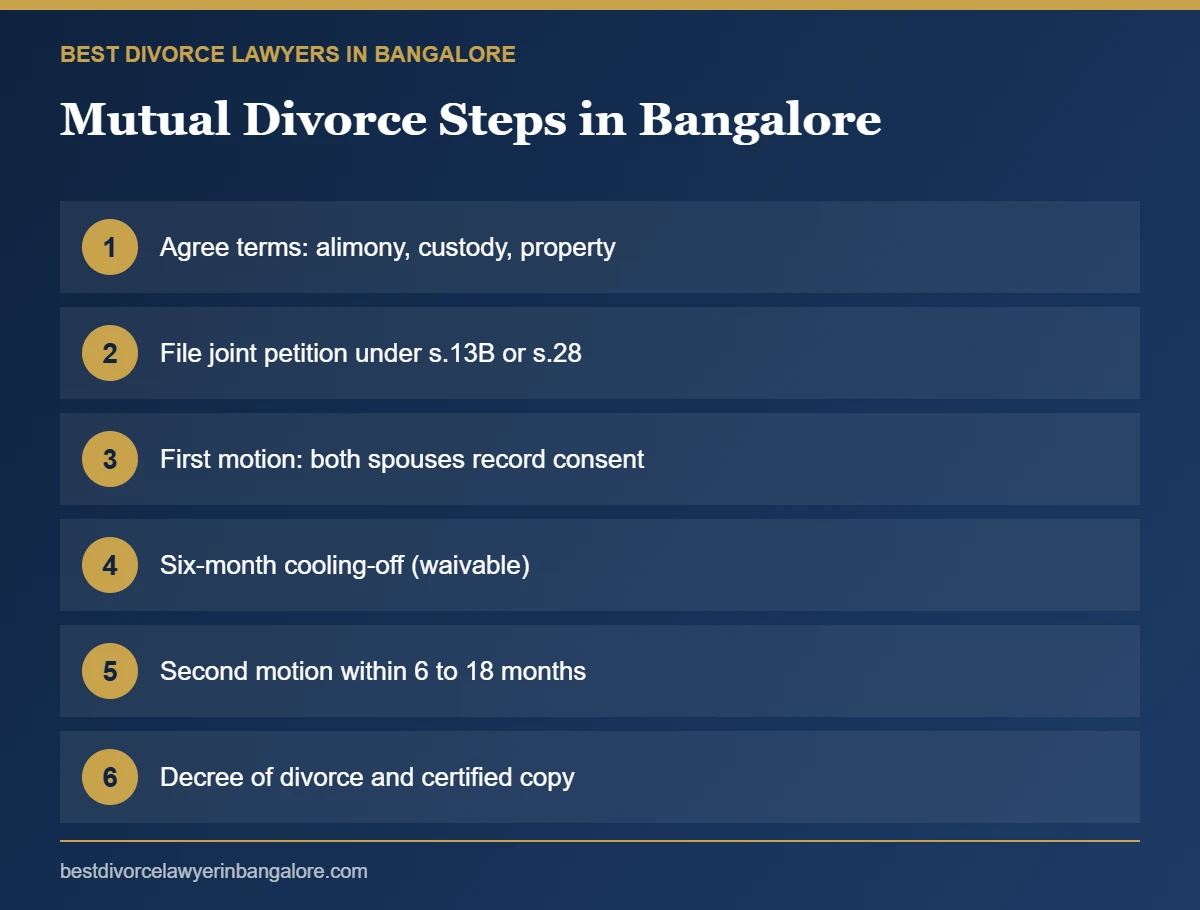
- Consultation and settlement. Your lawyer records the agreed terms on alimony, custody, property and pending cases in a memorandum of understanding or settlement deed.
- Drafting and filing. A joint petition under Section 13B (or Section 28), with supporting affidavits from both spouses, is filed and numbered.
- First motion. Both spouses appear before the judge, confirm consent and have their statements recorded. The court may refer you to the in-house mediation or counselling centre.
- Cooling-off period. Six months from the date of presentation, unless the court waives it.
- Second motion. Both spouses appear again, confirm that consent continues and that the agreed payments or transfers have been made as planned.
- Decree. The court passes the decree of divorce, and your lawyer applies for a certified copy for name changes, passport updates and remarriage.
Documents to Prepare
- Marriage certificate, or proof of marriage such as the wedding invitation and photographs
- Identity and address proof for both spouses (Aadhaar, passport, voter ID)
- Recent passport-size photographs of both spouses
- Details showing when and how you have lived separately for at least a year
- The signed settlement terms on alimony, streedhan, property and children
- Income, asset and liability details, including salary slips, bank statements and loan papers
- Children’s birth certificates and school details, if applicable
- Copies of any pending cases between you, such as maintenance or domestic violence matters
How Long a Mutual Divorce Takes in Bangalore
Most mutual divorces in Bangalore take around six to seven months from filing, because of the statutory waiting period. A case with an approved waiver can finish much sooner, while one where the second motion is delayed can run up to the eighteen-month limit. Court workload and adjournments also affect the timetable.
| Stage | What happens | Typical timing |
|---|---|---|
| Before filing | Settlement talks, drafting the petition and affidavits | A few days to several weeks |
| First motion | Filing, joint appearance, statements recorded | Within a few weeks of filing |
| Cooling-off | Statutory waiting period under s.13B(2) or s.28(2) | 6 months from presentation (waivable) |
| Second motion | Both spouses reconfirm consent | Between 6 and 18 months after filing |
| Decree and certified copy | Divorce granted; certified copy issued | On or soon after the second motion |
Talk to a Mutual Divorce Lawyer Today
Get clear advice on your settlement, timeline and fees in a free, confidential first consultation.
Mutual Divorce Lawyer Fees in Bangalore
There is no fixed scale for professional fees. A straightforward mutual divorce where everything is already agreed generally costs far less than a contested case, while matters with large alimony, shared property, children or an NRI spouse cost more because of the drafting and coordination involved. Fees are often quoted as a package for the full case, sometimes split between the two spouses. Ask for a written quote at your free first consultation, and check whether it covers drafting, both motions, a waiver application if needed, and the certified copy. Court fees and incidental costs are usually modest by comparison.
What a Good Mutual Divorce Lawyer Does for You
- Protects your settlement. Drafts terms that are clear, enforceable and timed so that neither side is exposed if consent is withdrawn.
- Handles children’s arrangements with care. Builds custody and visitation terms around the welfare of the child; for complex disputes, a child custody lawyer in Bangalore can advise alongside.
- Gets the money right. Advises on a fair one-time alimony figure, tax points and how payment is made; see our alimony lawyers in Bangalore for disputes over amounts.
- Cleans up pending cases. Plans the withdrawal or quashing of related maintenance, DV or criminal proceedings as part of the deal.
- Moves the case efficiently. Files a waiver application where the facts support it and arranges video appearance where permitted.
How to Choose the Right Lawyer
- Check Karnataka State Bar Council enrolment and ask how long the advocate has practised family law.
- Ask how many mutual divorce petitions they handle at the Bengaluru Family Court.
- Look for someone who explains the settlement terms in plain language and puts their fee in writing.
- Prefer a lawyer who will tell you honestly whether a cooling-off waiver is realistic.
- Consider whether you would be more comfortable with a woman advocate.
- Make sure they can coordinate with your spouse’s lawyer calmly and professionally.
You can also compare all divorce lawyers in Bangalore on our homepage, or check the areas we serve across Bengaluru.
Helpful guides: read our step-by-step guide on how to file for divorce in India, see how the divorce process in Bangalore works at the Family Court, or browse our complete guide to divorce laws in India.
Frequently Asked Questions
Do both spouses have to come to the Bangalore Family Court?
Yes, as a rule both spouses appear for the first and second motions so the judge can confirm consent. Where one spouse lives abroad or in another city, the court may allow appearance by video conferencing; your lawyer has to request this.
Can we file for mutual divorce if we live in the same house?
Possibly. The law asks whether you have lived separately as husband and wife for a year, not only under different roofs. You will need to explain the arrangement clearly in the petition, so discuss the facts with your lawyer first.
Which court do we file in?
You can file where the marriage was solemnised, where the respondent lives, or where you last lived together as a couple. For Bengaluru city, that is usually the Family Courts on Siddaiah Road.
Can the six-month waiting period be skipped in Bangalore?
It can be waived, not skipped automatically. The Family Court applies the Amardeep Singh tests, including at least 18 months of separation before filing and a full settlement of all issues.
What if my spouse changes their mind after the first motion?
Either spouse can withdraw consent before the decree, and the mutual petition then fails. You can still seek a divorce on contested grounds if they apply, so keep your lawyer informed early.
Is the first consultation really free?
Yes. The first consultation is free and confidential, and you can reach the desk 24/7 to book it.
Ready to File Your Mutual Divorce?
Our desk is open 24/7 to connect you with an experienced mutual divorce lawyer in Bangalore.
Book your free consultation
Call this number to book a free consultation. Our appointment desk answers 24/7 and will confirm a time that suits you.