The difference in mutual divorce vs contested divorce comes down to agreement: in a mutual consent divorce both spouses jointly ask the court to end the marriage on agreed terms, while in a contested divorce one spouse files alone and must prove a legal ground against the other. Mutual divorce is usually quicker, cheaper and more private; a contested divorce is the route when your spouse will not agree or the terms cannot be settled. This guide compares the two side by side so you can judge which fits your situation in Bangalore.
Mutual Divorce vs Contested Divorce: The Quick Comparison
| Factor | Mutual consent divorce | Contested divorce |
|---|---|---|
| Who files | Both spouses, in a joint petition | One spouse files against the other |
| Legal basis (Hindu Marriage Act) | Section 13B | Section 13 grounds such as cruelty, adultery or desertion |
| Proof of fault | Not needed | Must be pleaded and proved with evidence |
| Pre-condition | Living separately for at least 1 year | A valid ground; generally not within 1 year of marriage |
| Typical duration | Often around 6 to 18 months; sometimes faster if the waiting period is waived | Commonly several years, depending on the court and how hard it is fought |
| Cost | Generally lower, as there is no trial | Generally higher, because of repeated hearings and evidence |
| Control over outcome | Spouses decide alimony, custody and property | The judge decides on the evidence |
| Privacy and stress | Fewer hearings, less public conflict | Cross-examination and allegations on record |
Under the Special Marriage Act, 1954, the equivalent provisions are Section 28 (mutual) and Section 27 (contested). Christians use Sections 10A and 10 of the Divorce Act, 1869, where mutual consent needs two years of separation instead of one. For the bigger picture, see our overview of divorce laws in India.
What Is a Mutual Consent Divorce?
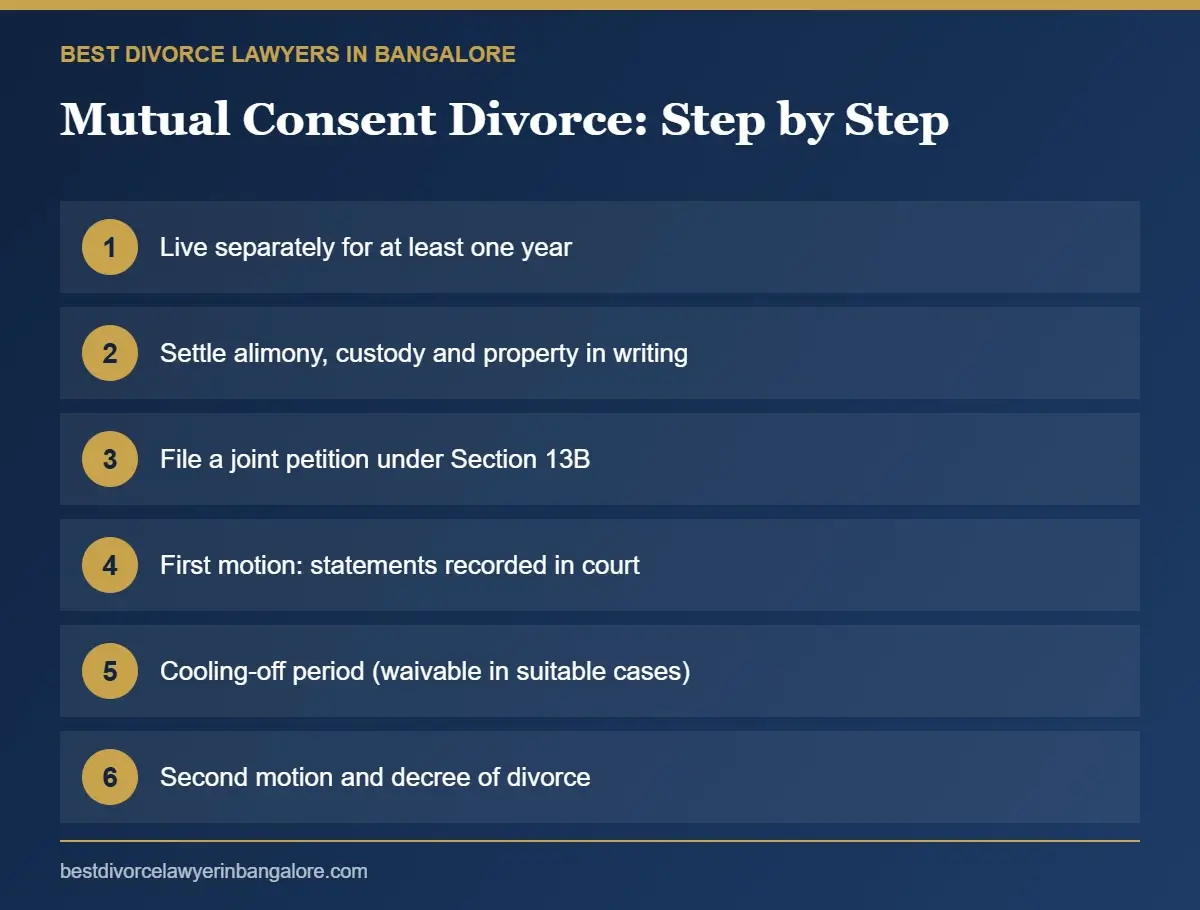
A mutual consent divorce is an agreed ending. Section 13B of the Hindu Marriage Act requires three things: the spouses have been living separately for one year or more, they have not been able to live together, and they have mutually agreed that the marriage should be dissolved. “Living separately” does not always mean different homes; courts have accepted that spouses can live under one roof but no longer live as husband and wife.
Settlement terms come first
The real work in a mutual divorce happens before filing. The couple should agree, in writing, on:
- Permanent alimony, whether a one-time lump sum or periodic payments.
- Return of stridhan, jewellery and gifts.
- Custody of children, visitation and child support.
- Division of jointly owned property, loans and joint accounts.
- Withdrawal of any pending cases, such as domestic violence or maintenance proceedings.
A clear settlement is what keeps a mutual divorce smooth. Vague terms are the most common reason couples fall out between the first and second motion.
The court process
The joint petition is filed in the Family Court with jurisdiction, which in Bangalore Urban means the Family Courts near Lalbagh Main Gate on Siddaiah Road. Under Section 19 of the Hindu Marriage Act, you can file where the marriage was solemnised, where the respondent lives, where you last lived together, or, if the wife is the petitioner, where she lives. Both spouses appear, their statements are recorded, and the court admits the petition as the first motion.
The law then provides a period of reflection: the second motion cannot ordinarily be moved earlier than six months, and must be moved within eighteen months of the petition. At the second motion, the court confirms that both still consent and that the settlement is being honoured, and then grants the decree.
Can the six-month waiting period be waived?
Yes, in suitable cases. In Amardeep Singh v. Harveen Kaur (2017), the Supreme Court held that the six-month period is directory, not mandatory. A Family Court can waive it if the spouses have already been separated for over eighteen months in total (the one year before filing plus the six months), mediation and reconciliation efforts have failed, and all issues including alimony and custody are fully settled. You apply for the waiver after the first motion, giving reasons.
Either spouse can withdraw consent
Consent must exist on the day the decree is passed. In Sureshta Devi v. Om Prakash (1991), the Supreme Court held that either spouse may withdraw consent before the decree. If that happens, the court cannot grant a mutual divorce, and the other spouse would need to file a contested petition on a legal ground. This is why many lawyers suggest that agreed payments be split between the first and second motions.
If you want help drafting the settlement and petition, a mutual divorce lawyer in Bangalore can take care of the paperwork and court appearances.
What Is a Contested Divorce?
A contested divorce is filed by one spouse without the other’s agreement. The petitioner must rely on a ground recognised by law. Under the Hindu Marriage Act these include cruelty, adultery, desertion for two years, conversion, serious mental disorder, communicable venereal disease, renunciation and presumption of death, with some additional grounds available only to the wife. Our detailed guide to the grounds for divorce in India explains each one and how it is proved.
How a contested case runs
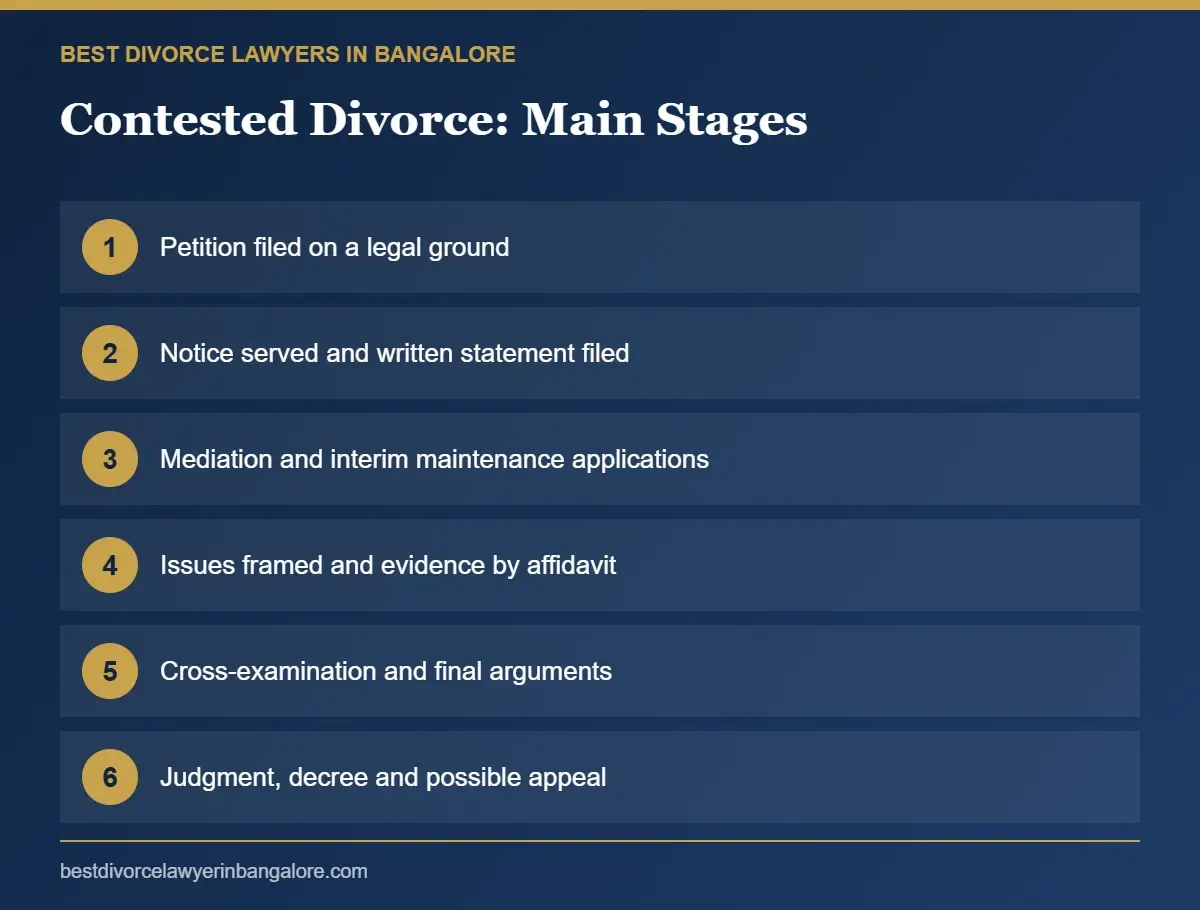
After the petition is filed, the court issues notice to the other spouse, who files a written statement and may raise counter-claims. The court refers the parties to mediation, often at the mediation centre attached to the Family Courts. If that fails, the court frames issues, the parties give evidence by affidavit, witnesses are cross-examined, and final arguments are heard before judgment. Interim applications run alongside, such as interim maintenance and litigation costs under Section 24 or temporary custody of children.
How long it takes
Section 21B of the Hindu Marriage Act asks courts to try divorce cases on a day-to-day basis as far as possible and to try to conclude them within six months of notice being served. In practice, contested divorces in busy cities including Bangalore commonly take much longer, often a few years, depending on the number of witnesses, adjournments and interim disputes. A decree can also be appealed to the Karnataka High Court, which adds time.
Which Route Is Right for You?
Choose a mutual consent divorce if both of you accept the marriage is over and you can agree on money, children and property, even if the negotiations are hard. Choose a contested divorce if your spouse refuses to cooperate, cannot be traced, or if there is serious misconduct such as violence where a court finding matters to you.
The two routes are not locked in. Many contested cases settle in mediation and convert into a mutual petition, with the original case withdrawn. A well-prepared contested petition can also bring a reluctant spouse to the negotiating table. If you are still at the start, read how to file for divorce in India and our step-by-step guide to the divorce process in Bangalore.
Common Mistakes to Avoid
- Filing mutual without a full settlement. Unresolved issues tend to surface at the second motion.
- Making exaggerated allegations in a contested case. Allegations that cannot be proved can backfire and may themselves be argued as cruelty.
- Moving out of the matrimonial home without advice where custody or desertion may later be argued.
- Ignoring notices. If you are the respondent and do not appear, the court can proceed ex parte.
How this guide was prepared
This guide is based on the bare acts published on India Code and on judgments of the Supreme Court of India and the Karnataka High Court. Section numbers, case citations and time limits were fact-checked in October 2026, and criminal-law references use the Bharatiya Nyaya Sanhita (BNS) and Bharatiya Nagarik Suraksha Sanhita (BNSS) in force since 1 July 2024. It is general information, not legal advice. For advice on your own case, speak to an advocate. Read our editorial standards and disclaimer.
Frequently Asked Questions
Can a contested divorce be converted into a mutual divorce?
Yes. If the spouses settle at any stage, they can file a joint petition under Section 13B and withdraw the contested case. Mediation in the Family Court is often where this happens.
Do both spouses need to be present for a mutual divorce?
Both normally appear at the first and second motions to confirm consent. Courts have allowed appearance through video conferencing or a power of attorney holder in some cases, especially where a spouse lives abroad, at the court’s discretion.
Is alimony compulsory in a mutual consent divorce?
No. The spouses decide whether any alimony is paid and how much. Some couples agree that neither will claim alimony, and the court records this.
Can I remarry immediately after a mutual divorce decree?
Under Section 15 of the Hindu Marriage Act, you can remarry once there is no right of appeal or no appeal is pending. Since a mutual decree is consensual, appeals are rare, but it is sensible to wait for the certified copy of the decree.
What if my spouse agrees to divorce but not to my terms?
Then a mutual petition cannot be filed yet. Negotiation or mediation may narrow the gap. If it does not, a contested petition on a legal ground is the alternative.
Whether you need a quick agreed separation or are preparing for a contested trial, early advice saves time and money. Talk to one of the top divorce lawyers in Bangalore to understand which route suits your facts.