Alimony in India is the money one spouse is ordered to pay the other during or after divorce so that the financially weaker spouse can live with dignity. It can be interim (while the case is pending) or permanent (fixed at the time of the decree), and it may be paid monthly or as a single lump sum. How much a court awards depends on both spouses’ real incomes, needs and conduct, not on a fixed formula.
Alimony vs maintenance: what is the difference?
People use the two words interchangeably, but Indian law treats them a little differently. Maintenance is support paid while the marriage subsists or while a case is pending, for example interim maintenance during a divorce case or a monthly order under the criminal-procedure law. Alimony usually refers to the permanent support a court fixes when it grants divorce, judicial separation or annulment. Both aim at the same thing: preventing a dependent spouse (and the children) from being left destitute because the marriage broke down.
Maintenance is not a punishment and not a reward. Courts repeatedly describe it as a measure of social justice. That is why a spouse who is earning well may get little or nothing, while a spouse who gave up a career to raise children may get substantial support even after many years of separation.
Laws that govern alimony in India
Which law applies depends on your religion and how you married, as with most divorce laws in India. Several remedies can run side by side, and courts adjust one order against another so that nobody is paid twice for the same need.
| Law | Provision | What it covers |
|---|---|---|
| Hindu Marriage Act, 1955 | Section 24 | Interim maintenance and litigation expenses while the case is pending (either spouse) |
| Hindu Marriage Act, 1955 | Section 25 | Permanent alimony at or after the decree (either spouse) |
| Hindu Adoptions and Maintenance Act, 1956 | Section 18 | A Hindu wife’s right to maintenance while married, including when she lives separately for a justified reason |
| Special Marriage Act, 1954 | Sections 36 and 37 | Interim and permanent alimony for inter-faith and registered civil marriages (claimed by the wife) |
| Divorce Act, 1869 (Christians) | Sections 36 and 37 | Alimony pending suit and permanent alimony |
| Parsi Marriage and Divorce Act, 1936 | Sections 39 and 40 | Interim and permanent alimony (either spouse) |
| Muslim Women (Protection of Rights on Divorce) Act, 1986 | Section 3 | Reasonable and fair provision and maintenance for a divorced Muslim woman |
| Bharatiya Nagarik Suraksha Sanhita, 2023 | Section 144 (formerly s.125 CrPC) | Monthly maintenance for a wife (including a divorced wife who has not remarried), children and parents, regardless of religion |
| Protection of Women from Domestic Violence Act, 2005 | Section 20 | Monetary relief for an aggrieved woman as part of a domestic violence case |
The Hindu Marriage Act and the Parsi law are gender-neutral: a husband who is genuinely unable to support himself can also ask for interim maintenance or permanent alimony from an earning wife. Section 144 of the BNSS, by contrast, is available to the wife, not the husband.
In July 2024, in Mohd. Abdul Samad v. State of Telangana, the Supreme Court confirmed that a divorced Muslim woman can also seek maintenance under the general secular provision (then Section 125 CrPC, now Section 144 BNSS), in addition to her remedies under the 1986 Act.
Who can claim alimony?
- A wife who cannot maintain herself at the standard she enjoyed in the matrimonial home, whether she is unemployed or earns much less than her husband.
- A husband under the Hindu Marriage Act or Parsi law, if he has no independent income sufficient for his support, for example due to illness or disability. Courts are cautious here: an able-bodied man who simply chooses not to work rarely succeeds.
- Children, who have an independent right to maintenance from the parent with means, irrespective of what is decided between the spouses.
An earning wife is not automatically disqualified. The question is whether her income lets her live at a level reasonably comparable to the life she had during the marriage. Equally, a qualified spouse who deliberately stays idle may find that the court imputes a notional income to them.
How courts decide the amount of alimony in India
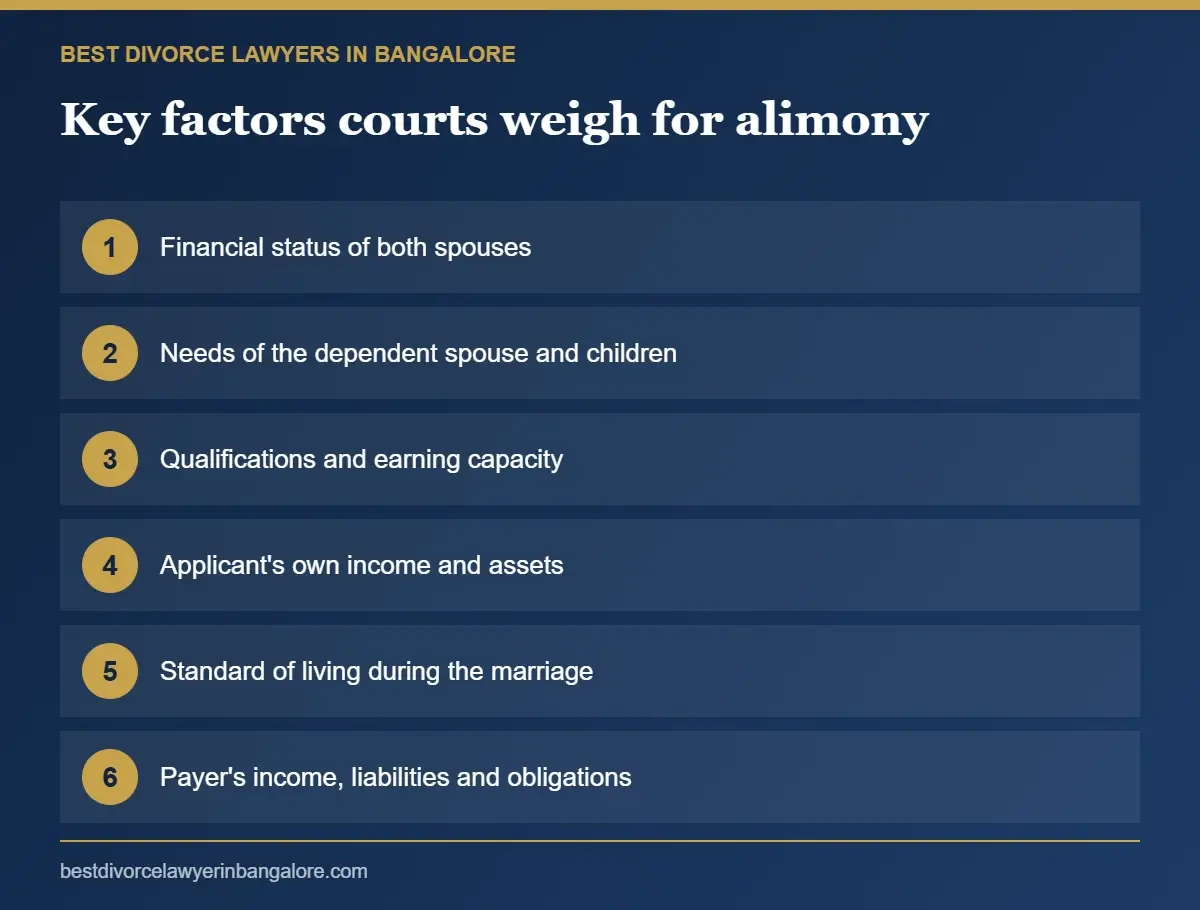
There is no statutory formula. Courts look at the full financial picture. In Rajnesh v. Neha (2020) the Supreme Court made it mandatory for both parties in maintenance cases to file a detailed Affidavit of Disclosure of Assets and Liabilities, and said maintenance should normally be paid from the date of the application. In December 2024, in Parvin Kumar Jain v. Anju Jain, the Court summarised eight factors for permanent alimony:
- The social and financial status of both parties
- The reasonable needs of the dependent spouse and the children
- Each party’s qualifications, employment and earning capacity
- Any independent income or assets the applicant already owns
- The standard of living enjoyed in the matrimonial home
- Any career sacrifices made for family responsibilities
- Reasonable litigation costs for a non-working spouse
- The paying spouse’s own financial capacity, liabilities and obligations
As a rough benchmark, in Kalyan Dey Chowdhury v. Rita Dey Chowdhury (2017) the Supreme Court said that 25% of the husband’s net salary would be a just and proper amount of maintenance in that case. It is a reference point that is often cited, not a rule: courts regularly award more or less depending on the facts, the number of children and the paying spouse’s other dependants.
Lump sum or monthly payments?
Permanent alimony can be ordered as a one-time settlement or as periodic payments. Each has trade-offs:
| One-time (lump sum) | Monthly / periodic | |
|---|---|---|
| Certainty | Final; no chasing payments later | Depends on the payer continuing to pay |
| Flexibility | Usually cannot be reopened | Can be increased or reduced if circumstances change |
| Typical use | Mutual consent settlements, clean breaks | Contested decrees, young children, uncertain incomes |
| Tax (general position) | Often treated as a capital receipt and not taxed in the recipient’s hands | Generally treated as taxable income of the recipient |
Tax treatment depends on how the order or settlement is worded, so take advice from a chartered accountant before signing. In a mutual divorce, the couple simply agree the figure and record it in the joint petition and consent terms. In a contested case, the family court decides.
How to claim alimony in Bangalore
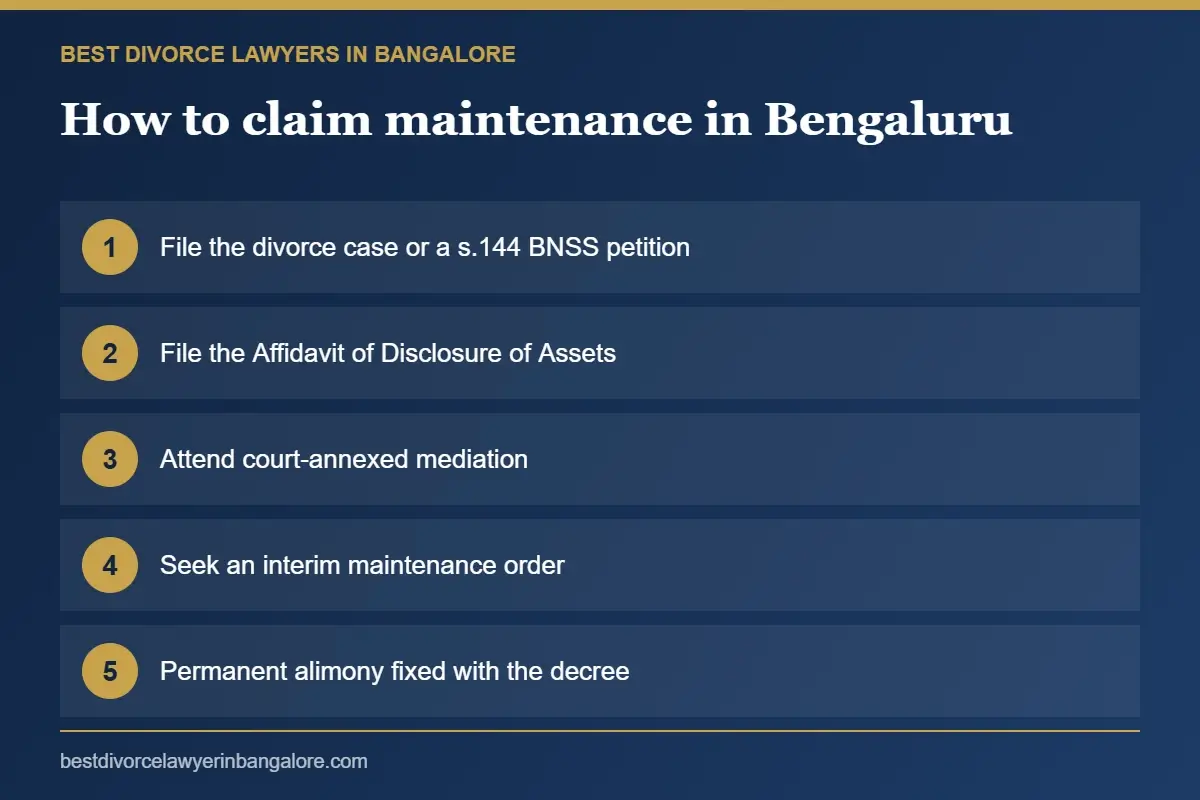
If you live in Bengaluru, maintenance and alimony claims under the Hindu Marriage Act, Special Marriage Act and BNSS are heard by the Family Courts in the court complex near Lalbagh Main Gate on Siddaiah Road. The usual sequence is:
- File the main case or a standalone application. Interim maintenance under Section 24 HMA is filed as an application inside the divorce case; a Section 144 BNSS petition can be filed on its own, even without a divorce case.
- File your Affidavit of Disclosure of Assets and Liabilities in the format prescribed in Rajnesh v. Neha, with salary slips, income tax returns, bank statements and details of property and loans. Gathering these early is part of the documents required for divorce in India.
- Mediation. Most Bengaluru family court matters are first referred to the court-annexed mediation centre, where many alimony disputes settle.
- Interim order. Under Section 144 BNSS, the court should try to decide an interim maintenance application within 60 days of notice to the other side, though delays do occur.
- Final decree. Permanent alimony is fixed when the divorce is granted, or on a later application.
If you cannot afford a lawyer, the Karnataka State Legal Services Authority and the district legal services authority at the city civil court can provide free legal aid to eligible women and children.
When alimony can be changed or stopped
- Change in circumstances: either side can ask the court to increase or reduce periodic payments if incomes or needs change substantially.
- Remarriage: under Section 25(3) of the Hindu Marriage Act the court may vary or cancel alimony if the recipient remarries; a wife who remarries also loses maintenance under Section 144 BNSS.
- Unchastity or living in adultery: may lead to the order being varied or rescinded under the personal laws.
- Full and final settlement: once a lump sum is accepted in settlement, future claims are usually closed.
If the paying spouse stops paying, the recipient can file an execution petition. For orders under Section 144 BNSS, the magistrate can issue a warrant to recover arrears and, if non-payment continues, order imprisonment for up to one month per default.
Practical tips before you negotiate
- Work out a realistic monthly budget for yourself and the children, with school fees, rent, medical costs and transport.
- Collect evidence of your spouse’s real income, including bonuses, business receipts, rental income and lifestyle spending. Courts are alert to incomes that are suddenly understated.
- Remember that child support is separate from spousal support; settle both clearly.
- Factor in what the case will cost; our guide to the cost of divorce in Bangalore gives the general picture.
- Get the settlement terms reviewed by an alimony lawyer in Bangalore before signing, especially the wording on tax, property transfers and future claims.
How this guide was prepared
This guide is based on the bare acts published on India Code and on judgments of the Supreme Court of India and the Karnataka High Court. Section numbers, case citations and time limits were fact-checked in October 2026, and criminal-law references use the Bharatiya Nyaya Sanhita (BNS) and Bharatiya Nagarik Suraksha Sanhita (BNSS) in force since 1 July 2024. It is general information, not legal advice. For advice on your own case, speak to an advocate. Read our editorial standards and disclaimer.
Frequently Asked Questions
Is there a maximum limit on alimony in India?
No statute caps alimony. The Supreme Court has treated about 25% of the payer’s net income as a reasonable benchmark for monthly maintenance in some cases, but the final figure depends on incomes, needs, children and the standard of living.
Can a working wife get alimony?
Yes, if her income is not enough to maintain the standard of living she had during the marriage. The court compares both incomes rather than refusing relief just because she works.
Does a husband have to pay alimony if the wife files for divorce?
Who files does not matter. Alimony depends on financial need and capacity. Under the Hindu Marriage Act either spouse can apply, whoever started the case.
Can alimony be claimed after the divorce decree?
Yes. Section 25 of the Hindu Marriage Act allows an application for permanent alimony at the time of the decree or at any time afterwards, though a full and final settlement usually rules this out.
Is maintenance payable from the date of filing?
Following Rajnesh v. Neha (2020), courts normally award maintenance from the date the application was filed, so delays in hearing should not defeat the claim.
Every alimony case turns on its own numbers, and small details in the disclosure affidavit or settlement wording can make a big difference. If you are negotiating or contesting maintenance, speak to one of the best divorce lawyers in Bangalore before you file or sign anything.