If you are looking for the best alimony lawyer in Bangalore, the four advocates below handle interim maintenance, permanent alimony and BNSS section 144 cases at the Bengaluru Family Court. Whether you need to claim support or are being asked to pay, book a free first consultation and get a realistic figure and a plan.
4 advocates · 20+ years’ experience · 2 women advocates · Free first consultation
Top Alimony Lawyers in Bangalore

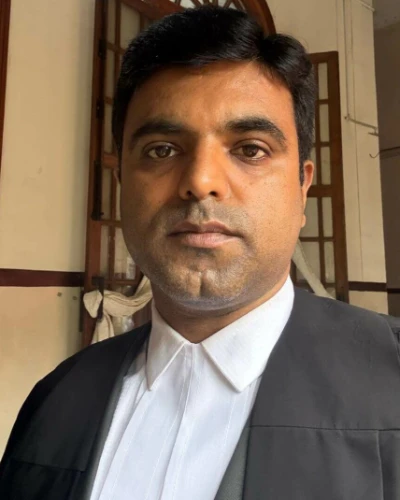
Advocate Varun Papireddy – Divorce Lawyer in Bangalore (20+ Years)
- Name: Advocate Varun Papireddy
- Experience: 20+ years
- Specialisation: Mutual and contested divorce, cruelty and domestic violence cases, child custody
- Known for: Careful case preparation and strong courtroom advocacy
Advocate Kiran Kumar B.M – Divorce Advocate in Bangalore (20+ Years)
- Name: Advocate Kiran Kumar B.M
- Experience: 20+ years
- Specialisation: Mutual and contested divorce, domestic violence, child custody, matrimonial property
- Known for: Discreet handling of complex disputes for both men and women
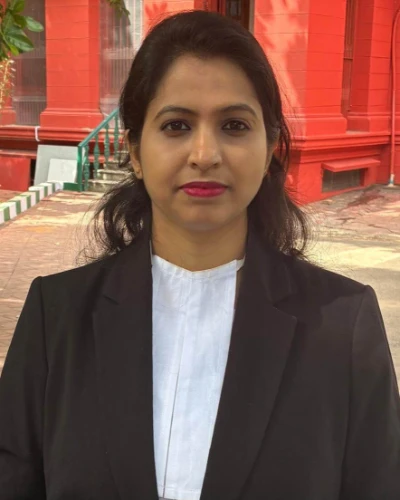
Advocate Poojashree – Female Divorce Lawyer in Bangalore
- Name: Advocate Poojashree
- Specialisation: Mutual and contested divorce, domestic violence, child custody, women’s rights
- Known for: A safe, respectful space where women can speak openly

Advocate Esther Balakrishna – Lady Divorce Lawyer in Bangalore
- Name: Advocate Esther Balakrishna
- Specialisation: Divorce, matrimonial disputes and other family law matters
- Known for: Protecting clients’ rights at every stage of the case
When you need an alimony or maintenance lawyer
- You have separated and your spouse has stopped paying for household expenses, rent or the children’s school fees.
- You have filed, or been served with, a divorce petition and need interim maintenance and litigation costs while it runs.
- You are negotiating a one-time settlement in a mutual divorce and want the figure, payment schedule and tax treatment right.
- Your spouse is hiding income, has resigned, or claims to earn far less than they do.
- You are the paying spouse and the amount claimed is beyond your real means, or there are overlapping claims in several courts.
- A maintenance order is not being paid and you need it enforced.
Alimony and maintenance law: the sections that apply
“Maintenance” usually means regular support while the parties are separated or a case is pending; “alimony” usually means support fixed at or after the divorce, monthly or as a lump sum. In Bengaluru several laws can apply at once, and choosing the right forum is half the work.
Hindu Marriage Act, sections 24 and 25
Section 24 lets either spouse with no sufficient independent income claim maintenance during the case (maintenance pendente lite) plus the expenses of the litigation. The proviso asks courts to decide such applications, as far as possible, within 60 days of service of notice. Section 25 allows permanent alimony when the decree is passed or afterwards, as a lump sum or periodic payment, and the order can later be varied or cancelled if circumstances change, for example if the receiving spouse remarries. Both sections are gender-neutral, so a husband with no income can also claim. The Special Marriage Act has similar provisions in ss.36 and 37.
BNSS section 144 (formerly CrPC section 125)
Since 1 July 2024, section 144 of the Bharatiya Nagarik Suraksha Sanhita replaces s.125 of the old CrPC. It is a quick, secular remedy available to a wife (including a divorced wife who has not remarried) who cannot maintain herself, to minor children and to dependent parents, against a person with sufficient means who neglects or refuses to maintain them. There is no upper limit on the amount, and interim maintenance can be ordered while the case is pending. In Mohd. Abdul Samad v. State of Telangana (2024) the Supreme Court confirmed that Muslim women can also claim under this provision. If the order is not obeyed, the Magistrate can issue a warrant to recover the amount and order imprisonment for unpaid months, provided the arrears are claimed in time.
Protection of Women from Domestic Violence Act, section 20
Where there is domestic violence, the Magistrate can grant monetary relief under s.20 of the DV Act, covering expenses, loss of earnings, medical costs and maintenance for the woman and her children, alongside protection and residence orders.
Rajnesh v. Neha (2020): the disclosure affidavit
In Rajnesh v. Neha the Supreme Court laid down guidelines that now govern every maintenance case. Both sides must file an Affidavit of Disclosure of Assets and Liabilities, listing income, property, investments, loans and expenses. Maintenance is to be awarded from the date of the application, amounts paid in one proceeding are to be adjusted in another, and courts must weigh factors such as the parties’ status, reasonable needs, the claimant’s own income and qualifications, and the payer’s liabilities. A well-prepared affidavit, with supporting documents, is often the single most important document in your case.
How much? The 25% benchmark
There is no fixed formula. In Kalyan Dey Chowdhury v. Rita Dey Chowdhury Nee Nandy (2017) the Supreme Court said 25% of the husband’s net salary would be just and proper as maintenance in that case. Courts often use this as a reference point, not a rule, and adjust it for children, other dependants, the wife’s own earnings and the standard of living during the marriage.
Step-by-step: a maintenance or alimony case in Bengaluru
Claims under the Hindu Marriage Act, Special Marriage Act and BNSS s.144 in the city are heard by the Family Courts on Siddaiah Road, near Lalbagh Main Gate. A typical case runs like this:
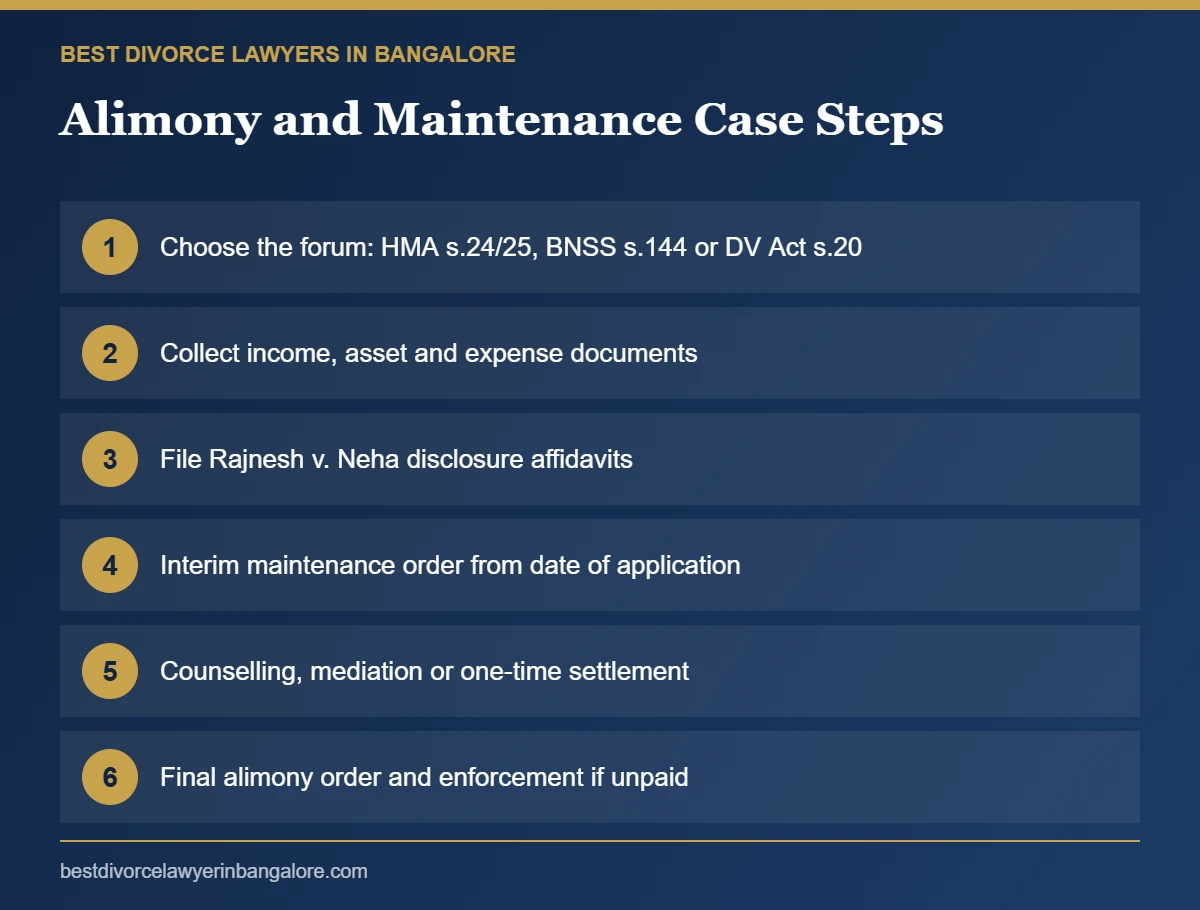
- Consultation and choice of forum. Your lawyer decides whether to claim under s.24/25 HMA inside the divorce case, under BNSS s.144, under the DV Act, or a combination, and how to avoid duplicated or conflicting orders.
- Collect financial evidence. Salary slips, bank statements, ITRs, property and loan papers for both spouses, as far as you can access them.
- Prepare the disclosure affidavit. Both parties file Rajnesh v. Neha affidavits of assets and liabilities.
- File the petition with an interim application. Interim maintenance and litigation expenses are sought at the start.
- Interim order. After hearing both sides on the affidavits, the court fixes an interim monthly amount, payable from the date of application.
- Counselling and mediation. The Family Court will usually refer the parties to counselling or mediation, where many cases settle on a one-time alimony figure.
- Evidence and final order. If there is no settlement, the court takes evidence and fixes final maintenance or permanent alimony, often with the divorce decree.
- Enforcement or appeal. Unpaid amounts can be recovered through execution or the s.144 recovery procedure. Appeals lie to the Karnataka High Court; the limitation is 30 days under the Family Courts Act or up to 90 days under s.28 of the Hindu Marriage Act depending on the provision, so confirm the deadline promptly.
Documents to prepare
- Marriage certificate or wedding proof, and copies of any pending case papers.
- Your last 6 to 12 months of salary slips, Form 16 and the last 3 years of income tax returns.
- Bank, credit card and investment statements.
- Whatever you know about your spouse’s income, employer, business, properties and lifestyle: payslips, ITRs, social media, vehicle and property details.
- Monthly expense evidence: rent, EMIs, school fees, medical bills, insurance, utility bills.
- Children’s birth certificates and school fee receipts.
- Evidence of any domestic violence, if a DV Act claim is being made.
How long it takes
Court timelines vary, so treat these as rough ranges.
| Stage | Typical time (approximate) |
|---|---|
| Interim maintenance (s.24 HMA / s.144 BNSS) | Law aims for about 60 days; in practice often a few months |
| One-time alimony in a mutual divorce | Agreed in the settlement and usually paid by the final hearing |
| Contested final maintenance or permanent alimony | Often 1 to 3 years, usually with the divorce decree |
| Recovery of unpaid maintenance | A few weeks to several months, depending on the payer’s assets |
Need maintenance or alimony advice now?
Talk to an experienced Bangalore alimony advocate today. The first consultation is free and the desk is open 24/7.
Alimony lawyer fees in Bangalore
Fees are not standardised. They depend on the advocate’s seniority, whether the claim is settled or contested, how many proceedings are involved (divorce, s.144, DV Act), and how much financial investigation is needed. A settlement negotiated within a mutual divorce typically costs much less than a contested case with evidence on income. Many advocates charge a fixed fee per stage or for the whole case. Ask for a written estimate at your free first consultation.
What a good alimony lawyer does for you
- Chooses the right forum and keeps parallel claims consistent, so amounts are adjusted rather than duplicated.
- Builds a complete, credible disclosure affidavit and exposes hidden or understated income on the other side.
- Argues for a fair figure using the Rajnesh v. Neha factors and the 25% reference point.
- Negotiates one-time settlements with secure payment terms, such as payment before the final decree.
- Coordinates maintenance with child custody and the divorce itself.
- Enforces orders promptly when payments stop.
How to choose the best alimony lawyer in Bangalore
- Check Karnataka State Bar Council enrolment.
- Ask how many maintenance and alimony cases they handle at the Bengaluru Family Court and Magistrate courts.
- Look for someone comfortable with financial documents such as ITRs, balance sheets and salary structures.
- Expect an honest estimate of the likely range, not a promise of a specific figure.
- Prefer an advocate who negotiates well but is prepared for trial.
- Agree the fee structure in writing.
- Check they can meet you conveniently; we cover clients across the Bangalore areas we serve, or you can compare all divorce lawyers in Bangalore.
Helpful guide: read our complete guide to alimony and maintenance in India, covering how interim and permanent alimony are worked out and how to claim them.
Frequently Asked Questions
Can a working wife claim maintenance in Bangalore?
Yes, if her own income is not enough to maintain the standard of living she had during the marriage. Courts compare both spouses’ incomes and needs from the disclosure affidavits; earning something does not automatically rule out a claim, though it usually reduces the amount.
Can a husband claim alimony from his wife?
Under ss.24 and 25 of the Hindu Marriage Act, yes: these provisions are gender-neutral and allow either spouse without sufficient income to claim. BNSS s.144, however, is available only to a wife, children and parents.
Is alimony paid monthly or as a lump sum?
Either. Courts can order periodic payments or a one-time amount. In mutual divorces in Bengaluru, couples commonly agree a one-time settlement, often paid before or at the final hearing so that the matter ends cleanly.
What if my spouse is hiding income?
Point it out in your own disclosure affidavit with whatever evidence you have, such as lifestyle, property, vehicles or past payslips. Your lawyer can ask the court to summon bank, employer or tax records, and courts can draw adverse conclusions from incomplete disclosure.
Can a maintenance order be changed later?
Yes. Permanent alimony can be varied under s.25 of the Hindu Marriage Act, and a s.144 order can be altered under BNSS s.146 (formerly CrPC s.127) when there is a change in circumstances, such as loss of a job or a big change in income.
Does remarriage end alimony?
Usually. Under s.25 HMA the court can rescind alimony if the receiving spouse remarries, and BNSS s.144 covers only a divorced wife who has not remarried. A one-time settlement already paid is generally not affected.
Get a fair maintenance or alimony outcome
Speak to an experienced Bangalore alimony advocate now. Free first consultation, 24/7 desk.
Book your free consultation
Call this number to book a free consultation. Our appointment desk answers 24/7 and will confirm a time that suits you.