Family laws in India are not one single code. Marriage, divorce, maintenance and custody are governed mainly by the personal law of your religion (or by the secular Special Marriage Act), while common rules on family courts, domestic violence and criminal offences apply to everyone. This guide explains how the system fits together, what has changed since 1 July 2024, and how to work out which law applies to your situation in Bengaluru.
How Family Laws in India Are Structured
India follows a system of personal laws. A Hindu couple, a Muslim couple, a Christian couple and a Parsi couple can each face different rules on how a marriage is formed, what grounds allow a divorce and how long they must wait. Sitting alongside these personal laws are secular statutes that apply regardless of religion:
- The Special Marriage Act, 1954, a civil marriage law open to any couple.
- The Family Courts Act, 1984.
- The Protection of Women from Domestic Violence Act, 2005.
- Maintenance under Section 144 of the Bharatiya Nagarik Suraksha Sanhita, 2023 (BNSS).
- The Guardians and Wards Act, 1890.
Most real cases involve more than one of these. Knowing how the laws interact is the first step towards a sensible strategy. For a deeper look at divorce specifically, see our guide to divorce laws in India.
The Personal Laws: An Overview
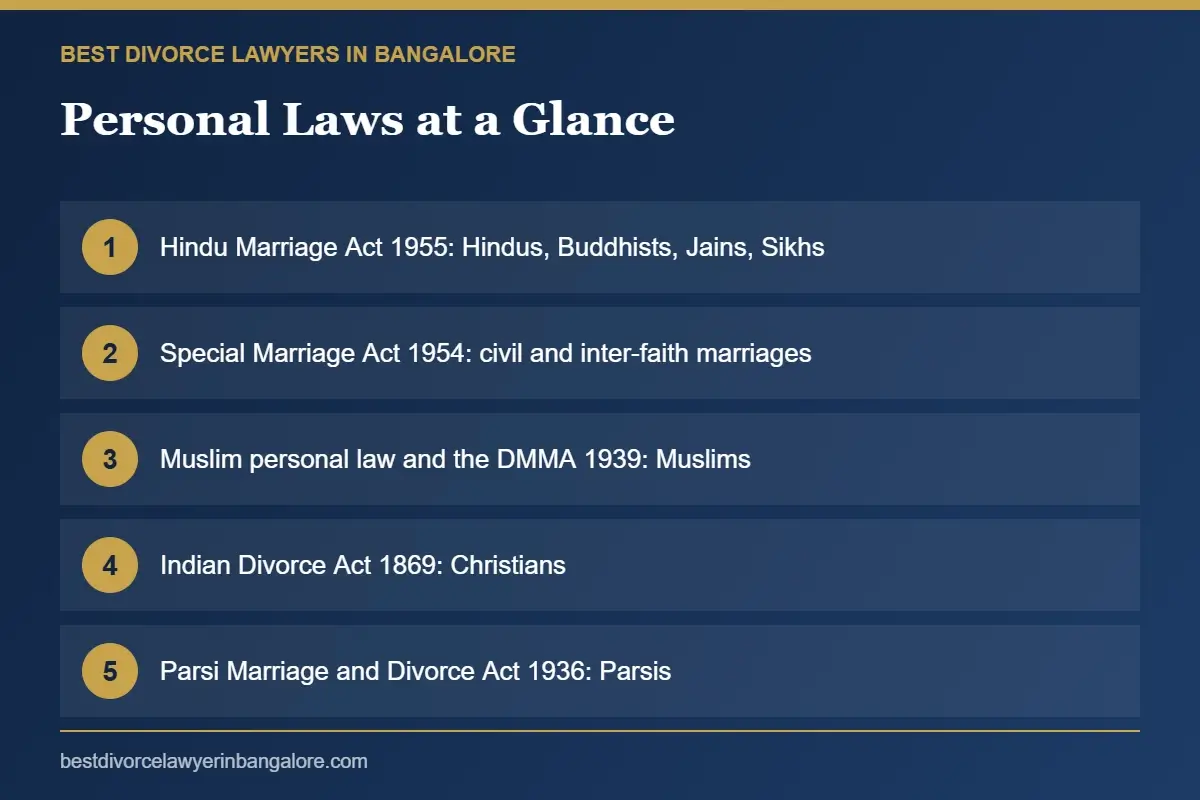
Hindu Marriage Act, 1955
The Hindu Marriage Act (HMA) applies to Hindus, Buddhists, Jains and Sikhs, and to anyone who is not a Muslim, Christian, Parsi or Jew by religion, unless it is shown they are governed by some other law. It is the law most couples in Bengaluru deal with.
- Section 13 lists the grounds for contested divorce, including cruelty, desertion for at least two years, adultery, conversion to another religion, incurable mental disorder, renunciation of the world and being unheard of for seven years.
- Section 13B allows divorce by mutual consent where the spouses have lived separately for at least one year and agree the marriage should end. A second motion follows after six months, a period the Supreme Court has held can be waived in suitable cases.
- Sections 24 and 25 deal with interim maintenance and permanent alimony, and Section 26 with custody of children.
Special Marriage Act, 1954
The Special Marriage Act (SMA) is a civil law that does not depend on religion. Couples marry before a Marriage Officer after giving notice, and many inter-faith and some same-faith couples choose it. Divorce grounds under Section 27 closely mirror the HMA, and Section 28 provides mutual consent divorce after one year of separation. A key feature is that succession for those married under the SMA is generally governed by the Indian Succession Act, 1925, rather than personal law.
Muslim Personal Law and the Dissolution of Muslim Marriages Act, 1939
For Muslims, marriage (nikah) is a contract, governed by the Muslim Personal Law (Shariat) Application Act, 1937 and these statutes:
- Dissolution of Muslim Marriages Act, 1939 (DMMA): lets a Muslim wife seek divorce from a court on grounds such as the husband’s whereabouts being unknown for four years, failure to maintain her for two years, imprisonment for seven years or more, failure to perform marital obligations for three years, impotence, insanity, and cruelty.
- Extra-judicial forms of divorce: talaq (by the husband), khula (initiated by the wife, usually with return of mahr) and mubarat (mutual).
- Muslim Women (Protection of Rights on Marriage) Act, 2019: makes instant triple talaq (talaq-e-biddat) void and a punishable offence, following the Supreme Court’s 2017 ruling in Shayara Bano.
- Maintenance: the Muslim Women (Protection of Rights on Divorce) Act, 1986 covers a fair provision for divorced wives. In July 2024, in Mohd. Abdul Samad v. State of Telangana, the Supreme Court confirmed that a divorced Muslim woman can also claim maintenance under the secular provision (Section 125 CrPC, now Section 144 BNSS).
Indian Divorce Act, 1869 (Christians)
Christian marriages are solemnised under the Indian Christian Marriage Act, 1872 and dissolved under the Indian Divorce Act, 1869. After major amendments in 2001, Section 10 gives both husband and wife equal grounds, such as adultery, cruelty, desertion for two years, conversion and incurable mental illness. Section 10A allows divorce by mutual consent, but only after the spouses have lived separately for at least two years, which is longer than under the HMA or SMA. Alimony and custody are covered in Sections 36–37 and 41–44.
Parsi Marriage and Divorce Act, 1936
Parsi marriages are governed by the Parsi Marriage and Divorce Act, 1936. Cases are heard by Parsi Matrimonial Courts, in which the judge sits with delegates from the community who decide questions of fact. Section 32 sets out the grounds for divorce (including non-consummation, desertion for two years, cruelty and adultery), and Section 32B allows mutual consent divorce after one year of separation.
Comparing the Personal Laws on Divorce
The table below summarises the main divorce provisions under each law.
| Law | Who it covers | Contested divorce | Mutual consent divorce | Maintenance / alimony |
|---|---|---|---|---|
| Hindu Marriage Act, 1955 | Hindus, Buddhists, Jains, Sikhs | Section 13 (cruelty, desertion 2 years, adultery and more) | Section 13B, after 1 year of separation | Sections 24 and 25 |
| Special Marriage Act, 1954 | Any couple married under the Act, including inter-faith couples | Section 27 | Section 28, after 1 year of separation | Sections 36 and 37 |
| Muslim personal law and DMMA, 1939 | Muslims | Wife: DMMA Section 2 grounds; husband: talaq (instant triple talaq void) | Mubarat; khula at the wife’s initiative | 1986 Act, plus Section 144 BNSS |
| Indian Divorce Act, 1869 | Christians | Section 10 | Section 10A, after 2 years of separation | Sections 36 and 37 |
| Parsi Marriage and Divorce Act, 1936 | Parsis | Section 32, before a Parsi Matrimonial Court | Section 32B, after 1 year of separation | Sections 39 and 40 |
Whatever the personal law, the practical steps of drafting, filing and attending court are similar. Our step-by-step guide on how to file for divorce in India walks through them.
Family Courts and the Bengaluru Family Courts
The Family Courts Act, 1984 requires family courts to be set up in cities with a population above one million, and allows them elsewhere. Under Section 7, these courts hear suits and proceedings on matrimonial relief (divorce, nullity, judicial separation, restitution of conjugal rights), the validity of a marriage, matrimonial property, maintenance, and guardianship and custody of children. They also hear maintenance applications under the BNSS.
The Act is built around reconciliation. Section 9 places a duty on the court to first try to bring the parties to a settlement, which is why most cases are referred to counselling or mediation early. Under Section 13 a party has no automatic right to a lawyer, though courts usually permit one. An appeal from a family court judgment lies to the High Court, and should be filed within 30 days to be safe, as courts differ on whether a longer period under the marriage law can apply.
In Bengaluru, the Family Courts sit in the court complex near Lalbagh Main Gate on Siddaiah Road, with appeals going to the Karnataka High Court. Jurisdiction usually depends on where the marriage was solemnised, where the respondent lives, or where the couple last lived together (and, for a wife, where she currently lives). The local procedure, from counselling to evidence, is explained in our guide to the divorce process in Bangalore. If you cannot afford a lawyer, the Karnataka State Legal Services Authority and the district legal services authority offer free legal aid to eligible applicants, including women and children.
Maintenance and Alimony
Maintenance is financial support paid by one spouse to the other (and to children or dependent parents). It can be claimed at three stages:
- Interim maintenance while a case is pending, for example under Section 24 HMA, so that a spouse without income can live and fight the case.
- Permanent alimony at or after the final decree, as a monthly amount or a one-time lump sum, for example under Section 25 HMA.
- Maintenance under Section 144 BNSS (formerly Section 125 CrPC), a quick, religion-neutral remedy for a wife, children and parents who cannot maintain themselves.
Courts look at each party’s income and assets, reasonable needs, standard of living during the marriage, the children’s needs and any other obligations. In Rajnesh v. Neha (2020), the Supreme Court required both parties to file sworn affidavits disclosing their assets and liabilities, and laid down guidelines to avoid overlapping awards under different laws. Under the Hindu Marriage Act, either spouse can claim, so a husband without means can also seek maintenance. For help with a claim or defence, see our alimony lawyers in Bangalore.
Child Custody and Guardianship
Indian courts treat the welfare of the child as the paramount consideration, whatever the religion of the parents. The main laws are the Guardians and Wards Act, 1890, the Hindu Minority and Guardianship Act, 1956, and the custody provisions of each marriage law.
- Physical custody decides where the child lives day to day; the other parent usually gets visitation or shared parenting time.
- Guardianship concerns legal decision-making about the child’s person and property.
- Under Section 6 of the Hindu Minority and Guardianship Act, custody of a child under five is ordinarily with the mother, although courts can depart from this if the child’s welfare requires it.
If custody is likely to be disputed, speak to a specialist child custody lawyer in Bangalore early.
The Protection of Women from Domestic Violence Act, 2005
The Domestic Violence Act (PWDVA) gives women a fast civil remedy against physical, sexual, verbal, emotional and economic abuse by a husband, male partner or his relatives. It applies to women of every religion and also covers women in a relationship in the nature of marriage. An application is filed before a Magistrate under Section 12, often with the help of a Protection Officer or a service provider. The reliefs include:
- Protection orders (Section 18) restraining further violence or contact.
- Residence orders (Section 19), backed by the right to reside in the shared household under Section 17, even if the woman has no ownership share.
- Monetary relief (Section 20) for expenses, losses and maintenance.
- Custody orders (Section 21) and compensation (Section 22).
Breach of a protection order is an offence under Section 31, punishable with imprisonment of up to one year, a fine of up to twenty thousand rupees, or both. A PWDVA case can run alongside a divorce petition.
Criminal Law Changes Since 1 July 2024: BNS and BNSS
From 1 July 2024, the Indian Penal Code was replaced by the Bharatiya Nyaya Sanhita, 2023 (BNS) and the Code of Criminal Procedure by the Bharatiya Nagarik Suraksha Sanhita, 2023 (BNSS). Most family-related offences are unchanged in substance but carry new section numbers.
| Subject | Old provision | New provision |
|---|---|---|
| Cruelty by husband or relatives | Section 498A IPC | Sections 85 and 86 BNS |
| Dowry death | Section 304B IPC | Section 80 BNS |
| Bigamy | Section 494 IPC | Section 82 BNS |
| Maintenance of wife, children and parents | Section 125 CrPC | Section 144 BNSS |
Cases registered before 1 July 2024 generally continue under the old law, while new complaints are registered under the BNS and BNSS. Adultery, struck down by the Supreme Court in Joseph Shine (2018), is not an offence under the BNS, though it remains a ground for divorce. The Dowry Prohibition Act, 1961 continues to apply.
Live-in Relationships
Live-in relationships between consenting adults are not illegal in India. There is no general statute governing them, but courts have extended some protection. In D. Velusamy v. D. Patchaiammal (2010), the Supreme Court held that a “relationship in the nature of marriage” can attract the Domestic Violence Act, including maintenance, if the couple lived together for a significant period and held themselves out as akin to spouses. Children born of such relationships have been treated as legitimate for many purposes, including inheritance of their parents’ property. Uttarakhand’s Uniform Civil Code, in force since January 2025, requires live-in relationships there to be registered; Karnataka has no such requirement.
How to Choose the Right Law for Your Situation
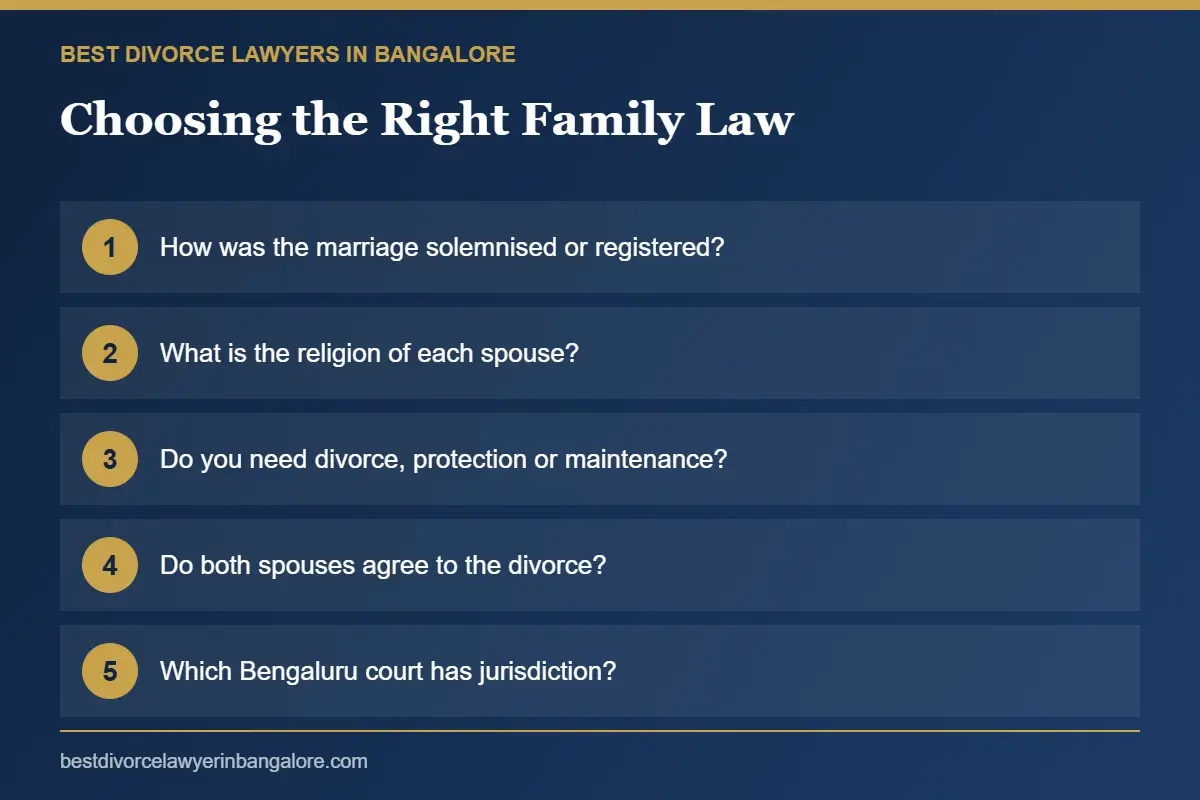
These questions usually settle which law applies:
- How was the marriage solemnised? A marriage registered under the Special Marriage Act stays under the SMA, even if both spouses share a religion. A religious ceremony usually brings in that community’s personal law.
- What is your religion and your spouse’s? Conversion by one spouse does not automatically change the law governing the marriage, but it can itself be a ground for divorce.
- What relief do you need? Divorce comes from the marriage law; urgent protection or a roof over your head may come faster from the Domestic Violence Act; quick maintenance is available under Section 144 BNSS.
- Do you both agree? If yes, a mutual consent petition is usually quicker and cheaper; if not, you will need a contested petition on a recognised ground.
- Where should you file? Check whether the Bengaluru Family Courts have jurisdiction based on where you married, last lived together or currently live.
If you both agree, a mutual divorce lawyer in Bangalore can draft the joint petition and settlement terms. If your spouse opposes, a contested divorce lawyer in Bangalore can assess your grounds and evidence.
Family Law Guides
Explore our detailed guides on specific family law topics below, which we add to as each one is published.
Frequently Asked Questions
Is there a uniform civil code for family law in India?
Not nationally. Marriage, divorce and succession are still largely governed by personal laws based on religion, with the Special Marriage Act as a secular option. Uttarakhand is the first state to implement its own Uniform Civil Code; it does not apply in Karnataka.
Can I file a divorce case in Bengaluru if I married in another city?
Often, yes. A petition can usually be filed where the marriage was solemnised, where the respondent lives, where the couple last lived together, or, if the wife is the petitioner, where she currently lives. Check the exact rule under your marriage law before filing.
Do I need to register my marriage before I can get a divorce?
No. A valid religious marriage can be dissolved even if it was never registered, but you will need other proof such as photographs, invitations or witnesses. A marriage certificate makes the process simpler.
Can a husband claim maintenance from his wife?
Under the Hindu Marriage Act, either spouse who lacks sufficient income can claim interim maintenance and permanent alimony. Section 144 BNSS, however, only allows a wife, children and parents to claim.
Does a domestic violence case have to be filed with the police?
No. A woman can apply directly to a Magistrate under the Domestic Violence Act, with help from a Protection Officer. A criminal complaint for cruelty under the BNS is a separate option.
Talk to a Family Lawyer in Bengaluru
Family law disputes are personal, and the right first step depends on your marriage, your goals and your evidence. If you are weighing divorce, maintenance, custody or protection, speak to one of the experienced divorce lawyers in Bangalore listed on our site for advice on the law that fits your situation.