Christian divorce in India is governed by the Divorce Act, 1869, as substantially reformed in 2001. A Christian couple can divorce by mutual consent under Section 10A after living separately for the statutory period, or either spouse can file a contested petition under Section 10 on grounds such as cruelty, adultery or desertion. Only a court decree ends the marriage: a church annulment or ecclesiastical decree, on its own, has no legal effect.
The law on Christian divorce in India
The Divorce Act, 1869 (earlier called the Indian Divorce Act) applies where at least one spouse professes Christianity. Its companion statute, the Indian Christian Marriage Act, 1872, governs how the marriage is solemnised. The Divorce (Amendment) Act, 2001 overhauled the old law, which had been criticised as discriminatory, especially towards women. The key changes were:
- Equal grounds for husband and wife: a wife no longer has to prove adultery combined with another wrong, as the original Section 10 required.
- New grounds such as cruelty and desertion.
- Divorce by mutual consent under the new Section 10A.
- Decrees passed by the District Court (in Bengaluru, the Family Court) no longer need confirmation by the High Court.
Christian divorce sits within the wider framework of family laws in India, and many principles on alimony, custody and evidence are common to all communities.
Mutual consent divorce under Section 10A
Section 10A allows both spouses to file a joint petition stating that they have been living separately for two years or more, that they have not been able to live together, and that they have mutually agreed to dissolve the marriage. The court then waits: the second (joint) motion must be made not earlier than six months and not later than eighteen months after the petition is presented. If the court is satisfied that consent is genuine, it grants the decree.
The two-year separation requirement is longer than the one year required of Hindu couples, and it has been challenged. The Kerala High Court read it down to one year in Saumya Ann Thomas v. Union of India (2010), and in December 2022 held that the minimum separation period itself was unconstitutional. Those rulings bind courts in Kerala; elsewhere, including in Karnataka, the practical position on the separation period and on waiver of the six-month interval should be checked with a lawyer before you file.
A mutual consent petition should set out agreed terms on permanent alimony, return of jewellery and gifts, custody and visitation, and who keeps which property. Each spouse also files a supporting affidavit for divorce.
Grounds for contested Christian divorce (Section 10)
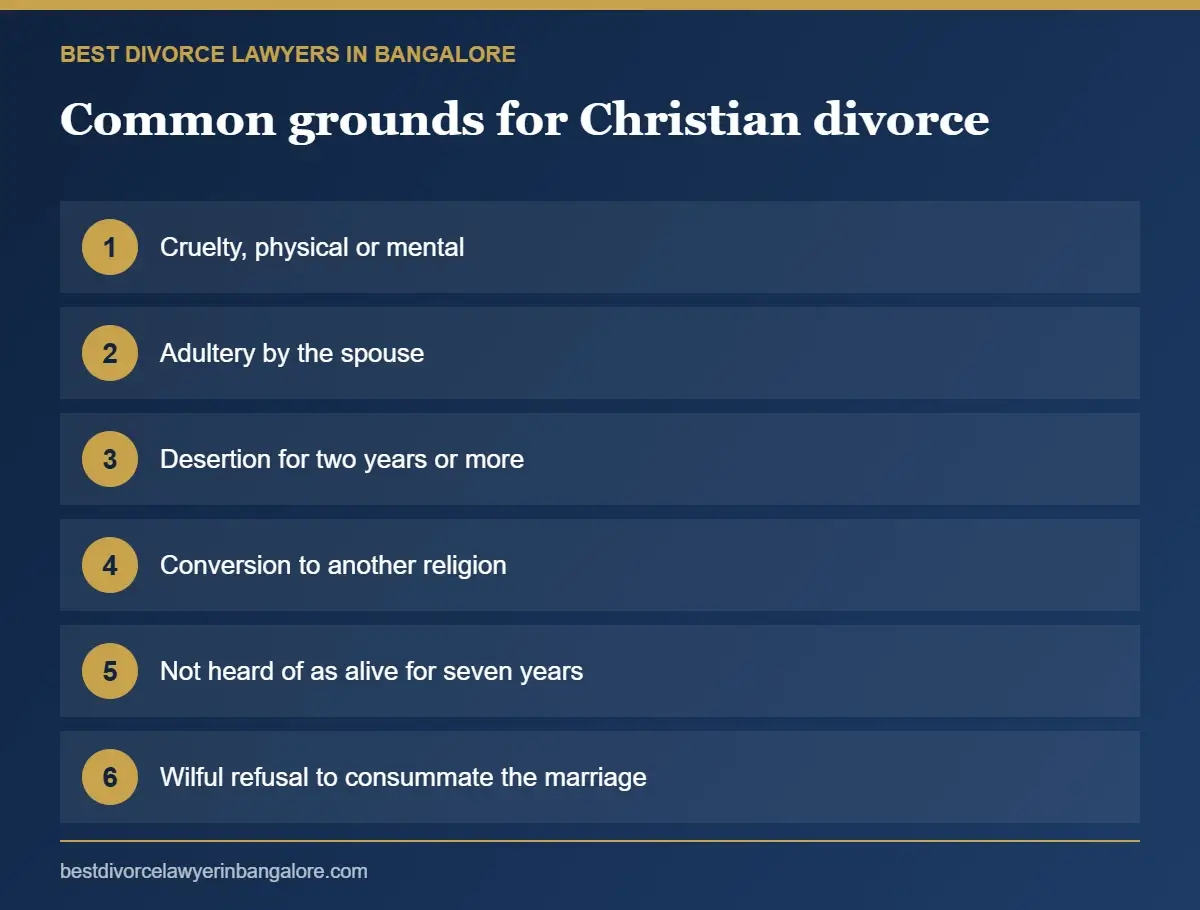
Either the husband or the wife can petition for divorce if, since the marriage, the other spouse:
| Ground | Key condition |
|---|---|
| Adultery | Voluntary sexual intercourse with someone other than the spouse |
| Conversion | Has ceased to be a Christian by converting to another religion |
| Unsoundness of mind | Incurably of unsound mind for a continuous period of at least two years before the petition |
| Leprosy | Virulent and incurable form, for at least two years |
| Venereal disease | In a communicable form, for at least two years |
| Presumed death | Not heard of as alive for at least seven years by those who would naturally have heard |
| Non-consummation | Has wilfully refused to consummate the marriage |
| Restitution decree ignored | Has failed to comply with a decree for restitution of conjugal rights for two years or more |
| Desertion | Has deserted the petitioner for at least two years |
| Cruelty | Treatment causing a reasonable apprehension that living together would be harmful or injurious |
In addition, under Section 10(2), a wife may seek divorce if her husband has been guilty of rape, sodomy or bestiality since the marriage.
Cruelty is the most commonly pleaded ground. It can be physical or mental, and courts look at the cumulative effect of the conduct on the petitioner rather than isolated quarrels.
Nullity and judicial separation for Christians
Divorce is not the only remedy. Under Section 19, a marriage can be declared null and void if the respondent was impotent at the time of marriage and when the suit was filed, if the parties are within prohibited degrees of relationship, if either was a lunatic or idiot at the time of marriage, or if either spouse had a living husband or wife from an earlier subsisting marriage. Our guide to annulment vs divorce explains how nullity differs in its consequences.
Under Section 22, either spouse can instead seek judicial separation on the ground of adultery, cruelty, or desertion without reasonable excuse for two years or more. The marriage continues, but the duty to live together is suspended. Some couples prefer this for religious reasons. See judicial separation vs divorce to compare the two.
Church annulment vs civil divorce
Many Catholic couples approach the diocesan tribunal for a declaration of nullity so that they can remarry in church. That process has spiritual significance, but it does not dissolve the marriage in law. In Molly Joseph v. George Sebastian (1996), the Supreme Court held that a decree of an ecclesiastical tribunal under canon law cannot dissolve a marriage governed by the Divorce Act. Anyone who remarries relying only on a church annulment risks a bigamous marriage, which is an offence under Section 82 of the Bharatiya Nyaya Sanhita (formerly Section 494 IPC). If you need both, run the civil divorce and the church process in parallel.
How to file for Christian divorce in Bangalore
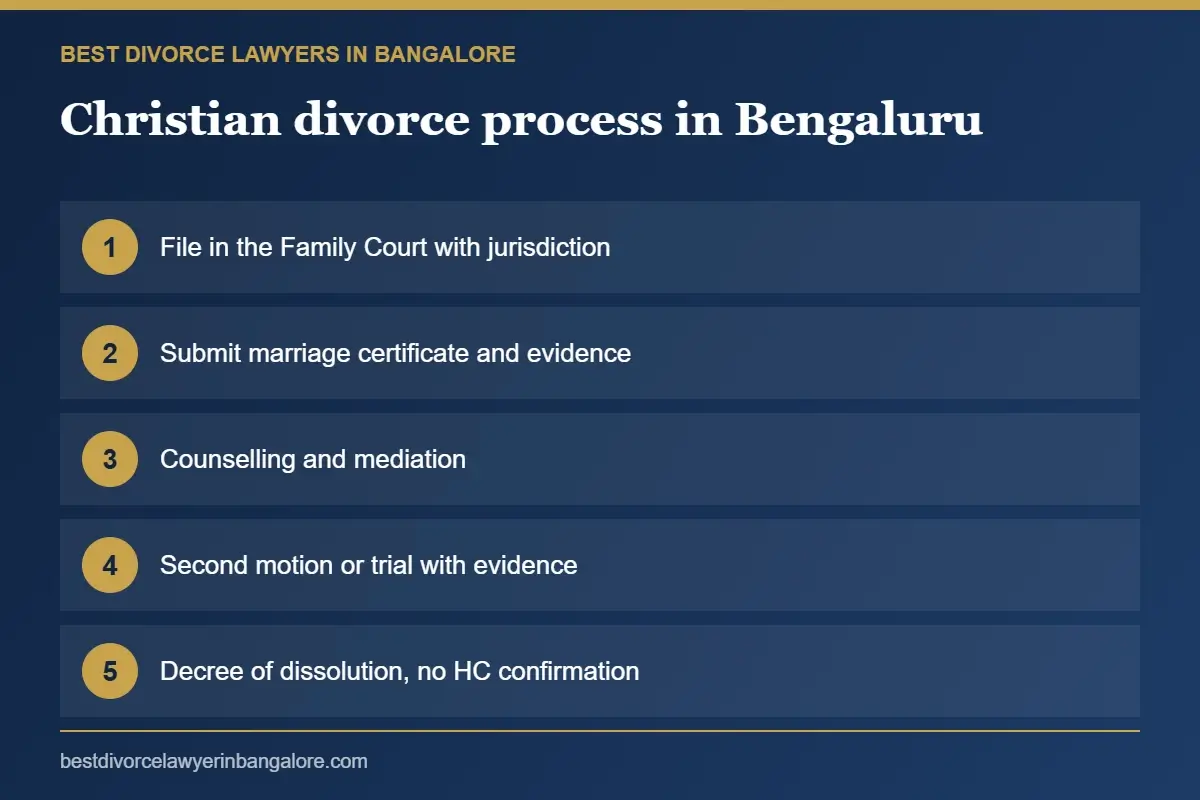
- Jurisdiction. The petition is filed in the court for the area where the marriage was solemnised, or where the husband and wife reside or last resided together. In Bengaluru, this is the Family Court at the complex near Lalbagh Main Gate, Siddaiah Road.
- Documents. The church marriage certificate or the certificate under the Indian Christian Marriage Act, photographs, address and ID proof, proof of separation and, for contested cases, evidence of the ground.
- Counselling and mediation. The court usually refers the parties to counselling or the mediation centre before trial.
- Hearing or second motion. In a mutual petition, both spouses appear for the second motion after the waiting period; in a contested case the parties lead evidence and are cross-examined.
- Decree. The court passes a decree of dissolution. No High Court confirmation is needed after the 2001 amendment.
A mutual divorce lawyer in Bangalore can draft the joint petition and consent terms so that the second motion goes smoothly.
Alimony, custody and remarriage
- Alimony: Section 36 provides for alimony pending the suit, and Section 37 for permanent alimony, either as a lump sum or periodic payments. A Christian wife can also claim maintenance under Section 144 of the Bharatiya Nagarik Suraksha Sanhita. See our guide to alimony in India.
- Custody: Sections 41 to 44 allow interim and final orders on custody, maintenance and education of minor children, decided on the child’s welfare. Read more in child custody laws in India.
- Remarriage: under Section 57, the parties may remarry once the decree has become final and the time for appeal has passed without an appeal, or any appeal has been dismissed.
How this guide was prepared
This guide is based on the bare acts published on India Code and on judgments of the Supreme Court of India and the Karnataka High Court. Section numbers, case citations and time limits were fact-checked in October 2026, and criminal-law references use the Bharatiya Nyaya Sanhita (BNS) and Bharatiya Nagarik Suraksha Sanhita (BNSS) in force since 1 July 2024. It is general information, not legal advice. For advice on your own case, speak to an advocate. Read our editorial standards and disclaimer.
Frequently Asked Questions
How long does a Christian mutual divorce take in India?
After the joint petition, the second motion cannot be made earlier than six months, so most mutual cases take at least six to eight months from filing, depending on the court’s calendar and any waiver granted.
Can a Christian marry a second time after a church annulment only?
No. Without a civil court decree the first marriage legally continues, and a second marriage would be void and could be prosecuted as bigamy.
Does the Divorce Act apply if only one spouse is Christian?
Yes. The Act applies where the petitioner or the respondent professes the Christian religion, subject to the jurisdictional conditions in the Act.
Can a Christian couple use the Special Marriage Act instead?
Only if they married under the Special Marriage Act. A marriage solemnised in church under the Indian Christian Marriage Act is dissolved under the Divorce Act, 1869.
Is adultery still a ground for Christian divorce after it was decriminalised?
Yes. The Supreme Court struck down adultery as a crime in 2018, but it remains a valid civil ground for divorce under Section 10.
Christian divorce has its own timelines and pitfalls, especially around the separation period and church proceedings. Speak to one of our good divorce lawyers in Bangalore to plan the right route for your case.