Parsi divorce law in India is contained in the Parsi Marriage and Divorce Act, 1936, as amended in 1988. A Parsi couple can divorce by mutual consent after living apart for a year, or either spouse can sue for divorce on grounds such as cruelty, adultery or desertion. Unlike other communities, Parsi divorce suits are tried by special Parsi Matrimonial Courts, where a panel of Parsi delegates, rather than the judge alone, decides the facts.
Who does Parsi divorce law apply to?
The Act applies to marriages between Parsis, meaning Parsi Zoroastrians, solemnised under the Act with the ashirvad ceremony performed by a priest in the presence of two Parsi witnesses. If a Parsi marries a non-Parsi under the Special Marriage Act, 1954, that Act governs any divorce instead. The Parsi law is one strand of the broader framework of family laws in India, alongside the separate codes for Hindus, Muslims and Christians; compare, for example, Christian divorce in India or divorce under Muslim law.
Parsi Matrimonial Courts and the delegate system
The 1936 Act sets up its own courts:
- Parsi Chief Matrimonial Courts in the presidency towns of Mumbai, Kolkata and Chennai (Section 18).
- Parsi District Matrimonial Courts at other places notified by the State Government, presided over by the judge of the principal civil court of the place (Section 20).
In the regular hearing of a suit, the judge sits with five Parsi delegates drawn from a panel. Under Section 46, the delegates decide questions of fact by majority, with the judge deciding if they are equally divided, while the judge alone decides questions of law and procedure. Interim applications, alimony, maintenance and custody are decided by the judge without delegates.
Because the Act gives these special courts jurisdiction, Parsi divorce suits are generally not heard by the ordinary Family Court. A petition pending before the Supreme Court since 2017 challenges this delegate system and the exclusion from Family Courts as discriminatory. For a Parsi couple living in Bengaluru, the first practical step is to confirm which Parsi Matrimonial Court currently has jurisdiction over the place where they last lived together, as this affects where and how quickly the case can be heard.
Divorce by mutual consent (Section 32B)
Since the 1988 amendment, a Parsi couple can jointly sue for divorce if:
- They have been living separately for one year or more;
- They have not been able to live together; and
- They have mutually agreed that the marriage should be dissolved.
The suit cannot be filed until at least one year has passed since the marriage. The court must be satisfied that the marriage was solemnised under the Act, that the statements in the plaint are true, and that neither consent was obtained by force or fraud; it then passes a decree dissolving the marriage. As with other communities, it is wise to settle alimony, custody and property terms in writing and file them with the suit.
Grounds for contested divorce (Section 32)
Either spouse can sue for divorce on one or more of the following grounds. Several carry strict time limits, so delay can be fatal to the claim.
| Ground | Condition or time limit |
|---|---|
| Non-consummation | Not consummated within one year of marriage owing to the defendant’s wilful refusal |
| Unsound mind at marriage | Plaintiff unaware of it; suit within three years of marriage |
| Incurable unsound mind or mental disorder | For two years or more before the suit, or a disorder such that the plaintiff cannot reasonably be expected to live with the defendant |
| Pregnancy by another person at marriage | Plaintiff unaware; suit within two years of marriage; no marital intercourse after discovery |
| Adultery, fornication, bigamy, rape or an unnatural offence | Suit within two years of the plaintiff learning of it |
| Cruelty, or conduct making cohabitation improper | Court may grant divorce or judicial separation instead |
| Grievous hurt, venereal disease, or forcing the wife into prostitution | Suit within two years of the act or of discovery |
| Imprisonment | Sentence of seven years or more, of which at least one year has been served |
| Desertion | For at least two years |
| Separate maintenance order | No marital intercourse for one year or more after a magistrate’s maintenance order |
| Conversion | Defendant ceased to be a Parsi; suit within two years of learning of it |
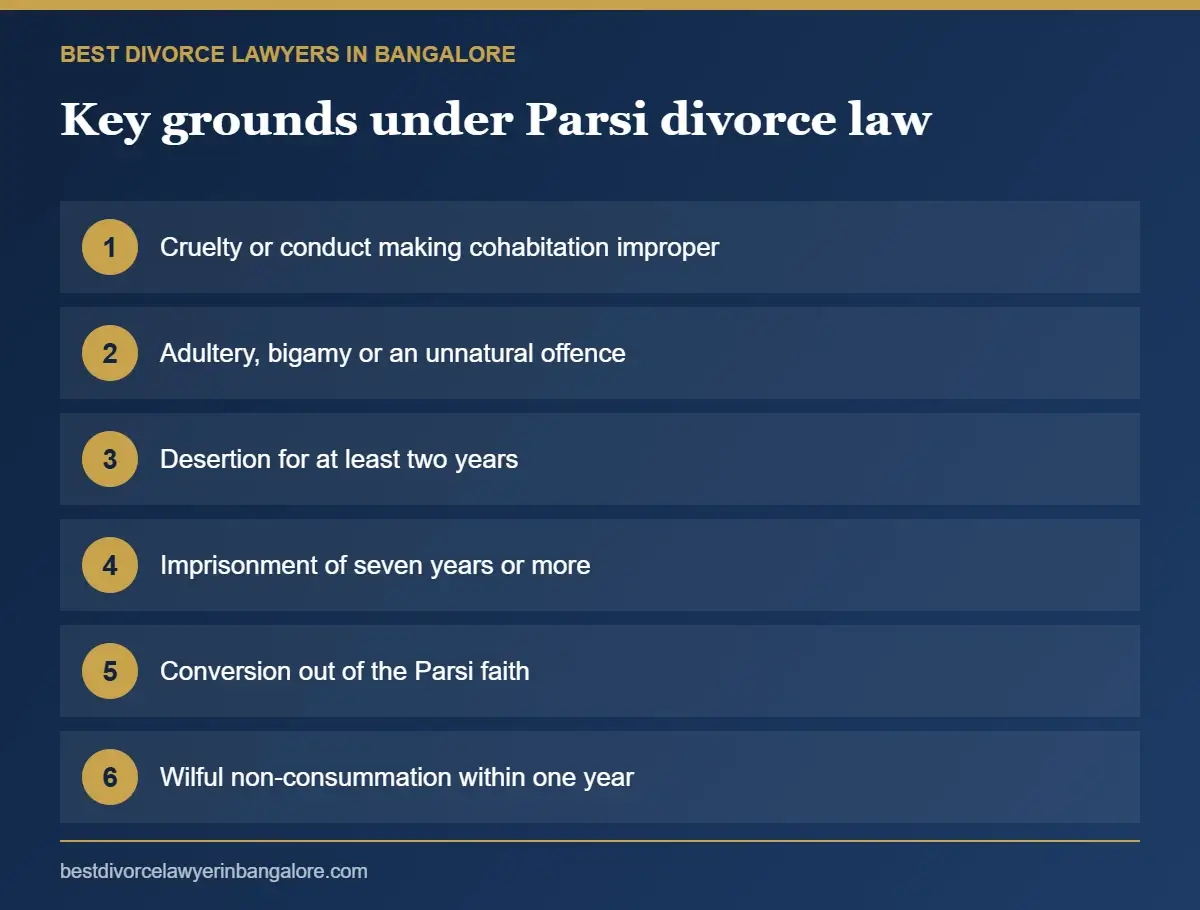
Section 32A adds a further ground for either spouse: that cohabitation has not resumed for one year or more after a decree of judicial separation, or that conjugal rights have not been restored for one year or more after a decree for restitution of conjugal rights. A suit on any of these grounds is fought on evidence, and a contested divorce lawyer in Bangalore can assess whether the facts and time limits are met before you file.
Nullity, presumed death and judicial separation
- Nullity (Section 30): a marriage can be declared void where consummation is impossible from natural causes.
- Absence for seven years (Section 31): if a spouse has been continually absent for seven years and not heard of as alive by those who would naturally have heard, the other spouse can sue to dissolve the marriage.
- Judicial separation (Section 34): a spouse can sue for judicial separation on any of the grounds on which they could have sued for divorce, keeping the marriage alive while living apart. Our guide to judicial separation vs divorce explains the practical difference.
Alimony, maintenance and custody
The Parsi Act is gender-neutral on money. Under Section 39, either spouse without sufficient independent income can claim maintenance and litigation expenses while the suit is pending, and under Section 40 the court can order permanent alimony as a lump sum or as monthly or periodic payments, taking into account both parties’ income and property and their conduct. The order can be varied if circumstances change, and can be rescinded if the recipient remarries or, in the case of a wife, does not remain chaste, or in the case of a husband, has sexual intercourse with any woman outside marriage. The general principles are explained in our guide to alimony in India.
Under Section 49, the court can make interim and final orders on the custody, maintenance and education of children under 18, and can vary them later. As in every community, the child’s welfare comes first; see child custody laws in India.
How a Parsi divorce suit proceeds
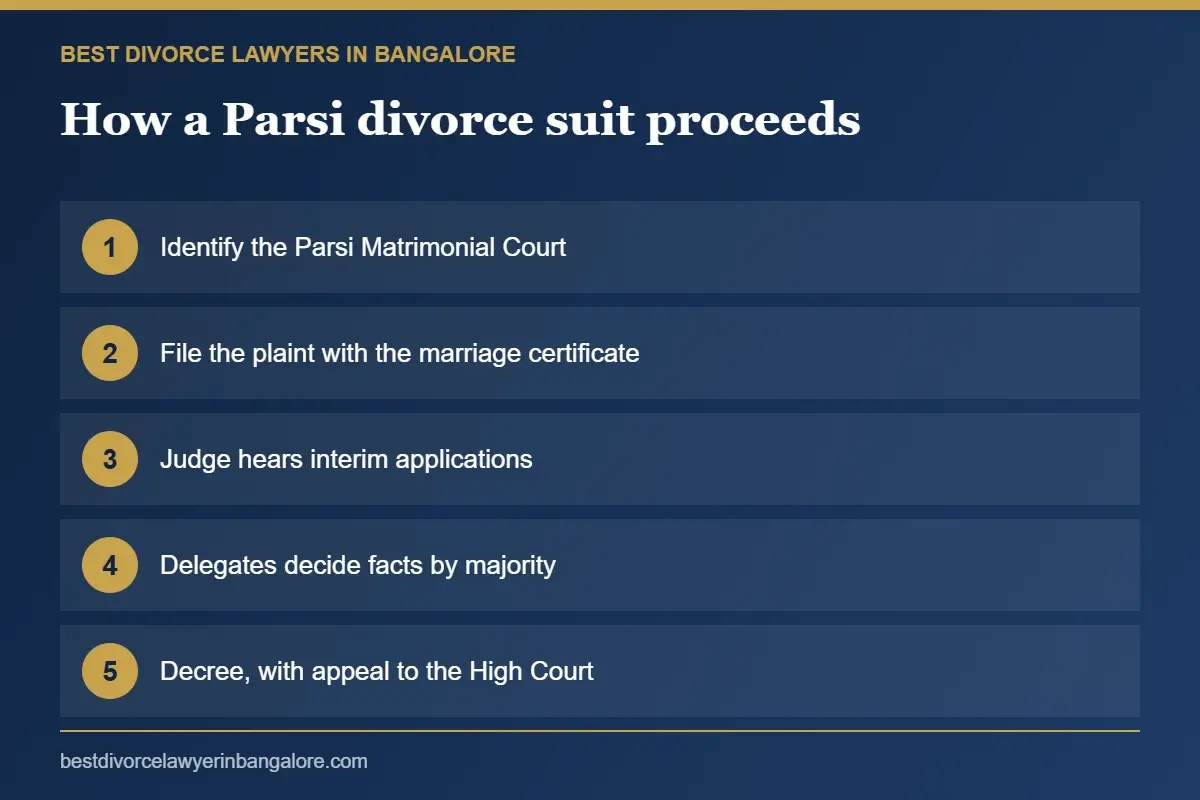
- Identify the court: the Parsi Chief or District Matrimonial Court with jurisdiction over the place where the couple last lived together or where the defendant lives.
- File the plaint with the marriage certificate issued under the Act, supporting documents and, if alimony is sought, a full financial disclosure.
- Interim applications for maintenance, custody or injunctions are heard by the judge alone.
- Trial with delegates: evidence is led, and the delegates decide the facts by majority.
- Decree and appeal: the judge passes the decree. Appeals lie to the High Court, mainly on questions of law, because the delegates’ findings of fact are generally final.
How this guide was prepared
This guide is based on the bare acts published on India Code and on judgments of the Supreme Court of India and the Karnataka High Court. Section numbers, case citations and time limits were fact-checked in October 2026, and criminal-law references use the Bharatiya Nyaya Sanhita (BNS) and Bharatiya Nagarik Suraksha Sanhita (BNSS) in force since 1 July 2024. It is general information, not legal advice. For advice on your own case, speak to an advocate. Read our editorial standards and disclaimer.
Frequently Asked Questions
How long does a Parsi divorce take?
A mutual consent suit can be quicker than a contested one, but timelines depend heavily on how often the Parsi Matrimonial Court and its delegates sit. Contested suits can take a year or several years.
Is there a six-month cooling-off period in Parsi mutual divorce?
Section 32B does not prescribe a separate six-month second motion like the Hindu Marriage Act. The key conditions are one year of separate living and at least one year since the marriage.
Can a Parsi husband claim alimony?
Yes. Sections 39 and 40 allow either spouse to claim interim maintenance and permanent alimony, depending on their own income and the other spouse’s means.
What if a Parsi married a non-Parsi?
If the marriage was registered under the Special Marriage Act, divorce is governed by that Act and heard by the Family Court, not by a Parsi Matrimonial Court.
Can the delegates’ decision on facts be appealed?
The delegates’ majority finding on facts is generally final. Appeals to the High Court are mainly limited to questions of law, which is one reason the system has been challenged.
Parsi divorce has its own courts, time limits and procedure, so specialised advice early on saves time later. Speak to one of the famous divorce lawyers in Bangalore about how the Act applies to you.