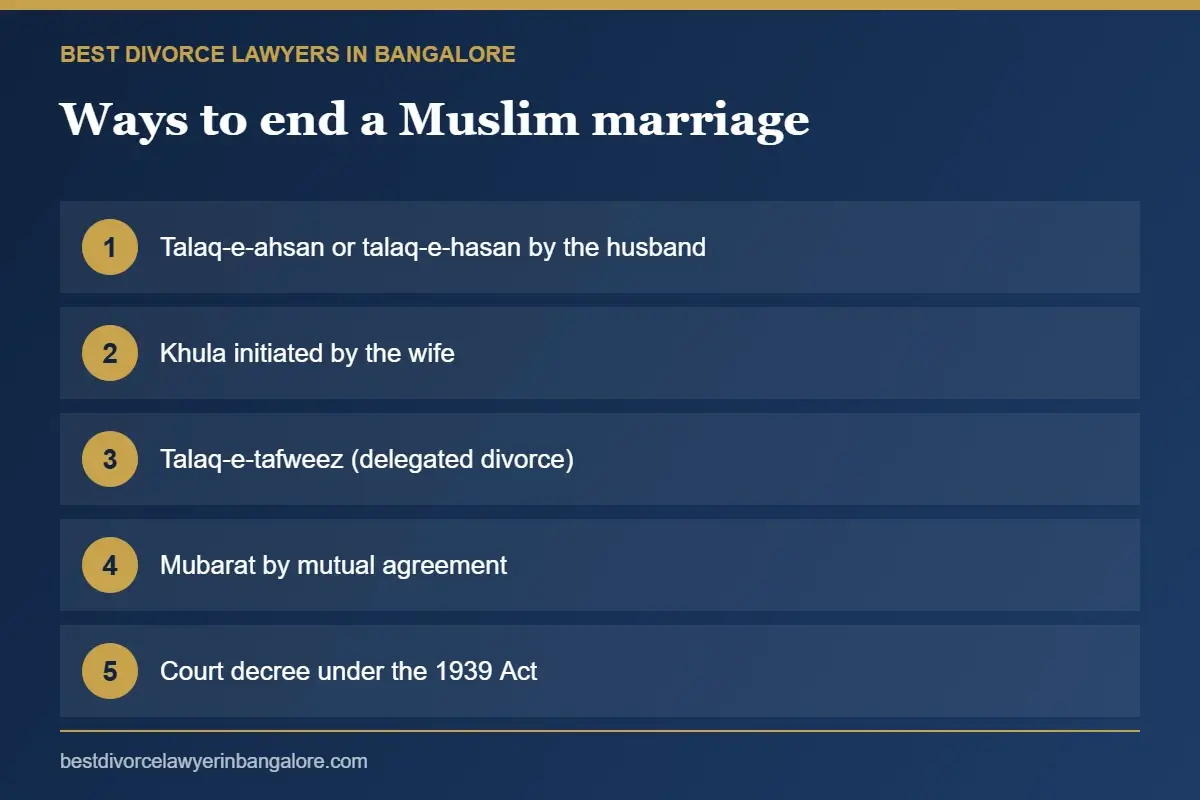
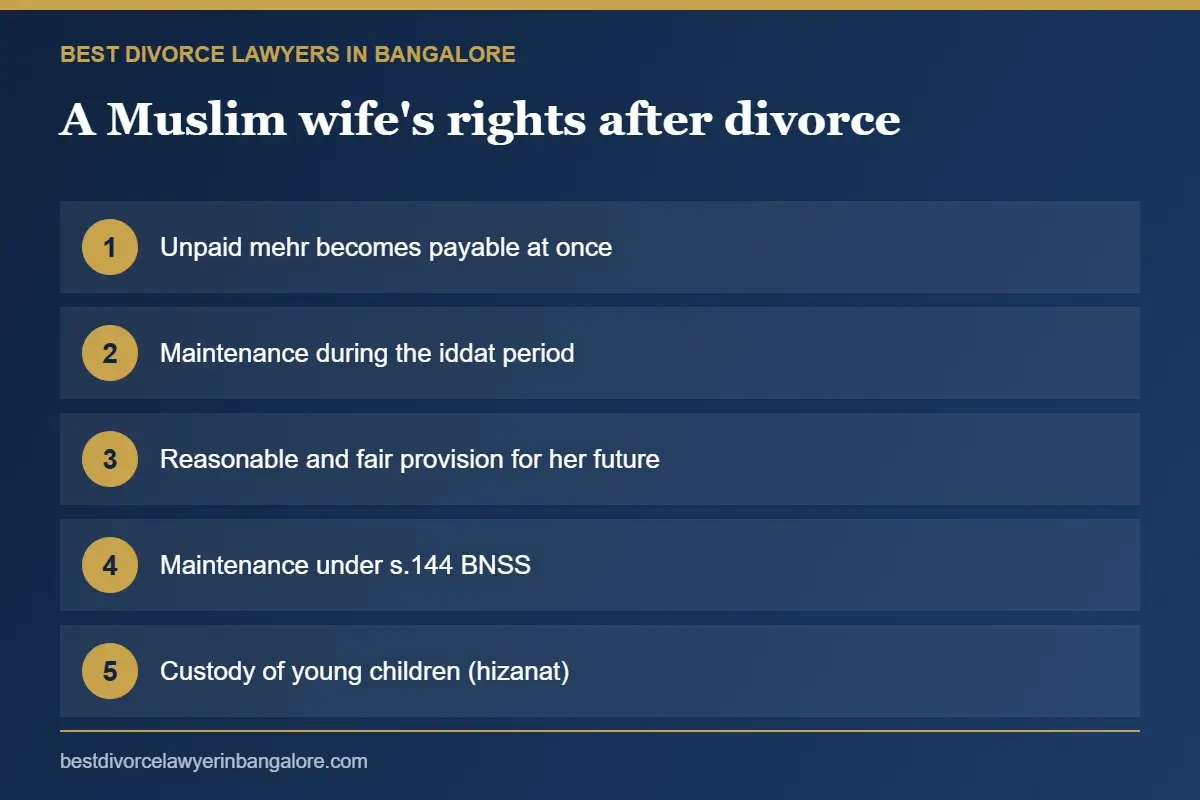
Divorce under Muslim law in India can happen in three ways: by the husband through talaq, by the wife through khula or delegated talaq, or by mutual agreement (mubarat), and a wife can also obtain a court decree under the Dissolution of Muslim Marriages Act, 1939. Instant triple talaq is no longer valid: the Supreme Court set it aside in 2017 and Parliament made it a criminal offence in 2019. Whatever the route, the wife’s rights to mehr, iddat maintenance, a fair provision and child custody remain.
Sources of divorce under Muslim law in India
Muslim marriage (nikah) is a civil contract, and its dissolution is governed by Muslim personal law as applied through the Muslim Personal Law (Shariat) Application Act, 1937, together with these statutes:
- Dissolution of Muslim Marriages Act, 1939: grounds on which a wife can seek a court decree.
- Muslim Women (Protection of Rights on Divorce) Act, 1986: mehr, maintenance and provision for a divorced woman.
- Muslim Women (Protection of Rights on Marriage) Act, 2019: declares instant triple talaq void and punishable.
- Family Courts Act, 1984: in Bengaluru, matrimonial disputes between Muslim spouses go to the Family Courts near Lalbagh Main Gate.
These sit within the wider scheme of family laws in India. A Muslim couple married under the Special Marriage Act, 1954 is governed by that Act instead, not by personal law.
Divorce by the husband: talaq
| Form | How it works | Legal status today |
|---|---|---|
| Talaq-e-ahsan | A single pronouncement during a period of purity (tuhr), followed by abstinence through the iddat period | Valid; revocable until iddat ends |
| Talaq-e-hasan | Three pronouncements in three successive periods of purity | Valid under personal law; becomes final after the third |
| Talaq-e-biddat (instant triple talaq) | Three pronouncements at once, orally, in writing or electronically | Void since Shayara Bano v. Union of India (2017); an offence under the 2019 Act |
Even an approved form of talaq is not unconditional. In Shamim Ara v. State of U.P. (2002), the Supreme Court held that talaq must be for a reasonable cause and preceded by genuine attempts at reconciliation by arbiters from both families, and that merely pleading an earlier talaq in court papers does not prove it.
The 2019 law on triple talaq
Under the Muslim Women (Protection of Rights on Marriage) Act, 2019, pronouncing talaq-e-biddat is void and illegal, and the husband can be punished with imprisonment of up to three years and a fine. The wife is entitled to a subsistence allowance for herself and her dependent children and, ordinarily, to custody of the minor children. The offence is cognizable when reported by the wife or her close relatives, and bail can be granted only after hearing her.
Divorce at the wife’s instance
Khula
Khula is divorce sought by the wife, usually in return for giving up her mehr or returning some consideration. In 2021, a Division Bench of the Kerala High Court held that a Muslim wife’s right to khula does not depend on the husband’s consent and recognised extra-judicial khula, while noting that courts may still be approached to confirm the dissolution. Practice in other states varies, so many women in Karnataka also seek a court decree to remove any doubt.
Talaq-e-tafweez (delegated divorce)
The nikahnama can delegate to the wife the power to pronounce talaq on specified conditions, for example if the husband takes a second wife or fails to maintain her. If the condition occurs, she can exercise that power herself.
Mubarat (mutual divorce)
Where both spouses want to end the marriage, they can agree to a mubarat. The offer may come from either side, and once accepted the divorce is irrevocable. It is sensible to record the terms on mehr, maintenance and children in a written settlement.
Lian, ila and zihar
Classical law also recognises lian (where the husband falsely accuses the wife of adultery), ila (a vow of abstinence) and zihar (comparing the wife to a prohibited relative). These are rarely relied on today but can support a claim for dissolution.
Judicial divorce under the Dissolution of Muslim Marriages Act, 1939
Section 2 of the 1939 Act lets a Muslim wife obtain a decree of dissolution from the court on any of these grounds:
- The husband’s whereabouts have not been known for four years
- He has neglected or failed to provide maintenance for two years
- He has been sentenced to imprisonment for seven years or more (the decree takes effect only once the sentence is final)
- He has failed, without reasonable cause, to perform his marital obligations for three years
- He was impotent at the time of marriage and continues to be so
- He has been insane for two years, or suffers from leprosy or a virulent venereal disease
- Option of puberty: she was married off before 15, repudiated the marriage before 18, and it was not consummated
- Cruelty, including habitual assault, associating with women of ill repute, forcing her into an immoral life, interfering with her property or religious practice, or not treating her equally with other wives
- Any other ground recognised as valid for dissolution under Muslim law
A wife who files in Bengaluru presents the petition before the Family Court, which will usually refer the couple to counselling or mediation first. If the husband contests, both sides lead evidence and the court decides. A contested divorce lawyer in Bangalore can advise on which ground best fits the facts and what proof is needed.
What a Kazi can and cannot do
In Karnataka, as elsewhere, Kazis solemnise and record marriages and may record a talaq or khula. A Kazi’s certificate is useful evidence, but it is not a court decree. In Vishwa Lochan Madan v. Union of India (2014), the Supreme Court confirmed that fatwas and decisions of Darul Qazas or Shariat bodies have no legal force and cannot bind anyone who does not accept them.
Iddat, mehr and maintenance after divorce
| Right | What it means |
|---|---|
| Iddat | A waiting period after divorce, usually three menstrual cycles (or three lunar months), or until delivery if she is pregnant. She cannot remarry during iddat. |
| Mehr | Any unpaid (deferred) mehr becomes payable immediately on divorce and can be recovered as a debt. |
| Fair provision and maintenance | Under Section 3 of the 1986 Act, the husband must make a reasonable and fair provision and pay maintenance within the iddat period; in Danial Latifi v. Union of India (2001) the Supreme Court held this provision must cover her future, not just the iddat months. |
| Section 144 BNSS | In Mohd. Abdul Samad v. State of Telangana (2024), the Supreme Court held that a divorced Muslim woman can also claim maintenance under the general law (formerly Section 125 CrPC). |
| Gifts and property | Her own property and gifts given to her at marriage remain hers. |
Our guides to alimony in India and wife rights after divorce in India explain how these claims are calculated and enforced.
Custody of children after a Muslim divorce
Muslim law gives the mother hizanat (custody) of young children, traditionally a son until about seven and a daughter until puberty under the Hanafi school, while the father remains the natural guardian. Indian courts, however, decide custody under the Guardians and Wards Act on the welfare of the child, using these rules as guidance. See our guide to child custody laws in India for how courts weigh welfare.
Remarriage after divorce
A divorced Muslim woman can remarry after completing iddat. Under classical law, a couple divorced by three effective pronouncements cannot remarry each other unless the wife has in between validly married and been divorced by another man (halala); this practice has been challenged before the Supreme Court and should be discussed with a lawyer before anyone relies on it.
How this guide was prepared
This guide is based on the bare acts published on India Code and on judgments of the Supreme Court of India and the Karnataka High Court. Section numbers, case citations and time limits were fact-checked in October 2026, and criminal-law references use the Bharatiya Nyaya Sanhita (BNS) and Bharatiya Nagarik Suraksha Sanhita (BNSS) in force since 1 July 2024. It is general information, not legal advice. For advice on your own case, speak to an advocate. Read our editorial standards and disclaimer.
Frequently Asked Questions
Is triple talaq valid in India now?
No. Instant triple talaq (talaq-e-biddat) is void after Shayara Bano (2017) and the 2019 Act. The marriage continues, and the husband can face up to three years in prison.
Can a Muslim woman divorce her husband without his consent?
Yes. She can seek a decree under the Dissolution of Muslim Marriages Act, 1939, exercise delegated talaq if her nikahnama provides for it, or seek khula, which the Kerala High Court has held does not need the husband’s consent.
Does a Muslim wife get maintenance only for the iddat period?
No. Under Danial Latifi (2001) the provision made within iddat must be reasonable and fair for her future, and she can also claim maintenance under Section 144 BNSS.
Is a talaqnama or Kazi certificate enough to prove divorce?
It is evidence, but if the divorce is disputed the court will look at whether a valid talaq was actually pronounced and communicated, with reconciliation attempts as required by Shamim Ara (2002).
Which court handles Muslim divorce cases in Bangalore?
The Family Courts in Bengaluru, located in the complex near Lalbagh Main Gate on Siddaiah Road, hear petitions under the 1939 Act and related maintenance and custody claims.
Muslim divorce mixes personal law, statute and recent case law, and the right route depends on the facts and the nikahnama. For advice on your situation, speak to an experienced divorce advocate in Bangalore.