The grounds for divorce in India are the legal reasons a court will accept to end a marriage, and they depend on the personal law that governs your marriage. Most couples in Bangalore marry under the Hindu Marriage Act, 1955 or the Special Marriage Act, 1954, where divorce is available either by mutual consent or on specific fault grounds such as cruelty, adultery or desertion. This guide explains each ground in plain language, how it is proved, and what to think about before filing.
Why the Ground for Divorce in India Matters
Indian law does not grant a divorce simply because one spouse wants out. Unless both of you agree to a mutual consent divorce, the spouse who files must plead and prove a ground recognised by the applicable statute. The ground you choose shapes the evidence you need, how long the case is likely to take, and how hard the other side will fight it. It also affects related claims such as maintenance and custody, though those are decided on their own principles.
Which law applies depends on the religion of the spouses and the way the marriage was solemnised:
- Hindus, Buddhists, Jains and Sikhs — Hindu Marriage Act, 1955 (HMA), Sections 13 and 13B.
- Inter-faith couples and anyone who registered under it — Special Marriage Act, 1954, Sections 27 and 28.
- Christians — Divorce Act, 1869, Sections 10 and 10A.
- Muslims — Muslim personal law, plus the Dissolution of Muslim Marriages Act, 1939 for a wife seeking divorce through court.
- Parsis — Parsi Marriage and Divorce Act, 1936.
If you are unsure where you stand, our overview of divorce laws in India sets out how these statutes fit together.
Fault Grounds Under the Hindu Marriage Act
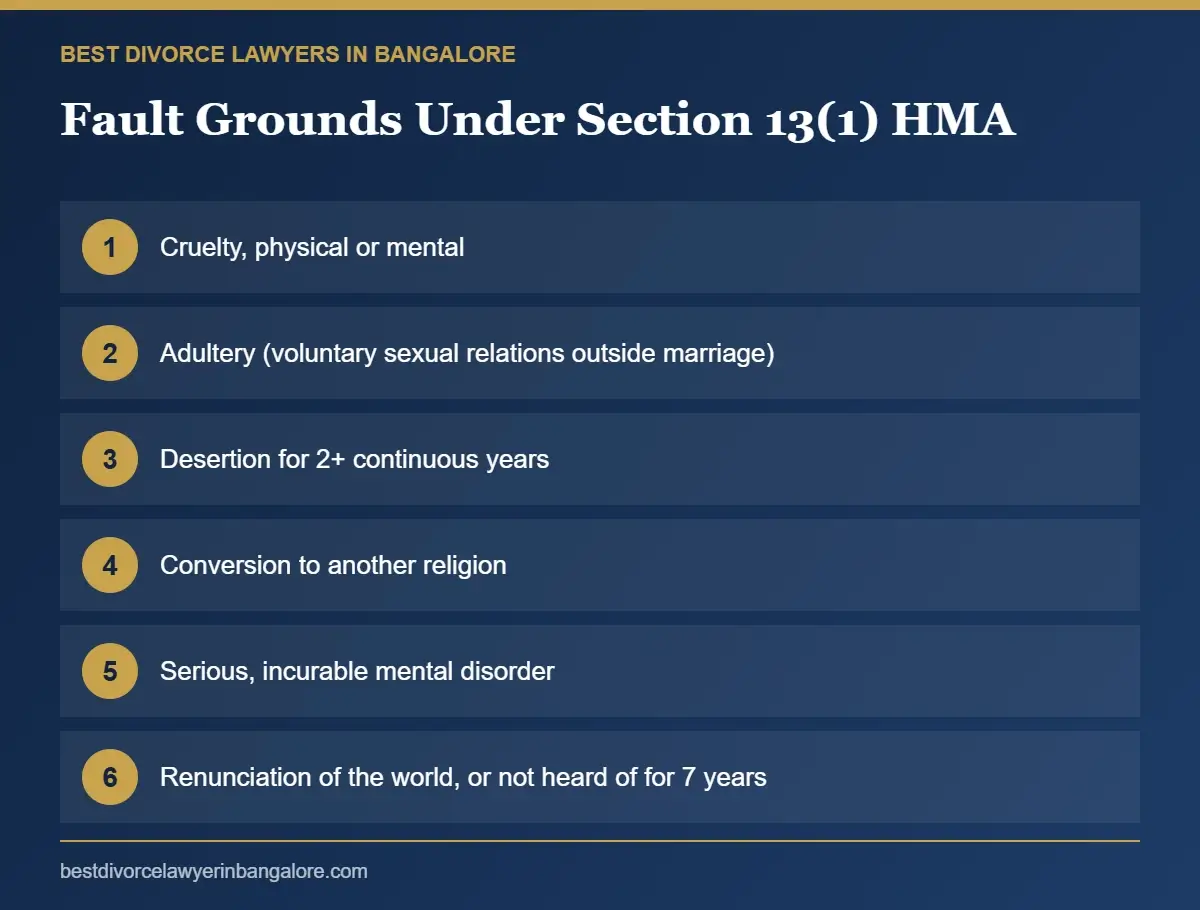
Section 13(1) of the HMA lists the grounds on which either the husband or the wife can seek divorce. The Special Marriage Act and the Divorce Act use very similar language, so the explanations below are broadly useful for those laws too.
1. Cruelty
Cruelty is the most frequently pleaded ground in Bengaluru’s Family Courts. It covers physical violence, but also mental cruelty: conduct so serious that the petitioner cannot reasonably be expected to keep living with the spouse. Courts look at the whole pattern of behaviour, not one quarrel. Examples recognised by the Supreme Court in cases such as Samar Ghosh v. Jaya Ghosh (2007) include sustained humiliation, unilateral refusal of marital relations for a long time without reason, and conduct that causes real mental anguish. Making false criminal complaints or baseless allegations of character against a spouse has also been treated as cruelty in many judgments.
Ordinary wear and tear of married life, such as occasional arguments or differences in temperament, is not enough on its own.
2. Adultery
A spouse who has had voluntary sexual intercourse with someone other than their husband or wife after marriage gives the other spouse a ground for divorce. Since Joseph Shine v. Union of India (2018), adultery is no longer a crime, but it remains a valid civil ground for divorce. Direct proof is rare, so courts accept circumstantial evidence that leads clearly to the conclusion.
3. Desertion
Desertion means one spouse has left the other without reasonable cause and without consent, intending to end cohabitation permanently, for a continuous period of at least two years immediately before the petition. Physical separation alone is not desertion; the intention to abandon matters. If you left because of the other spouse’s cruelty, it is usually the other spouse, not you, who is treated as the deserter.
4. Conversion
If a spouse has ceased to be a Hindu by converting to another religion, the other spouse may seek divorce. The spouse who converted cannot use their own conversion as a ground.
5. Mental disorder
Divorce is available where the spouse has been incurably of unsound mind, or has suffered continuously or intermittently from a mental disorder of such a kind and extent that the petitioner cannot reasonably be expected to live with them. Courts insist on clear medical evidence here and are careful not to treat ordinary illness or treatable conditions as grounds.
6. Venereal disease, renunciation and presumed death
The HMA also allows divorce where the spouse suffers from venereal disease in a communicable form, has renounced the world by entering a religious order, or has not been heard of as being alive for seven years or more by people who would naturally have heard of them. Leprosy used to be a ground but was removed by the Personal Laws (Amendment) Act, 2019.
Non-Compliance With an Earlier Decree
Under Section 13(1A), either spouse can seek divorce if there has been no resumption of cohabitation for one year or more after a decree of judicial separation, or no restitution of conjugal rights for one year or more after a decree for restitution. This route is useful where the couple already went through one round of litigation and the situation did not improve.
Additional Grounds Available Only to the Wife
Section 13(2) of the HMA gives a wife four further grounds:
- The husband had another wife living at the time of the marriage (for marriages before the Act came into force).
- The husband has, since the marriage, been guilty of rape, sodomy or bestiality.
- A maintenance order has been passed in her favour (under the Hindu Adoptions and Maintenance Act, or under Section 125 CrPC, now Section 144 of the Bharatiya Nagarik Suraksha Sanhita), and cohabitation has not resumed for one year or more after that order.
- She was married before turning 15 and repudiated the marriage after 15 but before 18 (the option of puberty).
Divorce by Mutual Consent
Where both spouses agree, Section 13B of the HMA (and Section 28 of the Special Marriage Act) allows a joint petition if you have lived separately for at least one year and agree the marriage should end. You do not need to prove fault. The court records statements on a first motion and, after a waiting period that it can waive in suitable cases, grants the decree on a second motion. Many couples who start with a fault-based case later settle and convert it into a mutual petition. Our guide on how to file for divorce in India walks through both routes.
Grounds Under Other Personal Laws
| Law | Key grounds | Mutual consent |
|---|---|---|
| Special Marriage Act, 1954 | Adultery, cruelty, desertion for 2 years, imprisonment of 7 years or more, mental disorder, communicable venereal disease, not heard of for 7 years | Section 28, after 1 year of separation |
| Divorce Act, 1869 (Christians) | Adultery, cruelty, desertion for 2 years, conversion, mental disorder, not heard of for 7 years, wilful refusal to consummate | Section 10A, after 2 years of separation |
| Dissolution of Muslim Marriages Act, 1939 (wife) | Husband missing 4 years, no maintenance for 2 years, imprisonment of 7 years, failure of marital obligations for 3 years, impotence, insanity, cruelty | Khula and mubarat under personal law |
| Parsi Marriage and Divorce Act, 1936 | Adultery, cruelty, desertion for 2 years, non-consummation, imprisonment of 7 years, and others under Section 32 | Section 32B |
Is Irretrievable Breakdown a Ground?
Not under any statute. Family Courts in Bangalore cannot grant divorce merely because the marriage has broken down. However, in Shilpa Sailesh v. Varun Sreenivasan (2023), a Constitution Bench of the Supreme Court held that it can dissolve a marriage on the ground of irretrievable breakdown using its special power under Article 142 of the Constitution. That power belongs to the Supreme Court alone and is used sparingly, so for most people the practical route remains a statutory ground or mutual consent.
The One-Year Bar and Other Limits
Section 14 of the HMA says no divorce petition can be presented within one year of the marriage, unless the court permits it on the basis of exceptional hardship to the petitioner or exceptional depravity of the respondent. Section 23 also requires the court to be satisfied that the petitioner is not taking advantage of their own wrong and that there is no collusion. These rules are why careful drafting at the start matters.
How Grounds Are Proved in a Bengaluru Family Court
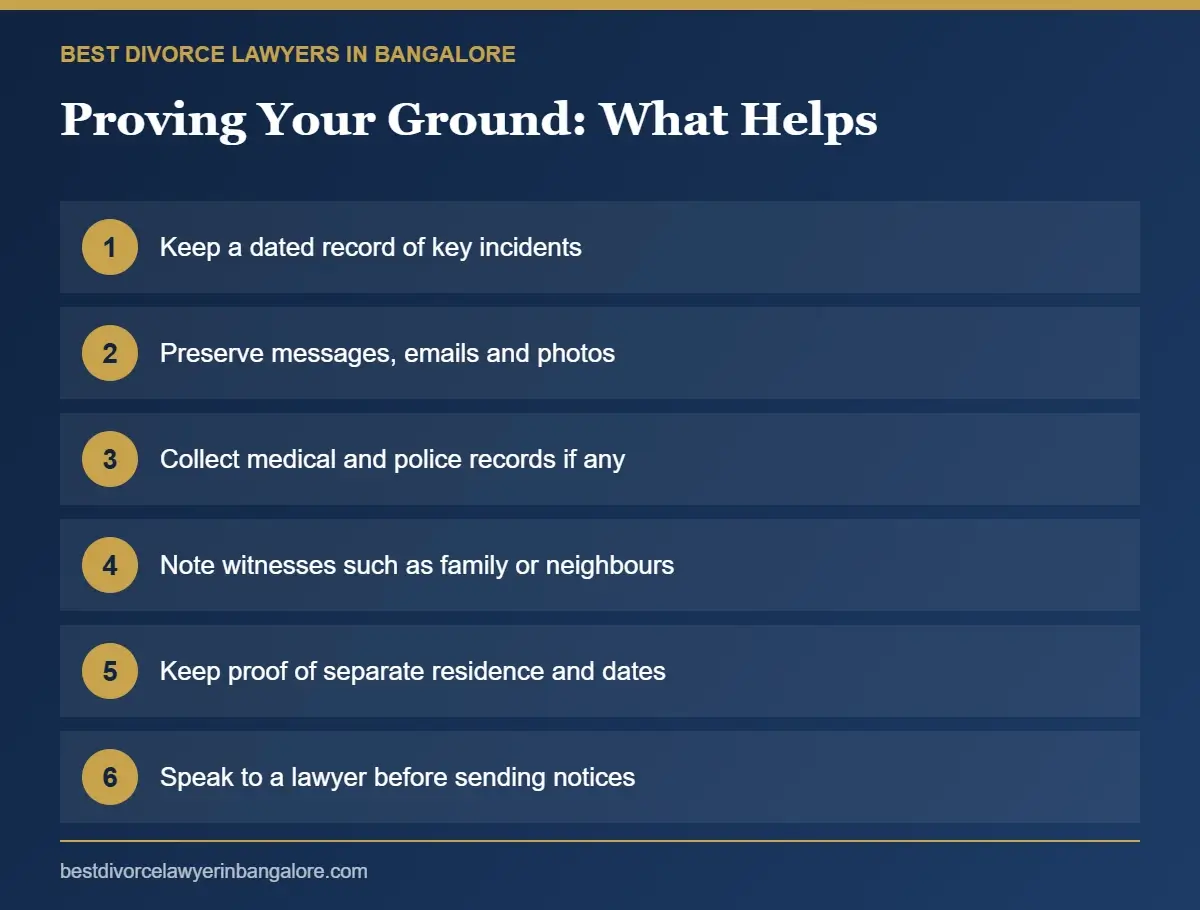
Contested cases in Bangalore Urban are heard by the Family Courts near Lalbagh Main Gate on Siddaiah Road. The petitioner files evidence by affidavit and is cross-examined, followed by the respondent’s witnesses. The standard of proof is the civil standard of preponderance of probabilities, but the court expects consistent, specific evidence: dates, incidents, documents and witnesses. Vague, general allegations rarely succeed. If you are considering a fault-based petition, a contested divorce lawyer in Bangalore can help you choose the strongest ground and the right evidence. You can also read about the divorce process in Bangalore stage by stage.
Once the petition is filed, the court will normally refer you to mediation. Many cases that begin on grounds of cruelty or desertion end with a settlement and a mutual consent decree, which is often faster and less painful for everyone, especially children.
How this guide was prepared
This guide is based on the bare acts published on India Code and on judgments of the Supreme Court of India and the Karnataka High Court. Section numbers, case citations and time limits were fact-checked in October 2026, and criminal-law references use the Bharatiya Nyaya Sanhita (BNS) and Bharatiya Nagarik Suraksha Sanhita (BNSS) in force since 1 July 2024. It is general information, not legal advice. For advice on your own case, speak to an advocate. Read our editorial standards and disclaimer.
Frequently Asked Questions
Can I get a divorce in India if my spouse does not agree?
Yes. If you can prove a statutory ground such as cruelty, adultery or desertion, the court can grant divorce even if your spouse opposes it. You will have to lead evidence and face cross-examination.
Is incompatibility a ground for divorce in India?
Incompatibility alone is not a listed ground. If both spouses agree, mutual consent divorce is the usual route. Otherwise, facts showing incompatibility may sometimes add up to mental cruelty, depending on how serious they are.
Can I file for divorce within one year of marriage?
Generally no. Section 14 of the Hindu Marriage Act bars a petition within one year of marriage unless the court allows it for exceptional hardship or exceptional depravity. A mutual consent petition also needs at least one year of separation.
Does living apart automatically count as desertion?
No. Desertion needs separation plus an intention to end the marriage permanently, without reasonable cause and without consent, for at least two continuous years before filing.
Can a husband claim cruelty against his wife?
Yes. Cruelty is a gender-neutral ground under the Hindu Marriage Act and the Special Marriage Act. Husbands regularly succeed on mental cruelty where the evidence supports it.
Every marriage is different, and the right ground depends on your facts, your evidence and what you want from the outcome. If you are weighing your options, speak to one of the best divorce lawyers in Bangalore for a confidential assessment before you file.