Cruelty as a ground for divorce is available to both husbands and wives under every major Indian matrimonial law. Under Section 13(1)(ia) of the Hindu Marriage Act, a spouse can seek divorce if the other has treated them with cruelty, physical or mental, after the marriage, and Indian courts have built up a detailed body of case law on what that means in practice.
What the Law Says About Cruelty
Cruelty became a ground for divorce under the Hindu Marriage Act in 1976, when Section 13(1)(ia) was inserted. The Act does not define cruelty, which allows courts to judge each case on its own facts. Equivalent grounds exist in other personal laws:
| Law | Provision |
|---|---|
| Hindu Marriage Act, 1955 (Hindus, Sikhs, Jains, Buddhists) | Section 13(1)(ia) |
| Special Marriage Act, 1954 (inter-faith and civil marriages) | Section 27(1)(d) |
| Indian Divorce Act, 1869 (Christians) | Section 10(1)(x): cruelty causing reasonable apprehension of harm or injury |
| Parsi Marriage and Divorce Act, 1936 | Section 32(dd) |
| Dissolution of Muslim Marriages Act, 1939 (wife’s petition) | Section 2(viii) |
Cruelty is the most commonly pleaded of the grounds for divorce in India, and it is also a ground for judicial separation. Our hub on divorce laws in India places it in the wider legal picture.
How Courts Define Cruelty
In N.G. Dastane v. S. Dastane (1975), the Supreme Court asked whether the conduct was such as to cause a reasonable apprehension in the petitioner’s mind that it would be harmful or injurious to live with the other spouse. The same case held that cruelty in matrimonial cases need only be proved on a preponderance of probabilities, not beyond reasonable doubt as in criminal law.
In V. Bhagat v. D. Bhagat (1994), the Court explained that mental cruelty is conduct that inflicts such mental pain and suffering that the parties cannot reasonably be expected to live together. It must be judged against the couple’s background, status, education and social setting, and ordinary wear and tear of married life does not qualify.
Physical Cruelty
Physical cruelty is the easier kind to recognise: slapping, beating, pushing, burning, confining a spouse, or denying food or medical care. A single serious incident can be enough if it creates a genuine fear for safety. Medical records, photographs of injuries, police complaints and witness statements are usually the key evidence.
Mental Cruelty
Most cruelty cases today involve mental cruelty. In Samar Ghosh v. Jaya Ghosh (2007), the Supreme Court gave an illustrative, non-exhaustive list of conduct that may amount to mental cruelty. Drawing on that and later decisions, examples include:
- sustained abusive and humiliating language, or constant indifference and neglect;
- persistent demands for dowry, which the Court in Shobha Rani v. Madhukar Reddi (1988) treated as cruelty;
- unilateral refusal to have marital intercourse for a long period without sufficient reason;
- unilateral decision not to have children after marriage, or forcing a spouse to undergo sterilisation or abortion without consent;
- false and defamatory allegations against a spouse’s character, including in letters to employers or colleagues, as in Joydeep Majumdar v. Bharti Jaiswal Majumdar (2021);
- filing false criminal complaints against the spouse and their family, recognised as mental cruelty in K. Srinivas Rao v. D.A. Deepa (2013);
- repeated threats or attempts to commit suicide to pressure the spouse, and persistent pressure to separate the husband from his elderly parents without justification, discussed in Narendra v. K. Meena (2016);
- long separation where the marriage has become a fiction, which courts have said may itself cause mental cruelty.
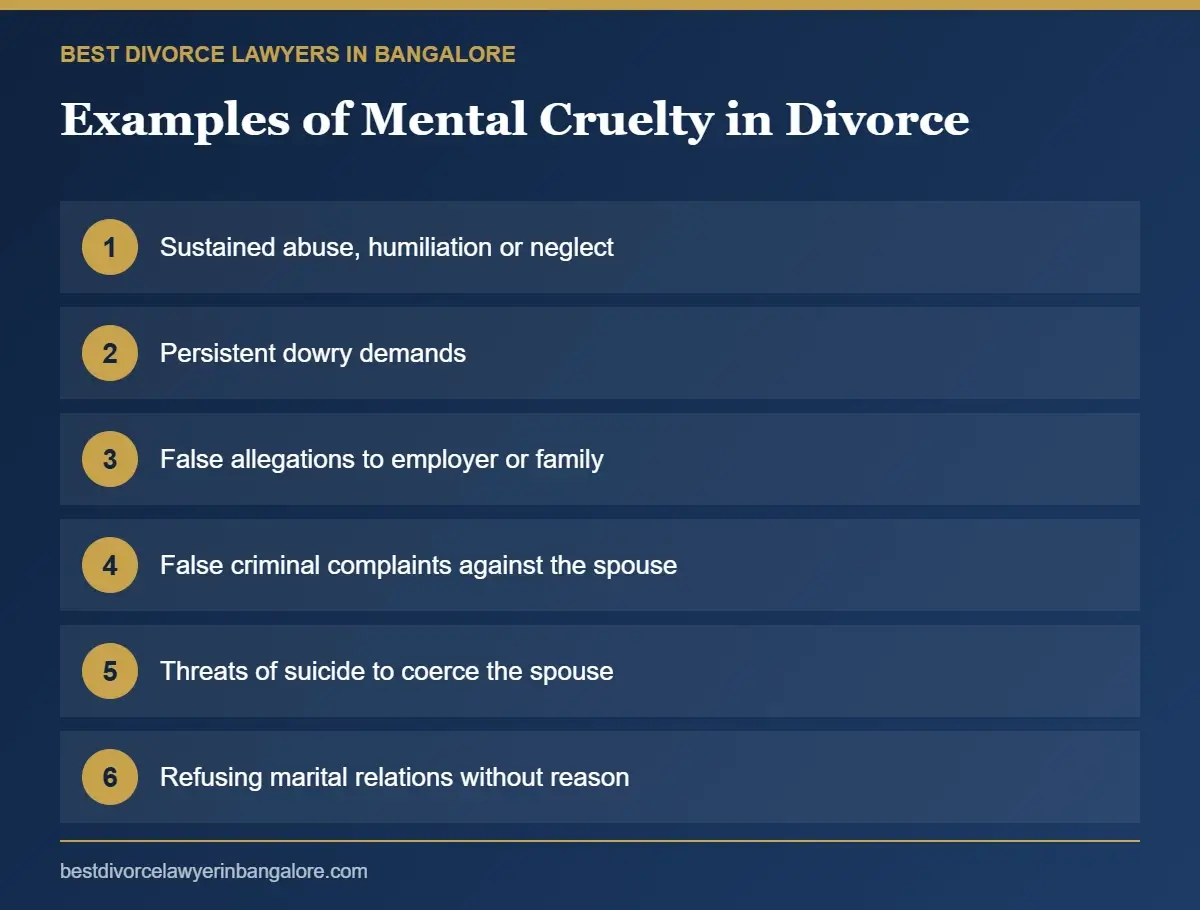
No single item is automatically cruelty. Courts look at the conduct as a whole, its seriousness, its duration and its effect on the petitioner.
Proving Cruelty as a Ground for Divorce
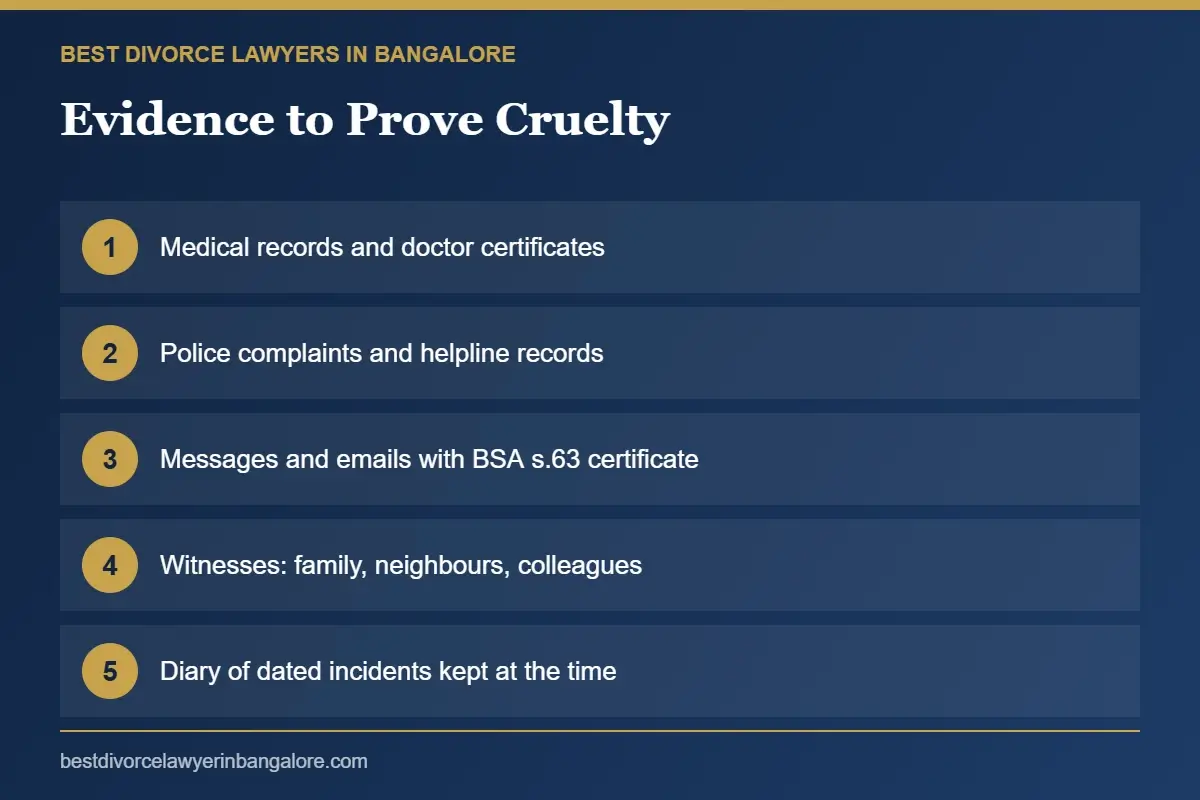
A cruelty case is won or lost on evidence. The petition must set out specific incidents with dates, places and details; vague statements such as “she was always rude” or “he harassed me” rarely succeed. Useful evidence includes:
- medical records and doctors’ certificates for injuries or treatment for anxiety and depression;
- police complaints, FIRs and records of calls to helplines;
- emails, WhatsApp messages, recordings and social media posts, supported by a certificate under Section 63 of the Bharatiya Sakshya Adhiniyam, 2023 (which replaced Section 65B of the Evidence Act);
- testimony of family members, neighbours, friends or colleagues who saw incidents;
- counselling or mediation records where admissible, and letters or complaints sent to employers.
Our checklist of documents required for divorce in India covers the standard paperwork you will also need.
Condonation and Delay
Under Section 23(1)(b) of the Hindu Marriage Act, the court must be satisfied that the petitioner has not condoned the cruelty. If you forgave the conduct and resumed normal married life, those past incidents may not support divorce on their own, although fresh cruelty can revive them. Long, unexplained delay in filing can also weaken a case, so keep records as events happen.
Cruelty in Divorce vs Criminal Cruelty Under the BNS
Cruelty in a divorce petition is different from the criminal offence of cruelty. Since 1 July 2024, the offence formerly in Section 498A IPC is in Sections 85 and 86 of the Bharatiya Nyaya Sanhita, which punish a husband or his relatives for cruelty to a wife with imprisonment of up to three years and a fine. Key differences:
| Point | Divorce on cruelty | Criminal cruelty (BNS ss. 85-86) |
|---|---|---|
| Who can use it | Husband or wife | Protects the wife; usually begins with her complaint to police |
| Forum | Family Court | Police and criminal court |
| Standard of proof | Preponderance of probabilities | Beyond reasonable doubt |
| Outcome | Divorce or judicial separation | Conviction and punishment |
A wife facing abuse can also seek protection, residence and monetary orders under the Protection of Women from Domestic Violence Act, 2005, and maintenance under Section 144 of the Bharatiya Nagarik Suraksha Sanhita. These proceedings can run alongside a divorce. Equally, courts have held that filing false criminal complaints can itself amount to mental cruelty, so criminal remedies should be used honestly and carefully.
Cruelty Against Husbands
Cruelty is a gender-neutral ground in divorce law. Husbands have obtained divorce where the wife made false allegations to his employer, filed false criminal cases, persistently humiliated him or his parents, or threatened suicide to coerce him. The same rules on specific pleading and evidence apply.
Filing a Cruelty Divorce Petition in Bengaluru
- Consult a lawyer and gather evidence before filing.
- File the petition in the Bengaluru Family Courts near Lalbagh Main Gate on Siddaiah Road (or where jurisdiction lies under Section 19 HMA).
- Service of notice on the respondent, followed by counselling or mediation.
- Written statement by the respondent, often with counter-allegations.
- Evidence: affidavits, documents and cross-examination of both sides.
- Arguments and judgment, with an appeal to the Karnataka High Court (within 90 days under Section 28 of the Hindu Marriage Act, though some High Courts apply the 30-day limit in Section 19 of the Family Courts Act, so file promptly).
If your spouse will not agree to a divorce, cruelty is often the strongest ground available; our guide on one sided divorce in India explains how contested petitions proceed. If you are not ready to end the marriage, the same facts can support judicial separation instead of divorce. If you cannot afford a lawyer, the Karnataka State Legal Services Authority provides free legal aid to eligible applicants, including women.
How this guide was prepared
This guide is based on the bare acts published on India Code and on judgments of the Supreme Court of India and the Karnataka High Court. Section numbers, case citations and time limits were fact-checked in October 2026, and criminal-law references use the Bharatiya Nyaya Sanhita (BNS) and Bharatiya Nagarik Suraksha Sanhita (BNSS) in force since 1 July 2024. It is general information, not legal advice. For advice on your own case, speak to an advocate. Read our editorial standards and disclaimer.
Frequently Asked Questions
Can a single incident of cruelty be enough for divorce?
Sometimes. A single act that is grave enough, such as a serious assault, can create a reasonable fear of harm. Usually, though, courts look for a pattern of conduct.
Do I need to file a police complaint to prove cruelty?
No. A police complaint is helpful evidence but not a requirement. Courts can find cruelty from medical records, messages and witness testimony alone.
Is a husband’s or wife’s refusal to live with in-laws cruelty?
Not by itself. Wanting a separate home is not cruelty, but courts have treated persistent, unjustified pressure to abandon elderly dependent parents, combined with other conduct, as cruelty in some cases.
How long does a cruelty divorce case take in Bengaluru?
Contested cruelty cases commonly take a few years because they involve full evidence and cross-examination. Many couples settle during mediation and convert the case to a mutual consent divorce.
Can the accused spouse counter-claim cruelty?
Yes. Respondents often deny the allegations and file a counter-claim alleging cruelty by the petitioner. The court then assesses both sides’ evidence.
Speak to a Lawyer About a Cruelty Divorce
A well-drafted petition with specific incidents and solid evidence makes all the difference in a cruelty case. Many clients prefer to speak with female divorce lawyers in Bangalore about sensitive experiences, and our contested divorce lawyers in Bangalore can assess your evidence, protect your safety and guide you through the Family Court process.