An affidavit for divorce is a written statement of facts that you swear or affirm to be true before a notary or oath commissioner, and file in the family court in support of your divorce petition or an application in it. In India you will usually need one with the petition itself, another to disclose your income and assets, and often a third as your evidence. Writing it well means stating facts clearly, in numbered paragraphs, with a proper verification clause, and never including anything you cannot stand behind.
What is an affidavit for divorce?
An affidavit is sworn testimony on paper. The person making it (the deponent) declares that the statements in it are true, signs it, and has the signature attested by an authorised officer. Courts rely on affidavits to save time: instead of hearing every fact orally, the judge reads your sworn version and the other side can challenge it, including by cross-examining you.
Because it is made on oath, an affidavit carries legal consequences. A deliberately false statement can amount to the offence of giving or fabricating false evidence under Sections 227 to 229 of the Bharatiya Nyaya Sanhita, 2023 (formerly Sections 191 to 193 IPC), and the court can start perjury proceedings under Section 379 of the Bharatiya Nagarik Suraksha Sanhita (formerly Section 340 CrPC).
When you need an affidavit in a divorce case
| Type of affidavit | When it is used | Legal basis |
|---|---|---|
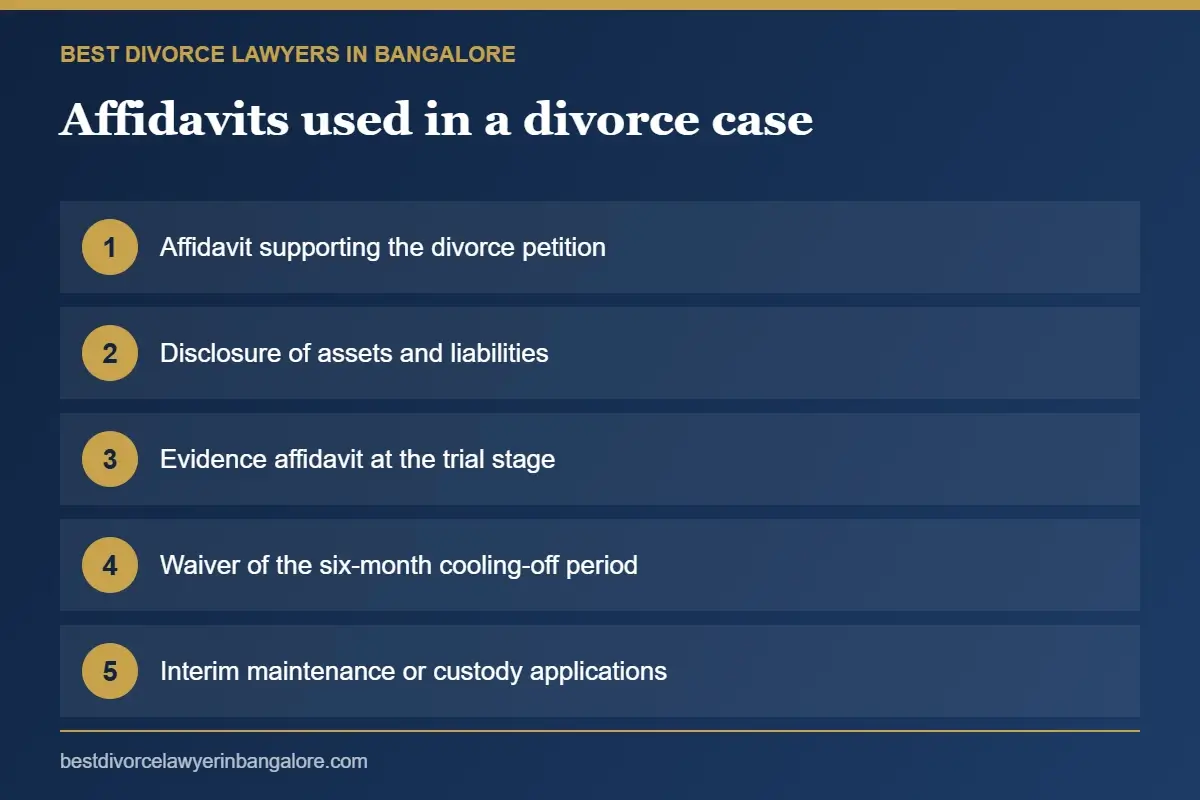
| Affidavit supporting the petition | Filed with a contested petition or each spouse’s affidavit with a mutual consent petition | Personal law and family court practice |
| Affidavit of Disclosure of Assets and Liabilities | Any case where maintenance or alimony is claimed | Rajnesh v. Neha (2020), Supreme Court |
| Evidence affidavit (chief examination) | Trial stage of a contested divorce, in place of oral examination-in-chief | Order XVIII Rule 4, Code of Civil Procedure; Section 16, Family Courts Act |
| Affidavit for waiver of the six-month period | Mutual consent divorce where the couple seek early decree | Amardeep Singh v. Harveen Kaur (2017) |
| Affidavit in support of interim applications | Interim maintenance, custody, visitation, injunctions | Order XIX CPC and the relevant personal law |
Your affidavits sit alongside the other papers listed in our guide to documents required for divorce in India.
In a mutual consent divorce
Each spouse usually files an affidavit confirming the date and place of marriage, that they have lived separately for at least a year, that they cannot live together, that consent is free and not obtained by force, fraud or undue influence, and the agreed terms on alimony, streedhan and custody. If you want the six-month cooling-off period waived, a supporting affidavit explains why the marriage has irretrievably broken down and why waiting serves no purpose. Our comparison of mutual divorce vs contested divorce explains when each route fits.
In a contested divorce
The petitioner files the petition with a supporting affidavit, and later an evidence affidavit setting out the full narrative of the grounds, such as cruelty or desertion, with references to documents marked as exhibits. The respondent does the same in reply. Both are then cross-examined on those affidavits.
Disclosure of assets and liabilities
Since Rajnesh v. Neha, both spouses must file a detailed disclosure affidavit in a prescribed format in maintenance proceedings. It covers personal details, education and employment, income from all sources, movable and immovable assets, loans and liabilities, household expenses and the needs of the children. It is the foundation for any alimony in India decision, and hiding an asset here is one of the fastest ways to lose a judge’s trust.
How to write an affidavit for divorce: structure
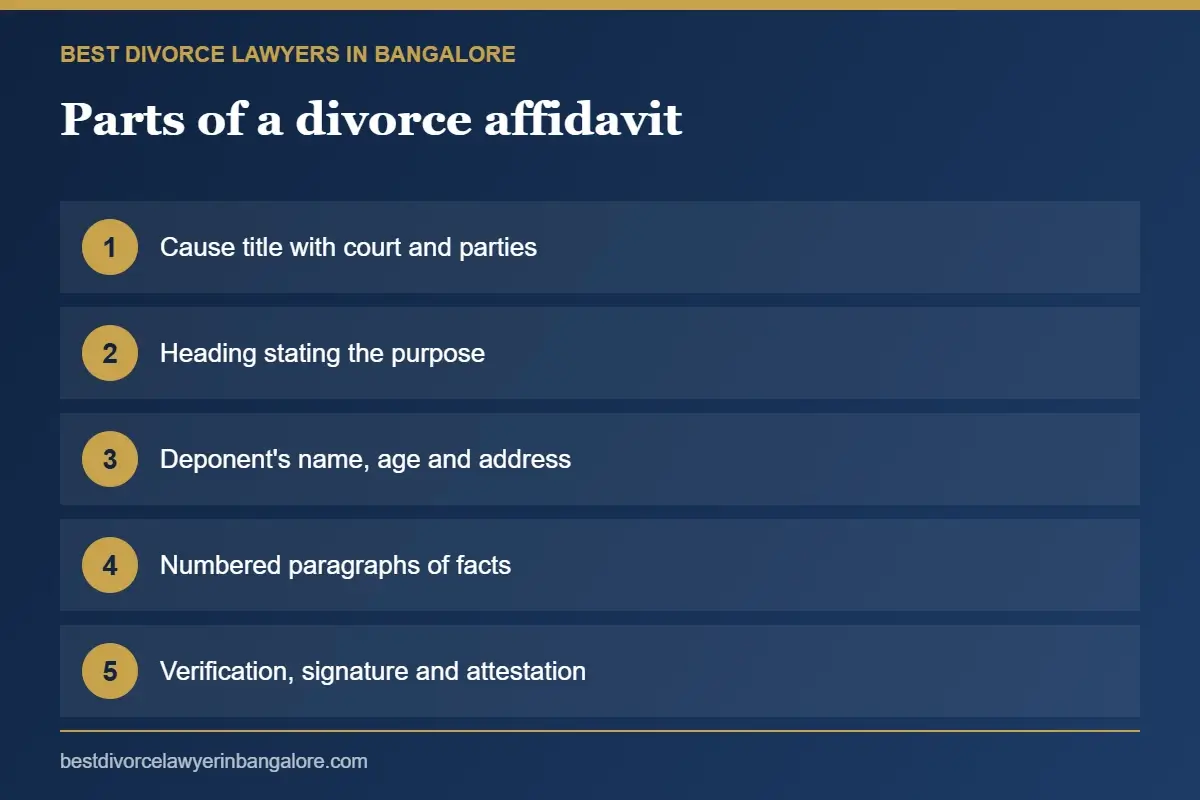
Family courts expect a familiar layout. A well-drafted affidavit has these parts:
- Cause title. The name of the court (for example, “Before the Principal Judge, Family Court, Bengaluru”), the case type and number if one has been allotted, and the names of the parties as petitioner and respondent.
- Heading. What the affidavit is, for example “Affidavit of the Petitioner in support of the petition under Section 13B of the Hindu Marriage Act, 1955”.
- Deponent’s details. Full name, parent’s or spouse’s name, age, occupation and residential address, followed by “do hereby solemnly affirm and state as follows”.
- Numbered paragraphs of facts. One fact or event per paragraph, in date order: marriage details, residence, children, separation, the grounds or the agreed terms, and the relief sought.
- Reference to documents. Mention each supporting document (marriage certificate, photos, bank statements) and its annexure or exhibit number.
- Verification. A clause stating which paragraphs are true to your own knowledge and which are based on information or belief, with the place and date.
- Signature and attestation. Signed by the deponent and attested by a notary public or an oath commissioner of the court.
Sample verification clause
“I, the above-named deponent, do hereby verify that the contents of paragraphs 1 to 12 of this affidavit are true and correct to the best of my knowledge, and that paragraphs 13 and 14 are based on information received and believed by me to be true. No part of it is false and nothing material has been concealed. Verified at Bengaluru on this __ day of ____, 20__.”
Treat this as an illustration only: wording varies with the court, the type of case and the personal law that applies, so your lawyer will adapt it.
Writing tips that make a real difference
- Stick to facts, not adjectives. “On 14 March 2025 the respondent left the matrimonial home at Jayanagar and has not returned” is far stronger than “the respondent cruelly abandoned me”.
- Be specific with dates and places. Vague allegations are easily attacked in cross-examination.
- Keep it consistent with your petition, police complaints, earlier affidavits and messages. Contradictions damage credibility.
- Disclose fully in financial affidavits: every account, investment, loan and source of income.
- Do not copy templates blindly. A template written for someone else’s facts is a common source of errors.
- Read every line before signing. You will be cross-examined on it, not your lawyer.
Notarisation, stamp paper and filing in Bangalore
Affidavits filed in the Bengaluru Family Courts near Lalbagh Main Gate are generally sworn before a notary or before the court’s oath commissioner. Whether non-judicial or e-stamp paper is needed, and of what value, depends on the type of affidavit and current Karnataka stamp rules, so confirm with your advocate or the court’s filing section. Bring original ID proof when you swear the affidavit, and keep a signed copy of everything you file.
Once sworn, the affidavit is filed with the petition or application and copies are served on the other side. For the full filing sequence, see our step-by-step guide on how to file for divorce in India, and for the bigger picture of each statute, our overview of divorce laws in India.
Responding to your spouse’s affidavit
When you receive the other side’s affidavit, do not panic at allegations you consider untrue. Go through it paragraph by paragraph and note what you admit, what you deny and what you do not know. Your reply affidavit or objection should deny specific false statements specifically, rather than with a single blanket denial, and should point to documents that contradict them. In maintenance cases, compare their disclosure with what you know of their bank accounts, property and lifestyle; gaps can be put to them in cross-examination or brought out by asking the court to direct production of documents.
Common mistakes to avoid
| Mistake | Why it hurts |
|---|---|
| Understating income or hiding assets | Adverse inference, higher maintenance, possible perjury proceedings |
| Exaggerated or unsupported allegations | Loss of credibility and possible counter-claims of cruelty |
| Mismatched dates or names across documents | Delays, objections and amendment applications |
| Missing verification or improper attestation | The registry may return the filing |
| Signing a spouse-drafted affidavit without legal advice | You may give away rights to alimony, streedhan or custody |
For a mutual consent divorce in particular, a mutual divorce lawyer in Bangalore can draft both spouses’ affidavits and the consent terms so that they match exactly.
How this guide was prepared
This guide is based on the bare acts published on India Code and on judgments of the Supreme Court of India and the Karnataka High Court. Section numbers, case citations and time limits were fact-checked in October 2026, and criminal-law references use the Bharatiya Nyaya Sanhita (BNS) and Bharatiya Nagarik Suraksha Sanhita (BNSS) in force since 1 July 2024. It is general information, not legal advice. For advice on your own case, speak to an advocate. Read our editorial standards and disclaimer.
Frequently Asked Questions
Can I write my own affidavit for divorce without a lawyer?
Yes, a party can draft and swear their own affidavit, and court staff will not refuse it for that reason. But because you will be bound by every statement in it, having a lawyer review it is strongly advisable.
Does a divorce affidavit need to be notarised?
It must be sworn or affirmed before an authorised officer, usually a notary public or the court’s oath commissioner. An unattested statement is not an affidavit.
Can an affidavit be corrected after filing?
Yes. If you find an error, file a further affidavit or an application explaining and correcting it at the earliest opportunity. Waiting until the other side points it out looks far worse.
Is an affidavit enough to get a divorce without going to court?
No. For most couples, including those married under the Hindu Marriage Act or the Special Marriage Act, a divorce can only be granted by a court decree. Even in a mutual consent divorce, both spouses must appear and confirm their consent before the family court.
How long should a divorce affidavit be?
As long as the facts require and no longer. A supporting affidavit may be two or three pages; an evidence affidavit in a contested case can run longer because it sets out the full history.
A carefully drafted affidavit can shorten a hearing; a careless one can follow you through the whole case. If you need help preparing yours, consult an experienced divorce lawyer in Bangalore before you sign.