Divorce under the Hindu Marriage Act, 1955 is available to Hindus, Buddhists, Jains and Sikhs either by mutual consent under Section 13B or on specific grounds under Section 13, and only a court decree can end the marriage. This guide explains who the Act covers, every ground for divorce, the mutual consent route, the one-year bar, and the related remedies of maintenance, custody and remarriage.
Who the Hindu Marriage Act applies to
Under Section 2, the Act applies to anyone who is a Hindu, Buddhist, Jain or Sikh by religion, including converts and reconverts, and to anyone domiciled in India who is not a Muslim, Christian, Parsi or Jew, unless they prove that a different law governs them. It does not apply to members of Scheduled Tribes unless the Central Government directs otherwise. If your marriage was registered under the Special Marriage Act, 1954, that Act governs your divorce instead. For how the Act fits alongside the other personal laws, see our overview of family laws in India, and you can read the full text of the Act on India Code.
Remedies the Act offers for a troubled marriage
Divorce is only one of several remedies the Act provides. Knowing the others helps you choose the right petition.
| Section | Remedy | Effect |
|---|---|---|
| 9 | Restitution of conjugal rights | Court directs a spouse who left without reasonable excuse to return |
| 10 | Judicial separation | Spouses no longer obliged to cohabit, but remain married |
| 11 | Void marriage | Marriage treated as never valid (e.g. bigamy, prohibited relationship) |
| 12 | Voidable marriage (annulment) | Marriage annulled for impotence, fraud, force or pre-marriage pregnancy by another |
| 13 | Contested divorce | Marriage dissolved on a proved ground |
| 13B | Mutual consent divorce | Marriage dissolved on joint petition |
If you are unsure whether separation or annulment suits you better, our comparisons of judicial separation vs divorce and between annulment and divorce set out the differences.
Grounds for divorce under the Hindu Marriage Act (Section 13)
Grounds available to either spouse: Section 13(1)
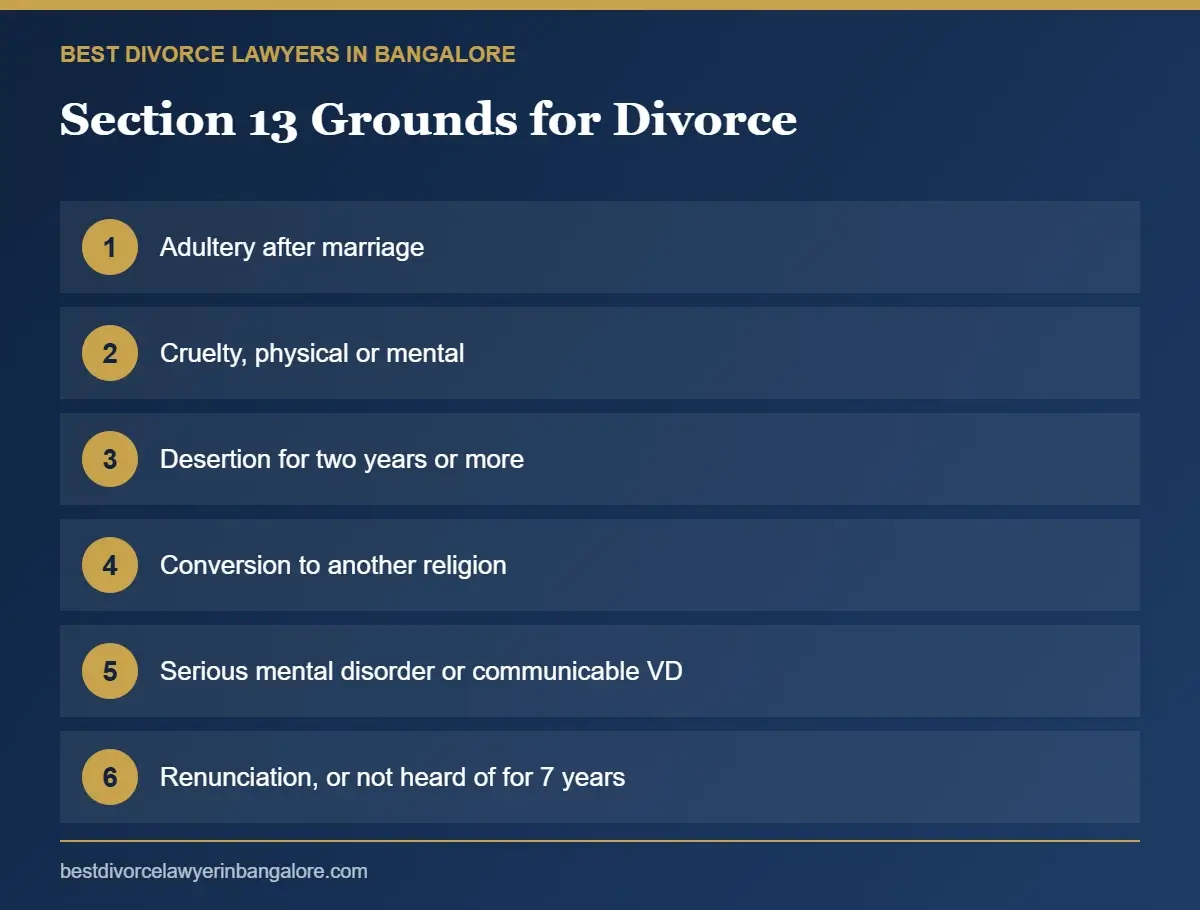
- Adultery: voluntary sexual intercourse with someone other than the spouse after marriage. It is no longer a crime after the Supreme Court’s 2018 decision in Joseph Shine v. Union of India, but it remains a ground for divorce.
- Cruelty: physical or mental conduct that makes it unreasonable to expect the petitioner to live with the respondent. This is the most commonly pleaded ground.
- Desertion: leaving the petitioner without reasonable cause and without consent for a continuous period of at least two years immediately before the petition.
- Conversion: the respondent has ceased to be a Hindu by converting to another religion.
- Mental disorder: incurable unsoundness of mind, or a mental disorder of such a kind and degree that the petitioner cannot reasonably be expected to live with the respondent.
- Venereal disease: suffering from venereal disease in a communicable form.
- Renunciation: renouncing the world by entering a religious order.
- Presumed death: not heard of as alive for seven years or more by those who would naturally have heard.
Leprosy was once a ground, but it was removed by the Personal Laws (Amendment) Act, 2019. Each ground has its own proof requirements, explained in our detailed guide to grounds for divorce in India.
Ground after a failed separation or restitution decree: Section 13(1A)
Either spouse can seek divorce if there has been no resumption of cohabitation for one year or more after a decree of judicial separation, or no restitution of conjugal rights for one year or more after a restitution decree. This applies even to the spouse against whom the earlier decree was passed.
Additional grounds for the wife: Section 13(2)
- The husband had another wife living from a marriage before the Act came into force.
- The husband has, since the marriage, been guilty of rape, sodomy or bestiality.
- A maintenance decree or order was passed in her favour and cohabitation has not resumed for one year or more since.
- She was married before the age of fifteen and repudiated the marriage after turning fifteen but before eighteen (the option of puberty).
Mutual consent divorce under Section 13B
Where both spouses agree, they can file a joint petition stating that they have lived separately for one year or more, that they have not been able to live together, and that they have mutually agreed to dissolve the marriage. “Living separately” means not living as husband and wife, so it can apply even if you were under the same roof. The court records the first motion and, on a second motion made between six and eighteen months after filing, passes the decree if it is satisfied that consent is genuine and the averments are true.
In Amardeep Singh v. Harveen Kaur (2017), the Supreme Court held that the six-month waiting period is directory, not mandatory, and can be waived where the parties have already been separated for a long time, mediation has failed, and all issues are settled. Consent must still exist on the day of the decree, so either spouse can withdraw it before then. For a side-by-side view of both routes, read mutual divorce vs contested divorce.
The one-year bar under Section 14
No divorce petition can be presented within one year of the date of marriage unless the High Court’s rules permit it and the court allows it on the ground of exceptional hardship to the petitioner or exceptional depravity on the part of the respondent. Courts treat this as a real safeguard, so an early filing needs a strong, well-documented application. If leave was obtained by misrepresentation, the court can postpone the decree’s effect or dismiss the petition.
What the court must be satisfied of: Section 23
Even a proved ground does not guarantee a decree. Under Section 23 the court must be satisfied that the petitioner is not taking advantage of their own wrong, has not condoned or connived at the conduct complained of (in cruelty and adultery cases), that the petition is not collusive, and that there has been no unnecessary or improper delay. The court must also try to reconcile the parties where that is consistent with the nature of the case. In practice, the Family Court will usually refer the couple to counselling or mediation, where many cases settle.
Where to file and how the case runs
Section 19 lets you file in the District Court, or the Family Court where one has been set up, where the marriage was solemnised, where the respondent lives, where the parties last lived together, or where the wife lives if she is the petitioner. In Bengaluru, these cases go to the Family Courts near Lalbagh Main Gate on Siddaiah Road. Section 21B encourages trials to proceed day to day and to conclude within six months of service of notice, though busy courts often take longer.
Maintenance, custody and property under the Act
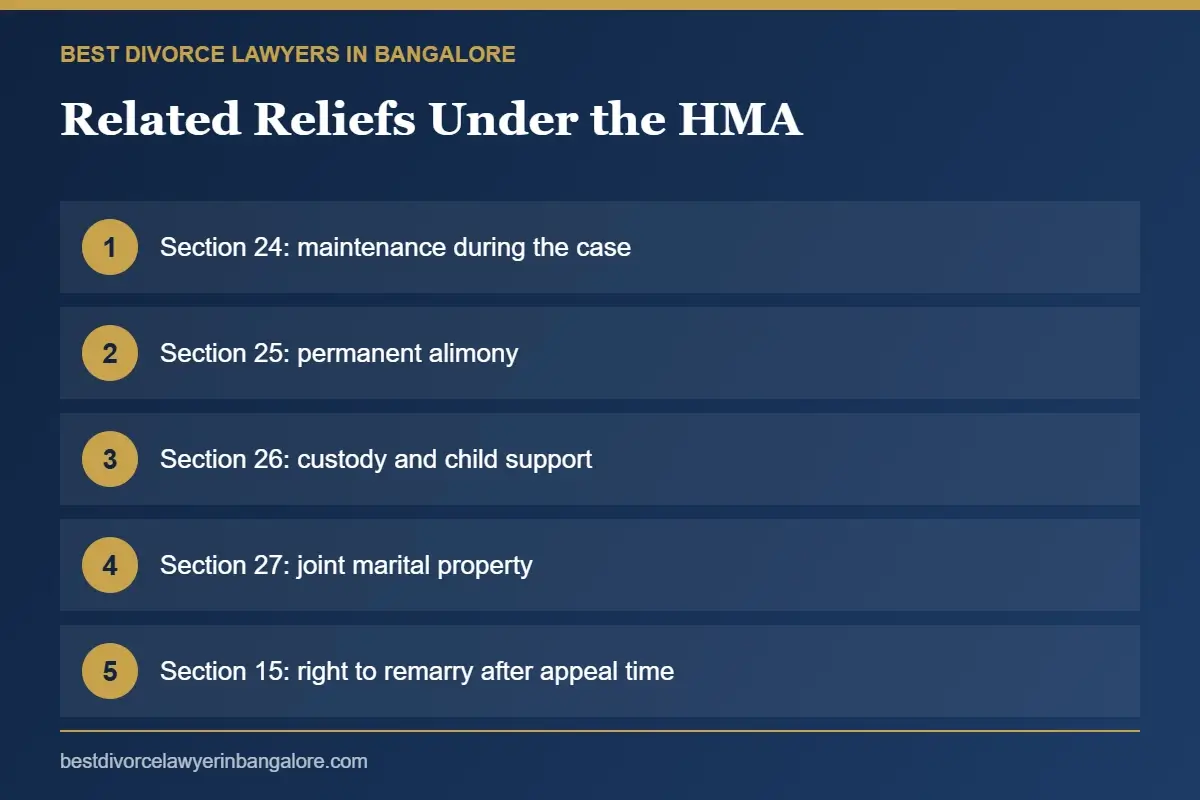
- Section 24: maintenance and litigation expenses while the case is pending, for a spouse without sufficient independent income. Either spouse can claim it.
- Section 25: permanent alimony at the time of the decree or later, as a lump sum or periodic payments, which the court can vary or cancel if circumstances change. See our guide to alimony in India.
- Section 26: interim and final orders on custody, maintenance and education of minor children, guided by the child’s welfare.
- Section 27: disposal of property presented at or about the time of the marriage that belongs jointly to both spouses.
A wife can also claim maintenance under Section 144 of the Bharatiya Nagarik Suraksha Sanhita, 2023 (formerly Section 125 CrPC) and relief under the Protection of Women from Domestic Violence Act, 2005. Cruelty by a husband or his relatives is separately an offence under Sections 85 and 86 of the Bharatiya Nyaya Sanhita, 2023, which replaced Section 498A IPC.
Irretrievable breakdown and remarriage
Irretrievable breakdown of marriage is not a ground under the Act, so a Family Court cannot grant divorce on that basis alone. In Shilpa Sailesh v. Varun Sreenivasan (2023), a Constitution Bench held that the Supreme Court itself can dissolve a marriage that has irretrievably broken down using its special power under Article 142 of the Constitution. That power belongs only to the Supreme Court.
Under Section 15, once a decree of divorce is passed and the time for appeal has expired without an appeal, or an appeal has been dismissed, either party may lawfully remarry. Marrying before then risks the second marriage being challenged.
How this guide was prepared
This guide is based on the bare acts published on India Code and on judgments of the Supreme Court of India and the Karnataka High Court. Section numbers, case citations and time limits were fact-checked in October 2026, and criminal-law references use the Bharatiya Nyaya Sanhita (BNS) and Bharatiya Nagarik Suraksha Sanhita (BNSS) in force since 1 July 2024. It is general information, not legal advice. For advice on your own case, speak to an advocate. Read our editorial standards and disclaimer.
Frequently Asked Questions
Does the Hindu Marriage Act apply if my marriage was in a temple but not registered?
Yes. A Hindu marriage is valid if the customary ceremonies, such as saptapadi where applicable, were performed. Registration is only evidence. The Act applies to your divorce, and you can prove the marriage with photographs, invitations and witnesses.
Can a Hindu couple get divorced in a foreign court?
A foreign divorce decree may not be recognised in India unless it was granted on a ground available under the Hindu Marriage Act and the respondent properly submitted to that court’s jurisdiction. NRIs should take advice before relying on a foreign decree, especially before remarrying.
Can a husband claim maintenance under the Hindu Marriage Act?
Yes. Sections 24 and 25 are gender-neutral. A husband with no sufficient independent income can claim maintenance during the case and permanent alimony, although such claims are less common and depend on the facts.
Is a divorce by customary practice valid for Hindus?
Section 29(2) preserves divorce rights recognised by custom or special enactment. A customary divorce is valid only if the custom is proved to be ancient, certain and reasonable for that community, which is difficult, so most people seek a court decree.
Can I file for divorce on the ground of cruelty if I have no witnesses?
Yes. Cruelty is often proved through your own testimony, supported by messages, emails, medical records, police complaints or the respondent’s own conduct during the case. Consistency and documentary support matter more than the number of witnesses.
The Hindu Marriage Act gives you several routes, and choosing the right ground and remedy at the start can save years. To discuss your options, speak to an experienced divorce lawyer in Bangalore, or, if your spouse is opposing the divorce, consult our contested divorce lawyers in Bangalore.