If you need the best child custody lawyer in Bangalore, the four advocates below handle custody, guardianship and visitation cases at the Bengaluru Family Court every week. Call or book a free first consultation and get a clear plan for your child’s case, often the same day.
4 advocates · 20+ years’ experience · 2 women advocates · Free first consultation
Top Child Custody Lawyers in Bangalore

Advocate Varun Papireddy – Child Custody Lawyer in Bangalore (20+ Years)
- Name: Advocate Varun Papireddy
- Experience: 20+ years
- Specialisation: Mutual and contested divorce, cruelty and domestic violence cases, child custody
- Known for: Careful case preparation and strong courtroom advocacy

Advocate Kiran Kumar B.M – Child Custody Advocate in Bangalore (20+ Years)
- Name: Advocate Kiran Kumar B.M
- Experience: 20+ years
- Specialisation: Mutual and contested divorce, domestic violence, child custody, matrimonial property
- Known for: Discreet handling of complex disputes for both men and women

Advocate Poojashree – Female Child Custody Lawyer in Bangalore
- Name: Advocate Poojashree
- Specialisation: Mutual and contested divorce, domestic violence, child custody, women’s rights
- Known for: A safe, respectful space where women can speak openly

Advocate Esther Balakrishna – Lady Divorce & Family Lawyer in Bangalore
- Name: Advocate Esther Balakrishna
- Specialisation: Divorce, matrimonial disputes and other family law matters
- Known for: Protecting clients’ rights at every stage of the case
When you need a child custody lawyer
Custody is rarely the only issue in a family dispute, but it is usually the one parents care about most. Speak to a custody lawyer early if:
- You and your spouse have separated and cannot agree where the children will live.
- Your spouse has taken the child to another city, state or country, or is refusing to let you meet the child.
- A divorce petition has been filed and you need interim custody or visitation while it is pending.
- An existing custody or visitation order is not being followed, or circumstances have changed (a move, a new job, a child’s schooling or health).
- You are agreeing custody as part of a mutual divorce and want the terms drafted so they actually work.
- You are a grandparent or relative seeking guardianship because the parents cannot care for the child.
Child custody law in India: the provisions that decide your case
Custody in Bengaluru is decided under a small set of central laws. A good lawyer will tell you early which of them applies to your family and which court has jurisdiction.
Guardians and Wards Act, 1890
The Guardians and Wards Act applies to every community, whatever the religion. A petition is filed where the child “ordinarily resides” (s.9), so if your child lives in Bengaluru, the Bengaluru Family Court will usually hear it. Section 17 tells the court to be guided by the welfare of the minor, and lets it consider the child’s own preference if the child is old enough to form an intelligent one. Section 25 allows the court to order a child’s return to the guardian’s custody.
Hindu Minority and Guardianship Act, 1956, section 6
For Hindus (including Sikhs, Jains and Buddhists), s.6 names the father and then the mother as natural guardians. The Supreme Court in Gita Hariharan v. Reserve Bank of India (1999) read this so that the mother is also a natural guardian in her own right, not merely after the father. The proviso to s.6 says custody of a child under five years should ordinarily be with the mother, and s.13 makes the child’s welfare the paramount consideration.
Custody within a divorce case
If a divorce or other matrimonial case is pending, custody can be decided in the same proceedings under s.26 of the Hindu Marriage Act or s.38 of the Special Marriage Act. The court can pass interim orders about custody, maintenance and education of the children, and vary them later. If you are still deciding on the divorce itself, walk through the divorce process in Bangalore before you file.
The welfare of the child comes first
Indian courts repeatedly hold that a custody case is not a contest between parents but an inquiry into what is best for the child (for example, Gaurav Nagpal v. Sumedha Nagpal, 2009). Judges look at the child’s age, emotional bonds, schooling, health, stability of each home, each parent’s availability, and any history of violence or neglect. A higher income helps, but it does not decide custody on its own.
Types of custody and visitation
- Physical custody: where the child lives day to day.
- Legal custody or guardianship: who takes major decisions on education, health and travel.
- Joint or shared custody: both parents share time and decisions under a schedule; courts increasingly consider this where parents can cooperate.
- Visitation: the non-custodial parent’s time with the child, such as weekends, holidays and video calls. In Yashita Sahu v. State of Rajasthan (2020) the Supreme Court stressed that a child is entitled to the love of both parents and approved video-call contact alongside physical visits.
Interim custody
A full custody trial takes time, so most cases begin with an application for interim custody or interim visitation. These orders decide where the child lives and when the other parent meets the child while the case runs. They are temporary, but they shape the child’s routine, so they deserve as much preparation as the final hearing.
Step-by-step: a custody case at the Bengaluru Family Court
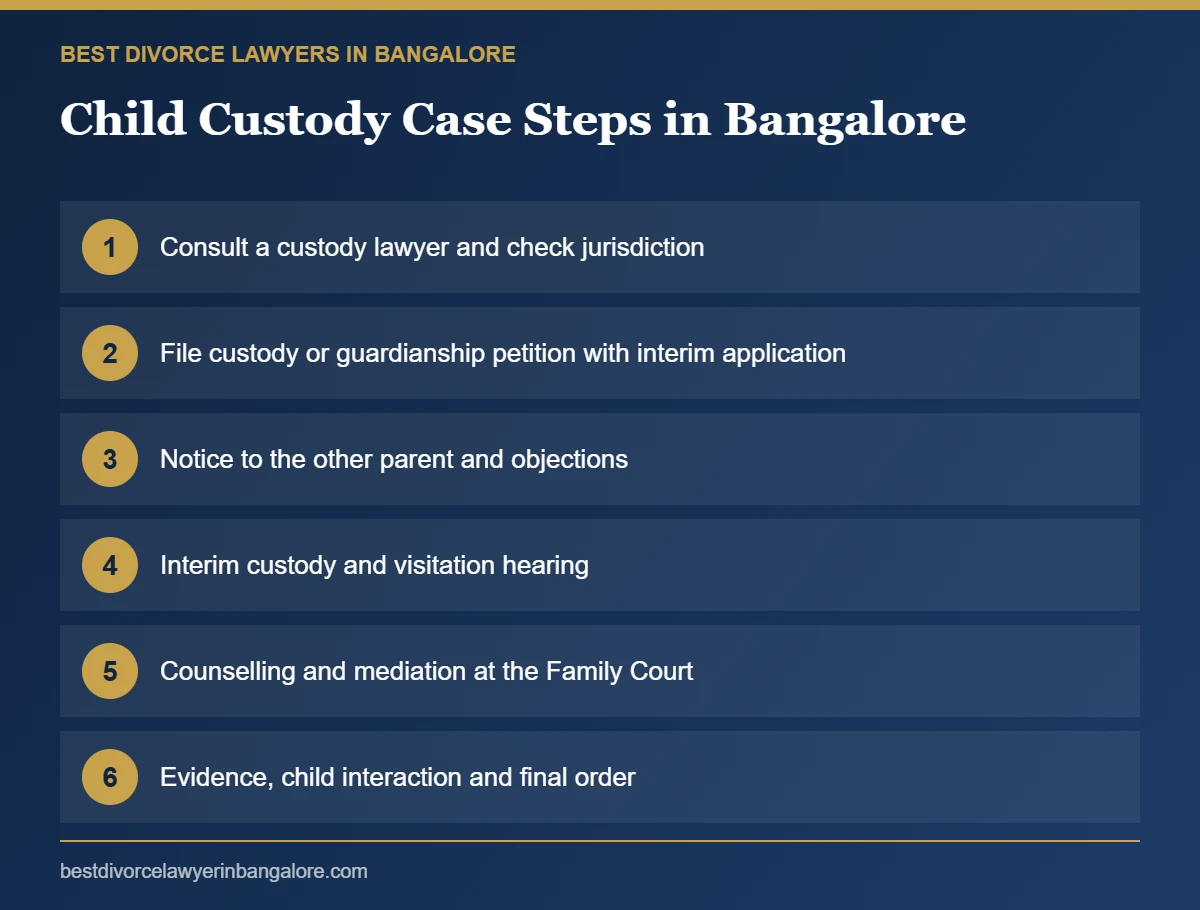
Custody, guardianship and visitation petitions in the city are heard by the Family Courts on Siddaiah Road, near Lalbagh Main Gate. A typical case moves like this:
- Consultation and strategy. Your lawyer checks jurisdiction, the applicable law, and whether custody should be claimed in a pending divorce case or in a separate guardianship petition.
- Drafting and filing. The petition sets out the child’s details, current living arrangement, your proposed parenting plan and the reasons it serves the child’s welfare. An application for interim custody or visitation is usually filed with it.
- Notice to the other parent. The court issues summons, and the other side files objections or a counter-petition.
- Interim hearing. The court decides where the child stays and how contact works while the case is pending.
- Counselling and mediation. Family Courts must try to settle disputes, so the parents are usually referred to the court’s counsellors or mediation centre. Many custody cases end here with an agreed parenting plan.
- Interaction with the child. Judges often speak to older children in chambers to understand their wishes, away from both parents.
- Evidence and arguments. If there is no settlement, each side files affidavits, documents and witnesses, followed by cross-examination and final arguments.
- Order and appeal. The court passes the final custody and visitation order. An appeal lies to the Karnataka High Court; the limitation period is 30 days under the Family Courts Act or up to 90 days under s.28 of the Hindu Marriage Act depending on the provision applied, so act quickly and confirm the deadline with your lawyer.
Documents to prepare
- Child’s birth certificate and recent photographs.
- Marriage certificate or proof of marriage, and copies of any pending divorce or DV case papers.
- School records: admission papers, report cards, attendance, fee receipts and any teacher communication.
- Medical records, vaccination cards and details of any special needs.
- Proof of your income, job and working hours, plus your address proof and a description of the home and childcare support available.
- Evidence of your involvement in the child’s life: photos, messages, school pickups, bills you have paid.
- Any evidence of risk from the other parent, such as police complaints, medical reports or threatening messages.
- Passport copies, if travel or relocation abroad is an issue.
How long a custody case takes in Bangalore
Every case is different and court workloads change, so treat these as rough ranges rather than promises.
| Stage | Typical time (approximate) |
|---|---|
| Interim custody or visitation order | A few weeks to a few months from filing |
| Counselling and mediation | 1 to 3 months |
| Agreed custody inside a mutual divorce | Decided along with the divorce decree |
| Contested custody trial to final order | Often 1 to 3 years |
| Modification of an existing order | Several months, depending on opposition |
Worried about your child’s custody?
Talk to a Bangalore custody advocate today. The first consultation is free and the desk is open 24/7.
Child custody lawyer fees in Bangalore
There is no fixed fee scale. What you pay depends on the advocate’s experience, whether custody is agreed or contested, how many hearings are needed, and whether there are linked cases such as divorce, maintenance or domestic violence. Many advocates quote a fixed fee per stage or for the whole case; an agreed custody arrangement inside a mutual divorce generally costs far less than a contested trial with evidence. Court fees in Karnataka for these petitions are modest compared to professional fees. Ask for a written fee estimate at your free first consultation so there are no surprises.
What a good custody lawyer does for you
- Gets interim arrangements in place quickly so your child’s routine is protected.
- Builds a practical parenting plan the judge can see is workable, covering school, holidays, festivals, travel and video calls.
- Prepares you for counselling, mediation and the judge’s interaction with your child.
- Gathers the right evidence and keeps the case focused on welfare, not blame.
- Coordinates custody with your divorce, alimony and maintenance and any domestic violence proceedings.
- Moves quickly for enforcement if a visitation or custody order is ignored.
How to choose the best child custody lawyer in Bangalore
- Check Karnataka State Bar Council enrolment.
- Ask how many custody and guardianship cases they have handled at the Bengaluru Family Court.
- Make sure they explain the realistic outcomes, not just what you want to hear.
- Prefer someone who encourages settlement where possible but is ready for trial if needed.
- Ask who will appear at each hearing and how you will get updates.
- Get the fee structure in writing.
- If you are a mother who would feel more comfortable with a woman advocate, ask for one. You can also compare all divorce lawyers in Bangalore before deciding.
Helpful guide: read our complete guide to child custody laws in India, covering the types of custody, how courts decide and the process in Bangalore.
Frequently Asked Questions
Can a father get custody of a child in Bangalore?
Yes. There is no rule that custody always goes to the mother. The proviso to s.6 of the Hindu Minority and Guardianship Act says a child under five should ordinarily be with the mother, but beyond that the court decides on the child’s welfare. Fathers who show stable care, involvement in schooling and a workable parenting plan do obtain custody or substantial shared parenting time.
At what age can a child choose which parent to live with?
There is no fixed age in Indian law. Under s.17(3) of the Guardians and Wards Act, the court may consider the preference of a child who is old enough to form an intelligent one. Judges in Bengaluru often speak to older children privately, but the final decision still rests on the child’s overall welfare.
Can I get custody without filing for divorce?
Yes. You can file a guardianship and custody petition under the Guardians and Wards Act while you are separated but still married. If a divorce case is already pending, custody is usually sought in that case instead.
Can I stop my spouse from taking our child out of India?
You can apply to the Family Court for an order restraining removal of the child from its jurisdiction, and in suitable cases the court can direct that the child’s passport be deposited. Act quickly if you fear relocation, because it is far harder to bring a child back once they have left India.
What if my spouse ignores the visitation order?
Your lawyer can file for execution of the order, seek a stricter or supervised schedule, or ask the court to reconsider custody. Repeated disobedience of court orders is taken seriously and can affect the outcome of the main case.
Can a custody order be changed later?
Yes. Custody orders are made for the child’s welfare and can be modified if circumstances change, for example a relocation, a change in the child’s schooling or health, or a parent’s failure to follow the order.
Get the right custody lawyer for your child
Speak to an experienced Bangalore child custody advocate now. Free first consultation, 24/7 desk.
Book your free consultation
Call this number to book a free consultation. Our appointment desk answers 24/7 and will confirm a time that suits you.