There is no fixed formula or percentage for calculating alimony in India. Courts work out a fair amount from the facts: both spouses’ income, assets and liabilities, the claimant’s reasonable needs, the standard of living during the marriage, its length, age and health, responsibilities for children, and the paying spouse’s real capacity to pay. In Kalyan Dey Chowdhury v. Rita Dey Chowdhury (2017), the Supreme Court treated about 25% of the husband’s net salary as a reasonable benchmark for monthly maintenance, but that is a guide, not a rule, and lump-sum settlements are assessed differently.
Alimony and maintenance: the basics
Alimony, also called spousal maintenance, is financial support one spouse pays the other during or after matrimonial proceedings. It can be interim (while the case is pending), permanent (at or after the decree), monthly, or a one-time lump sum. Its purpose is to prevent a financially weaker spouse from being left without reasonable support, not to punish the paying spouse. Our hub on alimony laws in India explains the different types.
Is there a fixed percentage for alimony?
No. No statute fixes alimony as a share of salary. The popular belief that a wife always gets a third or a quarter of her husband’s income is an oversimplification. Courts sometimes use rough benchmarks: in Kalyan Dey Chowdhury (2017), the Supreme Court said 25% of the husband’s net salary would be just and proper for maintenance in that case. But every award depends on the evidence, and courts can go higher or lower. For a one-time settlement, courts look at the overall financial picture rather than a monthly percentage.
Factors courts use to calculate alimony
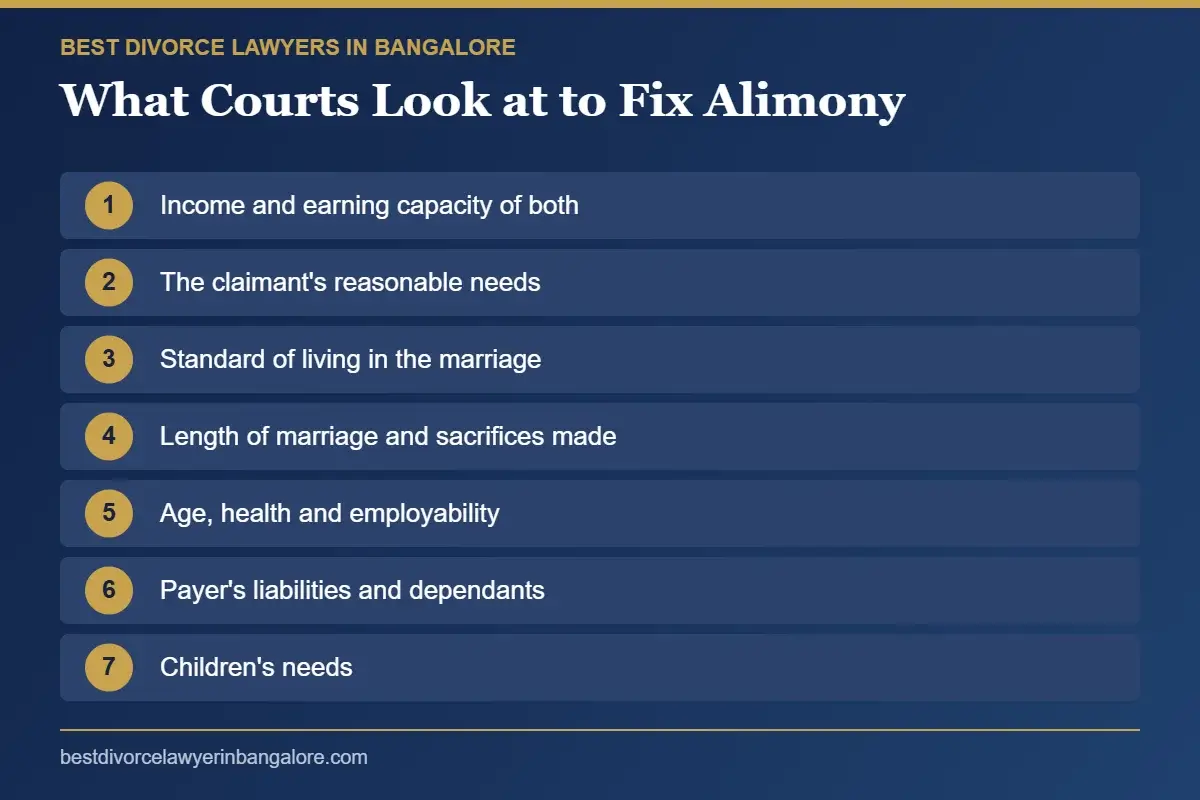
In Rajnesh v. Neha (2020), the Supreme Court set out the main factors for maintenance, and in Praveen Kumar Jain v. Anju Jain (2024) it summarised the considerations for permanent alimony. Together, they cover:
Income and earning capacity of both spouses
Salary, business profits, rent, interest, dividends and other resources count, and so does the ability to earn. Courts look at net income after statutory deductions such as income tax and provident fund, but not voluntary deductions like optional loan repayments made to reduce take-home pay.
The claimant’s reasonable needs
Housing, food, clothing, healthcare, transport and other ordinary expenses. In a city like Bengaluru, rent is often the biggest single factor, and courts take local living costs into account.
Standard of living during the marriage
A spouse should be able to live in reasonable comfort, broadly consistent with the lifestyle of the marital home, so far as the paying spouse’s means allow.
Length of the marriage and sacrifices made
Long marriages often involve financial interdependence and career sacrifices, such as a spouse giving up work to raise children or care for family. Courts recognise this when assessing what is fair.
Age, health and employability
Medical needs, disability and how realistic it is for the claimant to find work at their age and qualification level all matter.
The paying spouse’s obligations
Courts consider the payer’s reasonable expenses, dependants such as elderly parents or children from another marriage, and genuine liabilities. Maintenance must be affordable to be effective.
Children’s needs
Children’s education, health and living costs are assessed alongside spousal maintenance, though they are a separate entitlement of the child.
Conduct and other circumstances
Section 25 of the Hindu Marriage Act, 1955 allows the court to consider the conduct of the parties and other circumstances of the case.
A simple worked example
Suppose a husband in Bengaluru has a net monthly income of ₹1,60,000 and the wife earns nothing, with a child living with her. A court might consider her rent for a modest flat near the child’s school, household and medical expenses, the child’s school fees, and the husband’s own rent and EMI. Applying the 25% benchmark as a starting point gives about ₹40,000 for the wife, with a separate amount for the child, then adjusted up or down based on actual needs and his genuine liabilities. This is only an illustration: real awards depend entirely on the evidence each side produces.
What if the spouse seeking alimony is employed?
Employment does not automatically end a claim. The question is whether the claimant’s income is enough to maintain them at a reasonable standard. A wife earning ₹30,000 a month whose husband earns ₹3,00,000 may still receive maintenance. In Shailja v. Khobbanna (2018), the Supreme Court held that a wife being merely capable of earning is not a reason to reduce her maintenance. On the other hand, a spouse with a substantial income or assets may get little or nothing.
Which laws govern alimony?
- Hindu Marriage Act, 1955: Section 24 (interim maintenance and litigation expenses) and Section 25 (permanent alimony), both available to either spouse.
- Special Marriage Act, 1954: Sections 36 and 37.
- Divorce Act, 1869: Sections 36 and 37 for Christian marriages.
- Bharatiya Nagarik Suraksha Sanhita, 2023, Section 144: maintenance for wives (including divorced wives who have not remarried), children and parents, replacing Section 125 CrPC from 1 July 2024.
- Hindu Adoptions and Maintenance Act, 1956, Section 18 and the Protection of Women from Domestic Violence Act, 2005, Section 20.
- Muslim Women (Protection of Rights on Divorce) Act, 1986 for divorced Muslim women, alongside Section 144 BNSS.
Where claims are made under more than one law, Rajnesh v. Neha requires the earlier award to be disclosed and taken into account, so the same need is not paid for twice.
Financial disclosure is mandatory
Since Rajnesh v. Neha, both spouses in every maintenance case must file a detailed affidavit disclosing their income, assets, liabilities and expenses. Courts can draw adverse conclusions from concealment. Prepare:
- Salary slips, Form 16 and income-tax returns for the last three years
- Bank statements and investment statements
- Property documents and loan statements
- Rent agreement and utility bills
- Medical bills and children’s school fee receipts
From when is maintenance payable?
Rajnesh v. Neha held that maintenance is payable from the date the application was filed, not from the date of the order, which avoids penalising the claimant for court delays.
How this guide was prepared
This guide is based on the bare acts published on India Code and on judgments of the Supreme Court of India and the Karnataka High Court. Section numbers, case citations and time limits were fact-checked in November 2026, and criminal-law references use the Bharatiya Nyaya Sanhita (BNS) and Bharatiya Nagarik Suraksha Sanhita (BNSS) in force since 1 July 2024. It is general information, not legal advice. For advice on your own case, speak to an advocate. Read our editorial standards and disclaimer.
Frequently Asked Questions
Is alimony 25 percent of the husband’s salary?
Not as a rule. In Kalyan Dey Chowdhury (2017) the Supreme Court treated 25 percent of net salary as a reasonable benchmark in that case, but courts decide each case on its facts and can award more or less.
Do courts use gross or net salary to calculate maintenance?
Courts generally look at net income after statutory deductions such as tax and provident fund, but voluntary deductions made to reduce take-home pay are usually not allowed.
Do I have to disclose my assets in a maintenance case?
Yes. Since Rajnesh v. Neha (2020), both spouses must file an affidavit disclosing their income, assets, liabilities and expenses. Concealment can lead to adverse findings.
Is child maintenance included in alimony?
No. Child maintenance is the child’s separate right. Courts usually fix it separately from the spouse’s maintenance.
Speak to an alimony lawyer in Bangalore
Alimony in India is a fact-based assessment, not a calculator output. Income, reasonable needs, earning capacity, the length of the marriage, health and responsibilities all shape the final figure, and accurate financial records are the single biggest factor in a fair result. For advice on your own case, consult an experienced alimony lawyer in Bangalore, or compare the top divorce lawyers in Bangalore on our list. The first consultation is free.