An ex parte divorce in India is a divorce decree passed by the court after hearing only the petitioner, because the other spouse did not appear despite being properly served with notice. It is not a separate type or ground of divorce: the petitioner still has to prove a legal ground such as cruelty or desertion, but without opposition. This guide explains when Family Courts in Bangalore proceed ex parte, what the petitioner must show, and how the absent spouse can challenge the decree.
What Is an Ex Parte Divorce in India?
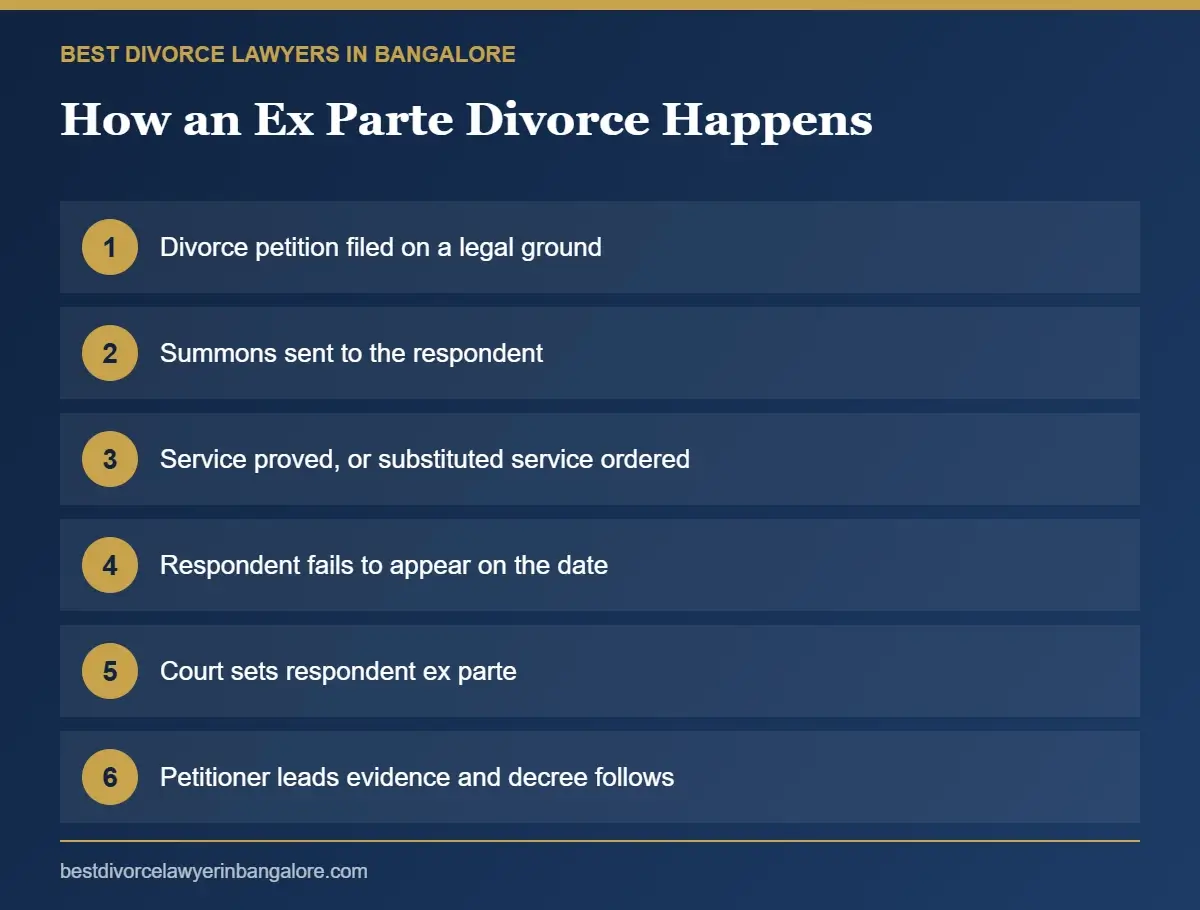
“Ex parte” is Latin for “from one side”. Family Courts follow the Code of Civil Procedure, 1908 (CPC) for procedure. Under Order IX Rule 6 of the CPC, if the plaintiff appears and the defendant does not, and the court is satisfied that the summons was duly served, it can proceed to hear the case ex parte. In a divorce, this means the petition goes ahead in the absence of the respondent spouse.
An ex parte decree is as valid as any other decree once it becomes final. But because one side was never heard, the law gives the absent spouse specific ways to have it set aside, discussed below.
It is not a shortcut or a separate ground
A common misunderstanding is that you can “apply for ex parte divorce”. You cannot. You file an ordinary contested petition on a ground recognised by your personal law, explained in our guide to the grounds for divorce in India. Whether the case ends up ex parte depends entirely on what the respondent does after notice. In that sense, an ex parte divorce is simply a one sided divorce in India in which the other side chose not to take part.
When Does a Court Proceed Ex Parte?
The court must first be satisfied about service. Typical situations include:
- The respondent received the summons, by court process or registered post, but did not appear on the date fixed.
- The respondent refused to accept the summons, which courts usually treat as good service.
- Ordinary service failed because the respondent was evading it, and the court ordered substituted service under Order V Rule 20, for example by affixing notice at the last known address or a newspaper publication, and the respondent still did not come.
- The respondent appeared initially but stopped attending, and the court proceeded ex parte from that stage.
Courts are careful here. If service is doubtful, the judge will usually order fresh notice rather than risk a decree that will later be set aside.
What the Petitioner Must Still Prove
An absent respondent does not mean an automatic decree. The petitioner files an affidavit of evidence, produces documents and, where needed, examines witnesses. The court checks that the facts actually make out the ground claimed, for example that the separation really has lasted two continuous years for desertion, or that the incidents described amount to cruelty in law. Section 23 of the Hindu Marriage Act also requires the court to be satisfied that there is no collusion and that the petitioner is not taking advantage of their own wrong.
Practical points for petitioners in Bangalore:
- Give the respondent’s correct, current address. Using a wrong address to secure an ex parte decree invites it being set aside, and may expose you to further legal consequences.
- Keep the postal receipts and tracking records, and the newspaper copy if publication was ordered.
- Prepare your evidence as carefully as in a fully contested trial.
How Long Does an Ex Parte Divorce Take?
Ex parte cases are often quicker than fully contested ones, because there is no written statement, no cross-examination of the petitioner and fewer interim disputes. The main delays tend to be at the service stage, especially when the respondent lives in another state or abroad. Once the respondent is set ex parte, the evidence and judgment stages can often move within months rather than years, depending on the court’s calendar. The Family Courts for Bangalore Urban, near Lalbagh Main Gate on Siddaiah Road, have heavy dockets, so no fixed timeline can be promised.
Can the Absent Spouse Still Join the Case?
Yes. If the respondent turns up before the decree and shows good cause for the earlier absence, the court may allow them to participate from that stage under Order IX Rule 7 of the CPC, sometimes on payment of costs. The case then proceeds as a contested matter.
How an Ex Parte Divorce Decree Can Be Challenged
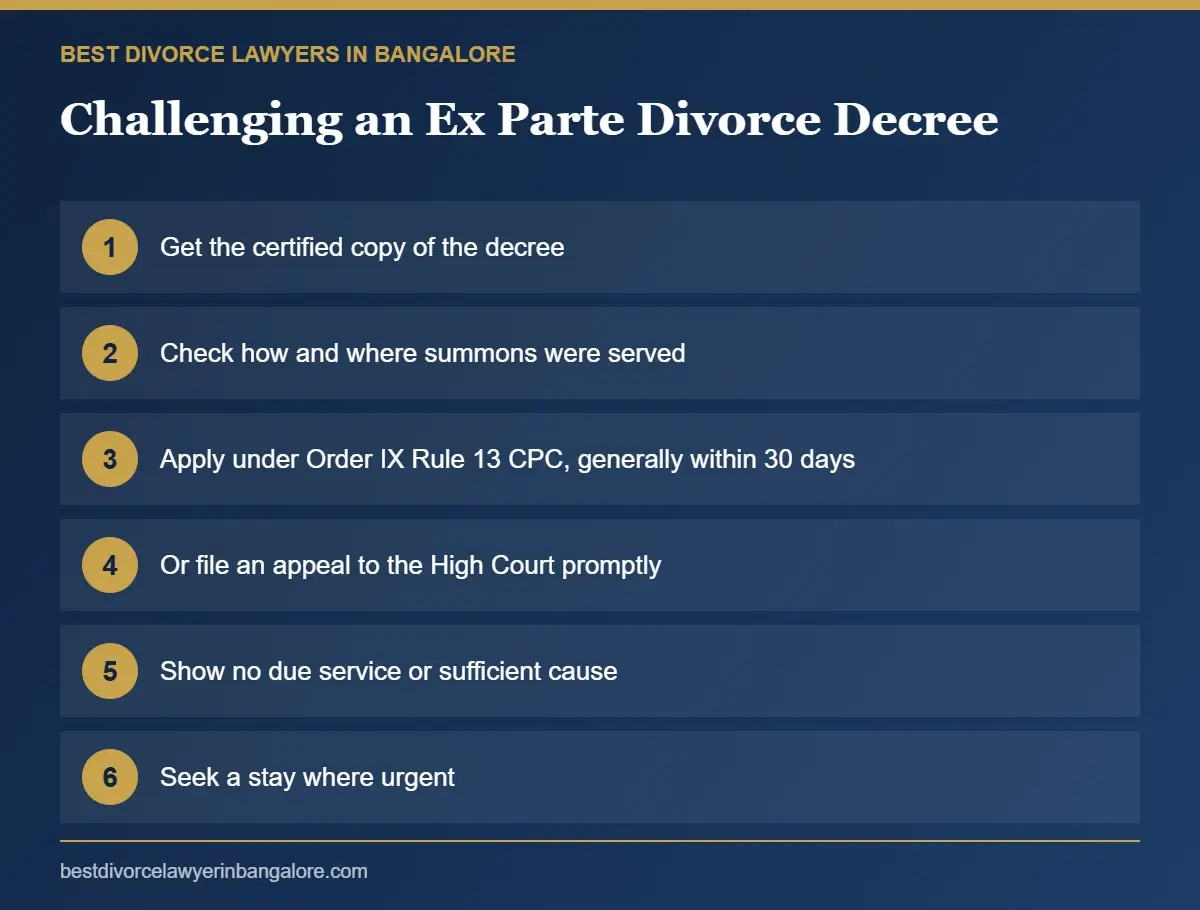
A spouse who learns that a divorce was granted in their absence has two main remedies:
| Remedy | Where | Time limit | What you must show |
|---|---|---|---|
| Application to set aside under Order IX Rule 13 CPC | The same Family Court | 30 days from the decree, or, if summons was not duly served, from when you learned of it (Article 123, Limitation Act, 1963) | Summons was not duly served, or you were prevented by sufficient cause from appearing |
| Appeal | The High Court (for Bangalore, the Karnataka High Court) | Section 28 of the Hindu Marriage Act allows 90 days, but Section 19 of the Family Courts Act sets 30 days and High Courts have differed on which applies, so file as early as possible | The decree is wrong on facts or law |
A delay application under Section 5 of the Limitation Act can be filed if you are outside the time limit, but courts expect a genuine explanation. Mere irregularity in service is not enough if you in fact had notice and time to appear.
Remarriage After an Ex Parte Decree
Under Section 15 of the Hindu Marriage Act, a divorced person may remarry once the time for appeal has expired without an appeal, or once any appeal is dismissed. With an ex parte decree, it is prudent to wait until both the appeal period and the period for a set-aside application have clearly passed, and to keep the certified copy of the decree safe. If the decree is later set aside, the legal status of a hurried second marriage can become complicated, including possible exposure under the bigamy provision, now Section 82 of the Bharatiya Nyaya Sanhita, 2023.
Why You Should Never Ignore a Divorce Notice
If you are the respondent, staying away rarely helps. You lose the chance to deny allegations, to cross-examine, and to raise your own claims for maintenance, alimony, custody or return of stridhan. Even if you do not oppose the divorce itself, appearing lets you negotiate terms or convert the case into a mutual consent divorce. If you are short of funds, the Karnataka State Legal Services Authority may provide free legal aid to eligible people, including women and children.
Whether you are filing or responding, a contested divorce lawyer in Bangalore can make sure service is done properly or that your challenge is filed in time. Our step-by-step guide to the divorce process in Bangalore and the wider overview of divorce laws in India are useful background.
How this guide was prepared
This guide is based on the bare acts published on India Code and on judgments of the Supreme Court of India and the Karnataka High Court. Section numbers, case citations and time limits were fact-checked in October 2026, and criminal-law references use the Bharatiya Nyaya Sanhita (BNS) and Bharatiya Nagarik Suraksha Sanhita (BNSS) in force since 1 July 2024. It is general information, not legal advice. For advice on your own case, speak to an advocate. Read our editorial standards and disclaimer.
Frequently Asked Questions
Is an ex parte divorce valid in India?
Yes. A decree passed ex parte after proper service and proof of a legal ground is a valid decree. It can, however, be set aside or reversed on appeal if the conditions for that are met.
Can I get an ex parte divorce if I do not know where my spouse lives?
The court will need reasonable efforts to locate and serve your spouse. If ordinary service is not possible, it may order substituted service, such as newspaper publication, before proceeding ex parte.
Can an ex parte divorce be granted against a spouse living abroad?
Yes, if the spouse is duly served through permitted modes for service outside India and still does not appear. Service abroad usually takes longer, so plan for extra time.
Does an ex parte decree also decide alimony and custody?
It can, if those reliefs were sought and supported by evidence. The court still applies the usual principles, including the welfare of the child for custody.
What happens if the ex parte decree is set aside?
The divorce case is restored and proceeds from the stage at which the respondent was set ex parte, with both sides now heard.
An ex parte decree is powerful but fragile if service or evidence is weak. For advice on either side of such a case, speak to an experienced divorce advocate in Bangalore.