Wife rights after divorce in India include the right to maintenance or alimony, full ownership of her streedhan, her share in jointly owned property, custody of or access to her children, and the freedom to remarry and use the name she chooses. These rights come from her personal law, the Bharatiya Nagarik Suraksha Sanhita, the Domestic Violence Act and general property law, and most of them must be asserted before or during the divorce case, not after it.
A quick overview of wife rights after divorce in India
| Right | Main legal source | Key point |
|---|---|---|
| Interim maintenance and permanent alimony | HMA ss.24-25, SMA ss.36-37, Divorce Act ss.36-37, Parsi Act ss.39-40, Muslim Women Act 1986 | Based on need and the husband’s capacity |
| Monthly maintenance as a divorced wife | Section 144 BNSS | Available until she remarries, regardless of religion |
| Streedhan | HMA s.27, Hindu Succession Act s.14, case law | Her absolute property; husband and in-laws hold it in trust |
| Residence during the marriage | Domestic Violence Act ss.17 and 19 | Right to live in the shared household; protection from dispossession |
| Custody and child support | Guardians and Wards Act, Hindu Minority and Guardianship Act, personal laws | Welfare of the child is paramount |
| Remarriage | HMA s.15 and other personal laws | Free to remarry once the decree is final |
Right to maintenance and alimony
The most important financial right is support. While the case is pending, a wife who does not have enough independent income can seek interim maintenance and litigation costs. At the time of the decree, the court can fix permanent alimony as a lump sum or as monthly payments. Courts look at both spouses’ incomes and assets, the standard of living during the marriage, the needs of the children and any career she gave up for the family. Our detailed guide to alimony in India explains how the amount is calculated.
Two points are often missed:
- A divorced wife is still a “wife” for Section 144 BNSS (formerly Section 125 CrPC) as long as she has not remarried. If she cannot maintain herself, she can claim monthly maintenance from her former husband even after the decree, unless she has accepted a full and final settlement.
- Muslim women are entitled to a reasonable and fair provision under the Muslim Women (Protection of Rights on Divorce) Act, 1986, and the Supreme Court confirmed in 2024 that they can also use the general maintenance provision. Our guide to divorce under Muslim law covers talaq, khula and a Muslim wife’s rights.
Right to streedhan
Streedhan is everything a woman receives before marriage, at the wedding and during the marriage as gifts to her: jewellery, cash, gifts from her parents, relatives, friends and even her in-laws, and property bought with those gifts. It belongs to her alone. The Supreme Court held in Pratibha Rani v. Suraj Kumar (1985) that a husband or in-laws who hold her streedhan only keep it as trustees, and must return it when she asks.
After divorce, a wife can:
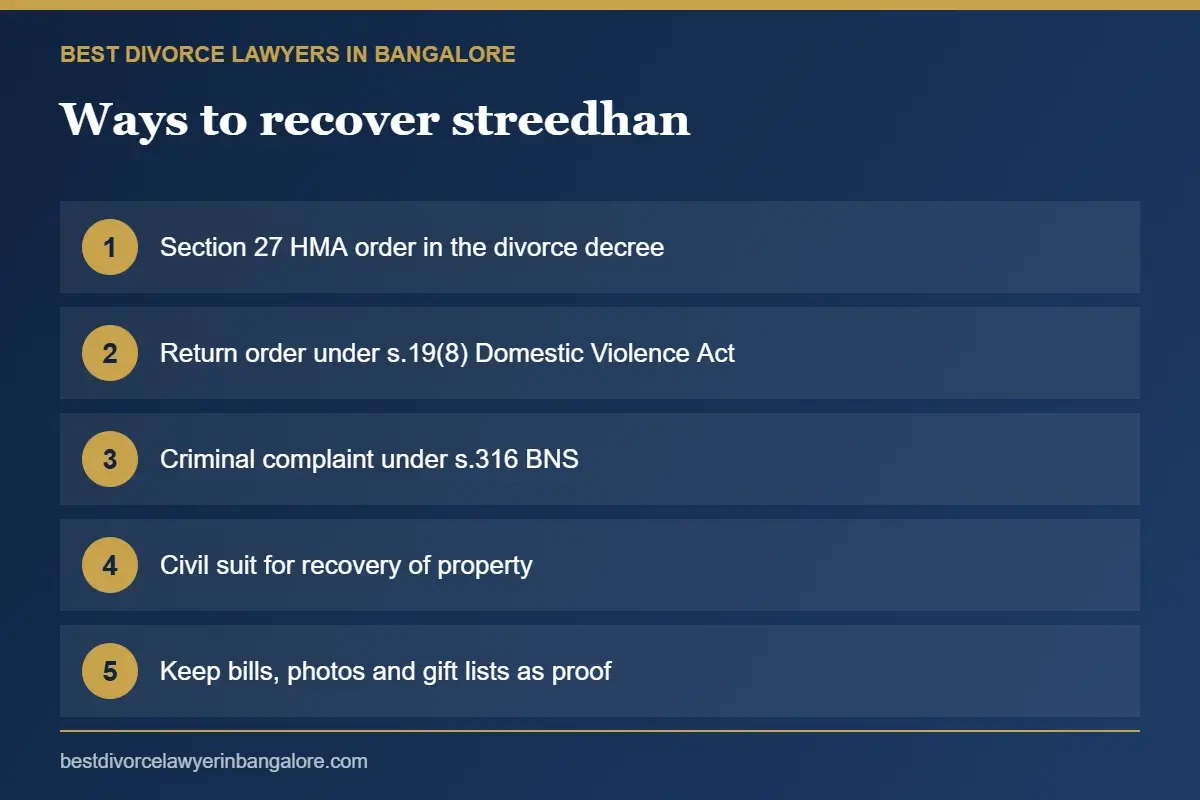
- Ask the family court to deal with jointly held wedding property under Section 27 of the Hindu Marriage Act as part of the divorce decree;
- Claim return of streedhan under Section 19(8) of the Domestic Violence Act;
- File a criminal complaint for criminal breach of trust (now Section 316 of the Bharatiya Nyaya Sanhita, formerly Section 406 IPC) if it is wrongfully withheld; or
- File a civil suit for recovery.
Proof matters. Wedding photographs, jewellery bills, bank transfers, gift lists and messages acknowledging that items were kept “safely” by the in-laws are all useful. Make an itemised list as early as possible.
Property rights after divorce
Property in the husband’s sole name
Indian law does not yet recognise an automatic 50:50 split of “matrimonial property”. A house or flat registered only in the husband’s name remains his, even if it was bought during the marriage. However, the wife may claim a share if she can show that she paid part of the price or the EMIs from her own money. Her contribution and the lifestyle the property represents are also relevant when the court fixes alimony, and many couples agree to transfer a flat to the wife as part of a settlement.
Jointly owned property
Where the flat or plot is in joint names, each spouse owns their share. On divorce, the couple can sell and divide the proceeds, one can buy out the other at an agreed value, or they can partition. If there is a joint home loan, both remain liable to the bank whatever the divorce decree says, so a buyout should include refinancing the loan in one name.
Property in the wife’s name
Property bought in the wife’s name, including flats a husband bought in her name, is ordinarily hers. A husband claiming it was really his has to prove it, and the Benami law specifically protects property bought in a spouse’s name from known sources of income.
Residence in the matrimonial home
During the marriage, Section 17 of the Domestic Violence Act gives a woman the right to live in the “shared household”, whether or not she owns it. In Satish Chander Ahuja v. Sneha Ahuja (2020), the Supreme Court held that this can include a house owned by the in-laws. Once the marriage ends, this right is usually replaced by alimony or an agreed accommodation arrangement, so negotiate housing before the decree.
Rights relating to children
A divorced mother can seek custody, joint custody or visitation, and child support from the father. Courts decide custody on the welfare of the child, not on which parent “wins” the divorce. Under the Hindu Minority and Guardianship Act, custody of a child below five years is ordinarily with the mother, and since Gita Hariharan v. Reserve Bank of India (1999) a mother can act as natural guardian even while the father is alive, for example to sign school or passport forms when the father is absent or uninvolved.
Child support is the child’s own right. It does not end because the mother remarries or earns well, and the father’s obligation continues at least until the child turns 18 (and for an unmarried daughter, under Hindu law, until her marriage). Children of the marriage keep their full rights to inherit from their father.
Right to remarry
Once the divorce decree becomes final, a woman is free to remarry. Under Section 15 of the Hindu Marriage Act, remarriage is lawful once the time for appeal has expired with no appeal filed, or the appeal has been dismissed. In a mutual consent divorce, both sides usually waive the right to appeal, so the decree becomes final quickly. Our guide to second marriage after divorce covers the details. Keep in mind that remarriage ends maintenance under Section 144 BNSS and can lead to permanent alimony being varied.
Your name, documents and finances
- Name: a woman may keep her married surname or return to her maiden name. Changing it usually needs a gazette notification and an affidavit, followed by updates to Aadhaar, PAN, passport and bank records.
- Bank accounts and lockers: close or convert joint accounts and empty joint lockers in the presence of both parties, ideally with an inventory signed by both.
- Insurance and nominations: change nominees in life insurance, PF, PPF, mutual funds and bank accounts. A divorce decree does not automatically change a nomination.
- Health insurance: if you were covered under your husband’s employer policy, arrange your own cover before the decree.
- Loans: confirm in writing who will pay each loan, and remove yourself as co-borrower or guarantor wherever possible.
What a divorced wife does not get
It is just as important to know the limits. A divorced wife is not an heir of her former husband: if he dies after the divorce, she will not inherit from him as a widow would, though her children will. She has no claim on her former in-laws’ ancestral property. And a wife who has accepted a lump sum in full and final settlement generally cannot reopen the issue of maintenance later.
How to protect your rights during the divorce in Bangalore
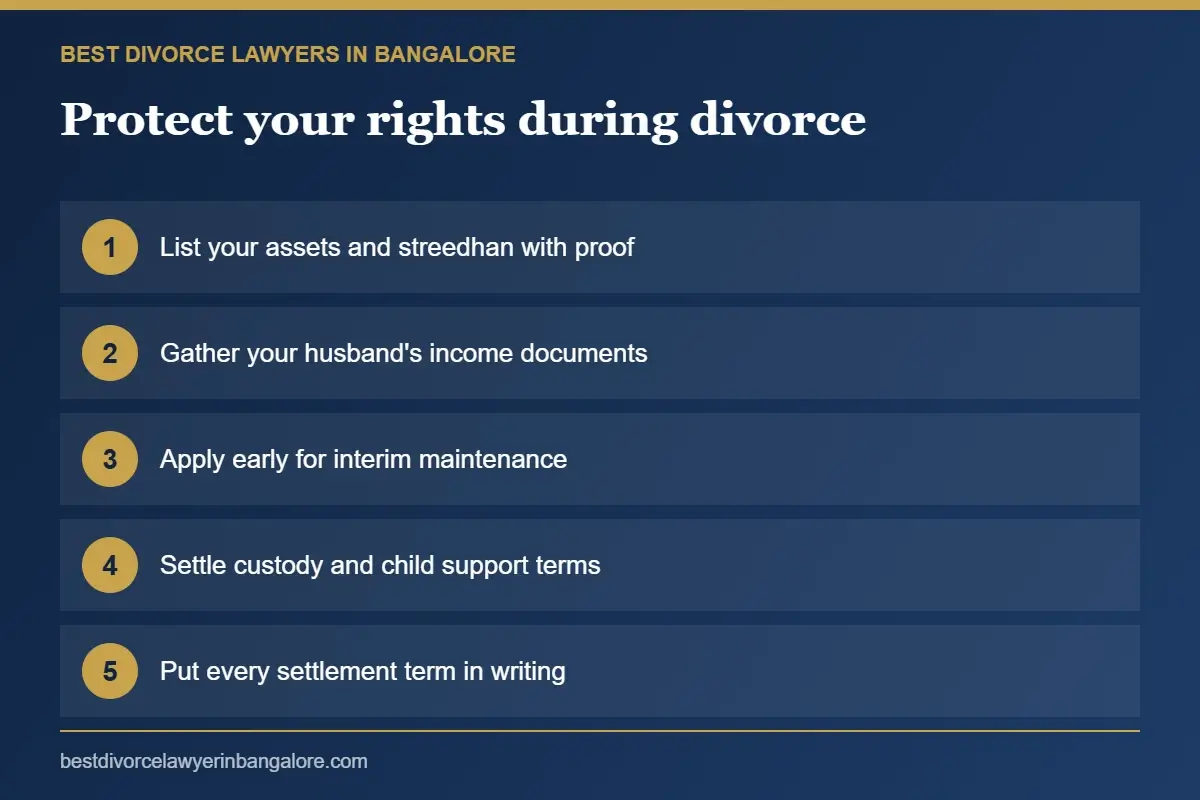
- List your assets and streedhan with photographs, bills and bank records.
- Collect financial documents about your husband’s income: salary slips, ITRs, Form 16, business records and property papers, so you can respond properly to his disclosure affidavit.
- Apply for interim maintenance as soon as the case is filed in the Bengaluru Family Court near Lalbagh Main Gate; it is usually payable from the date of the application.
- Decide on the children first: custody, schooling and support terms tend to shape everything else.
- Put every term in writing: in a mutual divorce, the consent terms filed with the joint petition become part of the decree and are enforceable. See how to choose between the routes in mutual divorce vs contested divorce.
Women who cannot afford a lawyer can apply for free legal aid through the Karnataka State Legal Services Authority or the Bengaluru Urban district legal services authority. For an overview of all the routes, start with our guide to family laws in India, or speak to an alimony lawyer in Bangalore about the financial side.
How this guide was prepared
This guide is based on the bare acts published on India Code and on judgments of the Supreme Court of India and the Karnataka High Court. Section numbers, case citations and time limits were fact-checked in October 2026, and criminal-law references use the Bharatiya Nyaya Sanhita (BNS) and Bharatiya Nagarik Suraksha Sanhita (BNSS) in force since 1 July 2024. It is general information, not legal advice. For advice on your own case, speak to an advocate. Read our editorial standards and disclaimer.
Frequently Asked Questions
Does a wife get half of the husband’s property after divorce in India?
No. India has no automatic 50% rule. She keeps her own property and streedhan, her share of jointly owned property, and any alimony or property transfer the court orders or the couple agree.
Can a divorced wife live in her husband’s house?
Her statutory right of residence in the shared household applies while the marriage subsists. After divorce, housing is usually addressed through alimony, a transfer of a flat or an agreed rent arrangement.
Can a wife claim maintenance if she left the matrimonial home?
Yes, if she had a justifiable reason such as cruelty or the husband’s neglect. Leaving without sufficient reason can weaken a claim under Section 144 BNSS.
Does a divorced wife have any right in her ex-husband’s pension or inheritance?
She does not inherit from him after divorce. Rights under specific service or pension rules vary, so check the applicable scheme; her children’s inheritance rights are unaffected.
Is there a time limit to claim streedhan back?
Criminal breach of trust is treated as a continuing offence while the property is withheld after a demand, but civil claims are subject to limitation. Make a written demand and act promptly.
The rights you secure at the time of divorce are much harder to win afterwards. If you are a woman facing divorce, talk to one of our female divorce lawyers in Bangalore early, so maintenance, streedhan and property are all addressed before the decree.