Child custody laws in India are built on one principle: the welfare of the child comes first, ahead of either parent’s rights. Custody can be sole, joint or shared, with visitation for the other parent, and it is decided by the family court under the Guardians and Wards Act, 1890 together with the parents’ personal law. Nothing is permanent: a custody order can be changed whenever the child’s welfare requires it.
The legal framework for child custody laws in India
India has no single custody statute. Instead, courts read a secular law alongside the personal law of the family:
| Law | Key provisions | Applies to |
|---|---|---|
| Guardians and Wards Act, 1890 | ss.7, 17 and 25 (appointment of guardian, welfare test, return of a ward) | Everyone, regardless of religion |
| Hindu Minority and Guardianship Act, 1956 | s.6 (natural guardians), s.13 (welfare paramount) | Hindus, Sikhs, Jains and Buddhists |
| Hindu Marriage Act, 1955 | s.26 (custody orders in matrimonial cases) | Hindu divorce, separation and nullity cases |
| Special Marriage Act, 1954 | s.38 | Civil and inter-faith marriages |
| Divorce Act, 1869 | ss.41 to 44 | Christians |
| Parsi Marriage and Divorce Act, 1936 | s.49 | Parsis |
| Muslim personal law | Rules of hizanat (custody) | Muslims, read with the Guardians and Wards Act |
Under the Family Courts Act, 1984, custody and guardianship disputes in cities such as Bengaluru go to the Family Court. A petition under the Guardians and Wards Act is filed where the child ordinarily resides. If the parents are already in a divorce case, custody is usually sought within that case. For the wider legal picture, see our guide to divorce laws in India.
Guardianship vs custody
These are different ideas. Guardianship is the legal authority to make decisions for the child and manage the child’s property. Custody is about who the child lives with day to day. A father may remain a natural guardian while the mother has physical custody.
Under Section 6 of the Hindu Minority and Guardianship Act, the father is named as the natural guardian of a minor, and after him the mother. But in Gita Hariharan v. Reserve Bank of India (1999), the Supreme Court read “after” to mean “in the absence of”, so a mother can act as natural guardian while the father is alive if he is absent, indifferent or not looking after the child. The same section says custody of a child under five should ordinarily be with the mother.
Types of custody courts can order
Physical (sole) custody
The child lives with one parent, and the other parent gets visitation. This is still the most common arrangement in India, especially for young children.
Both parents share time with the child under a schedule, for example alternate weeks or weekdays with one parent and weekends with the other. Courts increasingly favour this when both parents are capable, live reasonably close to each other and can cooperate.
Legal custody
Decision-making on education, health and religion is shared or given to one parent, separately from where the child lives.
Visitation and access
The non-custodial parent gets defined time with the child: weekends, part of school holidays, festivals, birthdays and regular phone or video calls. In Yashita Sahu v. State of Rajasthan (2020), the Supreme Court stressed that a child has a right to the love and company of both parents and approved video-call contact where physical visits are difficult.
Third-party custody
Occasionally, where neither parent is fit or both have died, custody is given to grandparents or other relatives.
How courts decide: the welfare of the child
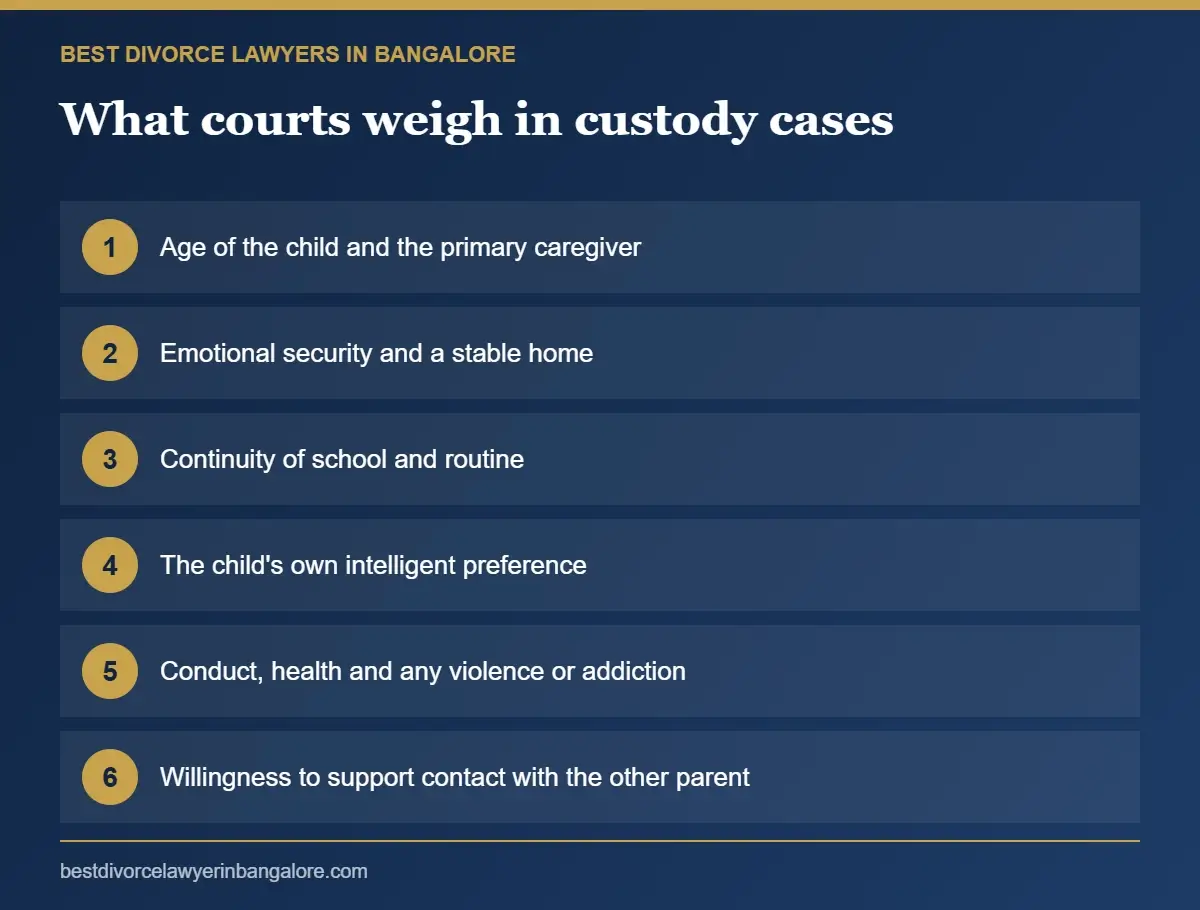
In Nil Ratan Kundu v. Abhijit Kundu (2008), the Supreme Court explained that welfare is not measured by money alone. Courts weigh:
- The child’s age and sex, and who has been the primary caregiver so far
- Each parent’s ability to provide emotional security, time and a stable home
- Continuity of schooling, friends and routine
- The child’s own wishes, if old enough to form an intelligent preference (Section 17(3), Guardians and Wards Act)
- Each parent’s health, character and conduct, including any violence or addiction
- Whether a parent is likely to cooperate with contact or to alienate the child from the other parent
- Keeping siblings together
A higher income does not by itself win custody. The earning parent can instead be ordered to pay child support.
Custody under different personal laws
Hindus
The Hindu Minority and Guardianship Act and Section 26 of the Hindu Marriage Act let the court make interim and final orders on custody, maintenance and education of children, and revise them at any time. Section 13 makes the welfare of the minor the paramount consideration.
Muslims
Muslim law separates guardianship (which belongs primarily to the father) from hizanat, the mother’s right to custody of young children. Under the Hanafi school, the mother generally keeps a son until about seven and a daughter until puberty; Shia rules give shorter periods. The mother can lose hizanat in some situations, such as remarriage to a person outside the prohibited degrees. In practice, Indian courts apply the welfare principle under the Guardians and Wards Act and treat these rules as guidance rather than rigid limits.
Christians and Parsis
Sections 41 to 44 of the Divorce Act, 1869 and Section 49 of the Parsi Marriage and Divorce Act, 1936 allow the court to make interim and final orders for custody, maintenance and education of minor children during and after matrimonial proceedings, again guided by the child’s welfare.
How to file for child custody in Bangalore
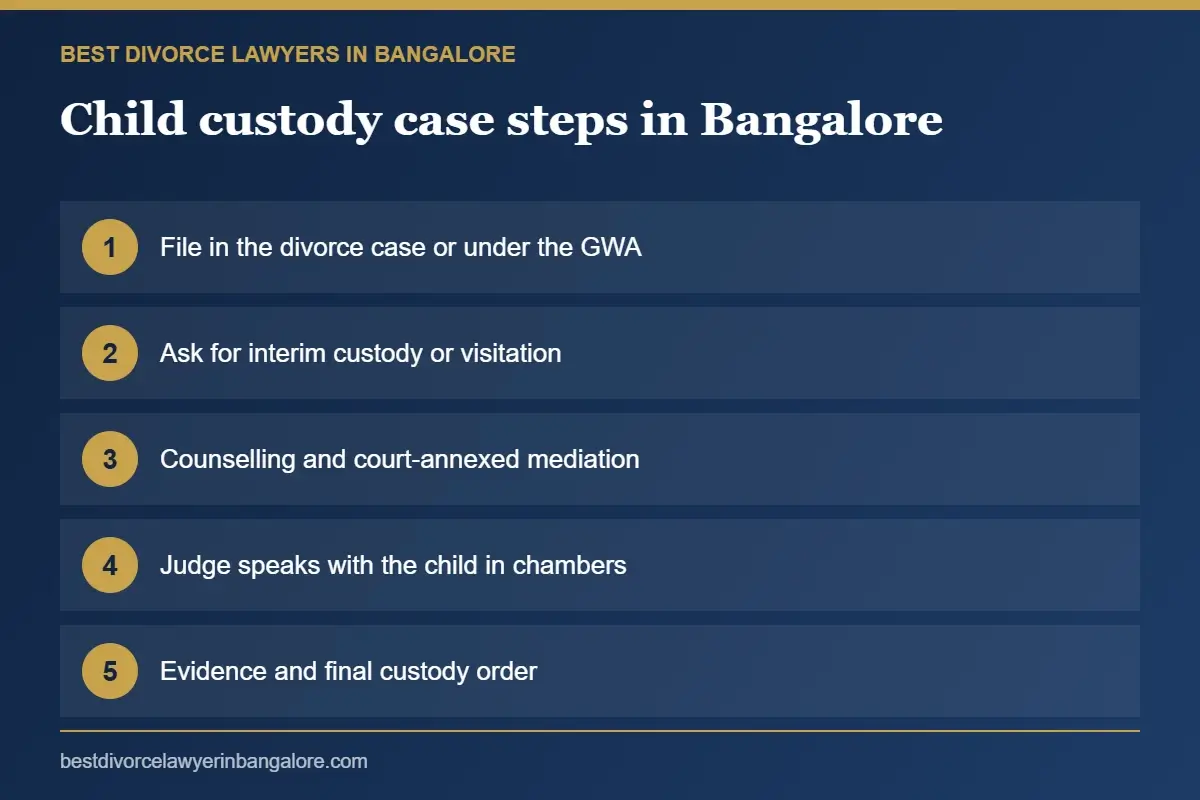
- Choose the route. If a divorce case is pending, file a custody application in it. Otherwise file a guardianship or custody petition under the Guardians and Wards Act before the Family Court where the child ordinarily resides; for Bengaluru, that is the Family Court complex near Lalbagh Main Gate on Siddaiah Road.
- Apply for interim custody or visitation so that the child’s routine is settled while the case is heard.
- Mediation and counselling. Family courts refer most custody disputes to counsellors and the court-annexed mediation centre. Many parents agree a parenting plan here; our guide to divorce mediation in India explains what to expect.
- Interaction with the child. Judges often speak to the child privately in chambers to understand their wishes, without the parents present.
- Evidence and final order. If no settlement is reached, both sides lead evidence and the court passes a final custody and visitation order, which can later be modified.
If a parent takes away a child in breach of an order, the other parent can seek execution, contempt, or in urgent cases a writ of habeas corpus before the Karnataka High Court. India is not a party to the Hague Convention on child abduction, so cross-border cases are decided on the child’s welfare rather than automatic return.
Child support and other parenting terms
Custody and money go together. The parent with means must contribute to the child’s food, schooling, medical needs and activities, whatever happens between the spouses. Child support is assessed alongside spousal support, explained in our guide to alimony in India, and mothers should also read about broader wife rights after divorce in India.
A good parenting plan, whether agreed in a mutual or contested divorce, should cover:
- Where the child lives and the weekly schedule
- Holidays, festivals and birthdays
- Phone and video contact
- Decisions on school, health and travel, including passports
- Relocation: how much notice either parent must give before moving city or country
- Monthly support and how school fees and medical costs are shared
Disputes over custody are among the hardest parts of a divorce. A specialist child custody lawyer in Bangalore can help you build a realistic parenting proposal and present it to the court.
How this guide was prepared
This guide is based on the bare acts published on India Code and on judgments of the Supreme Court of India and the Karnataka High Court. Section numbers, case citations and time limits were fact-checked in October 2026, and criminal-law references use the Bharatiya Nyaya Sanhita (BNS) and Bharatiya Nagarik Suraksha Sanhita (BNSS) in force since 1 July 2024. It is general information, not legal advice. For advice on your own case, speak to an advocate. Read our editorial standards and disclaimer.
Frequently Asked Questions
At what age can a child choose which parent to live with in India?
There is no fixed age. Under Section 17(3) of the Guardians and Wards Act the court considers the preference of a child old enough to form an intelligent preference; judges often give real weight to the views of older children, but the decision still rests on welfare.
Can a father get custody of a child in India?
Yes. Although young children often stay with the mother, fathers are granted custody or joint custody where that better serves the child, for example where the father has been the main caregiver.
Does a mother lose custody if she remarries?
Not automatically. The court asks whether the new home is good for the child. Under some Muslim law rules remarriage can affect hizanat, but courts still apply the welfare test.
Can custody orders be changed later?
Yes. Custody orders are never final in the strict sense. Either parent can apply for modification if circumstances change, such as relocation, a change in the child’s needs or breach of visitation.
Can I take my child abroad after divorce?
Only with the other parent’s consent or the court’s permission if there is a custody or visitation order. Courts may require undertakings or security before allowing travel or relocation.
Custody outcomes shape your child’s life for years, so get advice before you file or agree a parenting plan. Talk to the top divorce lawyers in Bangalore about your situation.