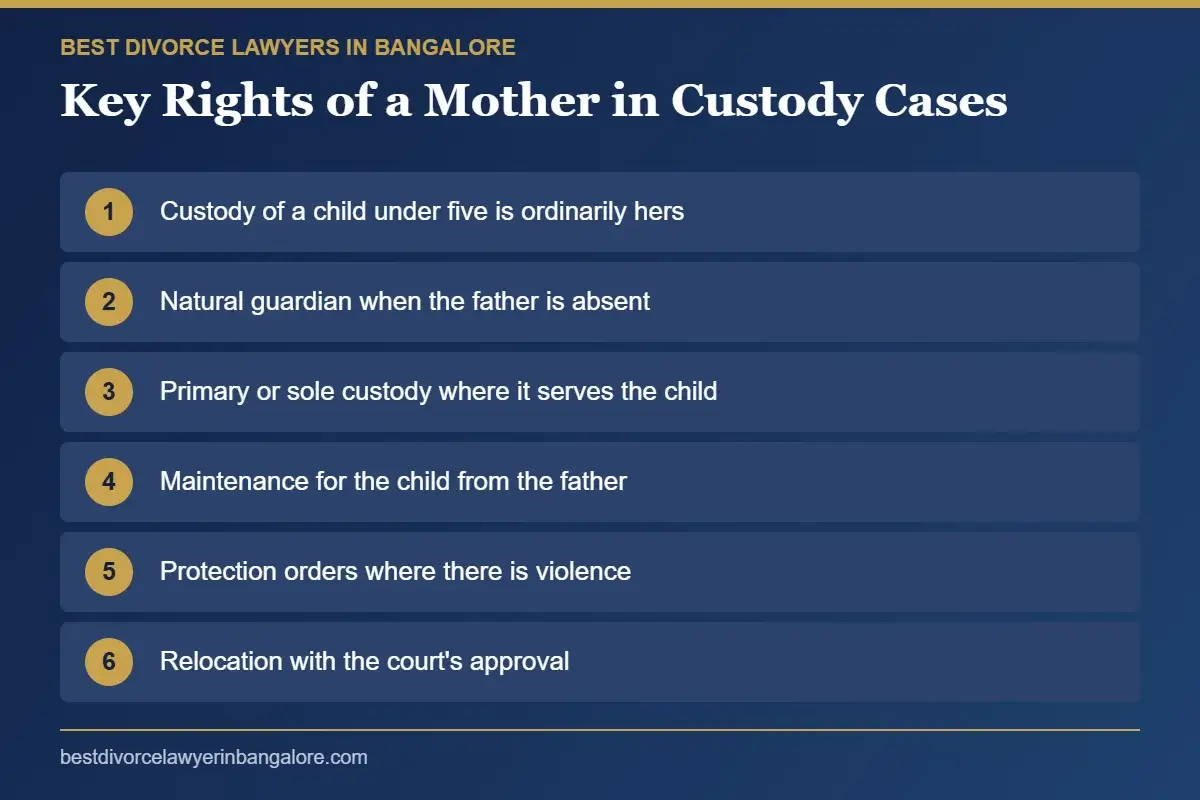
A mother in India can seek physical custody, joint custody, guardianship and financial support for her child, and the law gives her a clear advantage with very young children: under Section 6 of the Hindu Minority and Guardianship Act, 1956, custody of a child under five is ordinarily with the mother. But custody is not automatic for mothers. Courts decide on the child’s welfare, so a mother’s case rests on her role as caregiver, the stability of the home she offers and the child’s needs, while the father usually keeps a relationship with the child through visitation unless that would be unsafe.
The child’s welfare is the main consideration
Every custody decision in India starts and ends with the child’s welfare: physical safety, emotional security, education, health and overall development. Being the primary caregiver is a strong factor, but the court still looks at the child’s relationship with the father and what each parent can offer. Our guide on how courts decide child custody sets out every factor judges weigh.
Can a mother get custody of her child?
Yes, and in practice mothers are granted primary physical custody in many cases, particularly of young children and where they have handled the child’s daily routine, school and health. Continuity matters to courts: if the child has always lived with the mother, the court will be slow to move them. Custody is still not guaranteed. A father who can show strong involvement and a stable home can also be granted custody, and the court will look at both parents fairly.
What the law says about young children
Section 6(a) of the Hindu Minority and Guardianship Act provides that custody of a minor below five years shall ordinarily be with the mother. Under Muslim personal law, the mother’s right of hizanat similarly gives her care of young children. These provisions are sometimes misread as absolute. They are not: if there is evidence that the mother cannot care for the child safely, the court can decide otherwise, because the child’s welfare is paramount under Section 13 of the same Act. As the child grows, schooling, the child’s own views and the bond with each parent become more important.
Is a mother a natural guardian?
Yes. Although Section 6 names the father first, the Supreme Court in Githa Hariharan v. Reserve Bank of India (1999) held that the mother can act as natural guardian whenever the father is absent, uninvolved or unable to look after the child, and that the word “after” does not mean only after the father’s death. This lets a mother with custody sign school admissions, passport forms and bank papers for her child. Custody (daily care) and guardianship (legal responsibility) are still separate concepts, and courts can allocate them differently.
Does a mother lose custody if she works or has a lower income?
No. A working mother is not a less fit parent, and a mother with a lower income can still be the better custodial parent. What courts look at is the care arrangement: working hours, who looks after the child during the day, family support and the child’s routine. Where the mother earns less, the answer is maintenance from the father, not a change of custody.
Can a mother stop the father from seeing the child?
Not on her own. If the father is a suitable parent and contact benefits the child, the court will usually grant him visitation, and a mother with custody must comply with any order setting out access. The Supreme Court has stressed in Yashita Sahu v. State of Rajasthan (2020) that a child is entitled to the love and company of both parents. Where there are genuine safety concerns, such as violence, abuse or substance misuse, the right step is to raise them with the court, which can restrict contact or order supervised visits. Refusing access unilaterally can count against the mother later.
What if the father has not been involved?
A long record of the mother alone handling the child’s education, health and daily needs is strong evidence for her custody claim. It does not mean the father can never seek access; the court may allow contact to be introduced gradually, starting with short or supervised visits, if that suits the child.
Can a mother get sole custody?
Yes, where sole custody is genuinely necessary for the child. The court will want to know why shared decision-making will not work and what the child’s living arrangements, schooling and routine will be. Concerns about the father’s conduct need evidence, such as police complaints, medical records, messages or orders under the Protection of Women from Domestic Violence Act, 2005, which allows a magistrate to grant temporary custody under Section 21. Allegations unrelated to the child carry little weight.
Does a mother lose custody if she remarries?
Not automatically. Remarriage is one circumstance the court considers, mainly through its effect on the child: how the child relates to the step-parent and whether the new home is stable and safe. Many mothers keep custody after remarrying.
Relocating with the child
A mother may have good reasons to move to another city or abroad for work or family support. If the move would disrupt an existing custody or visitation order, she should seek the court’s permission or agree a revised schedule with the father first. Courts weigh the reasons for the move, its effect on the child’s schooling and the impact on the father’s contact, and may approve the move with longer holiday access and video calls for the father.
Child maintenance for mothers with custody
A mother with custody can claim maintenance for the child’s education, healthcare, food, clothing and housing. Claims can be made under Section 26 of the Hindu Marriage Act within a divorce case, Section 20 of the Hindu Adoptions and Maintenance Act, 1956, and Section 144 of the Bharatiya Nagarik Suraksha Sanhita. In Rajnesh v. Neha (2020), the Supreme Court required both parents to file affidavits of assets and liabilities, so keep records of the child’s expenses.
Evidence that helps a mother’s custody case
- School records, fee receipts and parent-teacher communications showing who manages education.
- Medical records and vaccination cards showing who handles health.
- Evidence of the daily routine and the support network at home.
- Documents supporting any safety concerns, such as complaints, medical reports or protection orders.
- A practical plan for school, childcare and the father’s contact.
Keeping the child out of the conflict
Do not use the child as a messenger, ask them to keep secrets, or speak badly of the father in front of them. Courts notice parental alienation and it can damage the alienating parent’s case. Where there is no safety concern, supporting the child’s relationship with both parents is usually what the court wants to see.
For the wider picture, see our guide to child custody laws in India, the types of child custody in India and father’s rights in child custody.
How this guide was prepared
This guide is based on the bare acts published on India Code and on judgments of the Supreme Court of India and the Karnataka High Court. Section numbers, case citations and time limits were fact-checked in November 2026, and criminal-law references use the Bharatiya Nyaya Sanhita (BNS) and Bharatiya Nagarik Suraksha Sanhita (BNSS) in force since 1 July 2024. It is general information, not legal advice. For advice on your own case, speak to an advocate. Read our editorial standards and disclaimer.
Frequently Asked Questions
Does a mother automatically get custody after divorce in India?
No. Custody is decided on the child’s welfare. Mothers often get custody, especially of children under five, but the court also considers the father’s role and what each parent can offer.
Can a working mother get custody of her child?
Yes. Working does not make a mother less fit. The court looks at the childcare arrangement, her availability and the child’s routine, not simply whether she is employed.
Can a mother sign school and passport forms as guardian?
Yes. After Githa Hariharan v. Reserve Bank of India (1999), a mother can act as natural guardian when the father is absent or not looking after the child.
Can a mother deny the father visitation?
Not on her own. If there is a court order for visitation she must follow it. If she has genuine safety concerns, she should ask the court to restrict or supervise contact.
Speak to a child custody lawyer in Bangalore
Mothers hold a strong position in Indian custody law, especially for young children, but custody is decided on the child’s welfare, not gender. A stable home, proven involvement, attention to the child’s education and health, and a sensible approach to the father’s contact give a mother the strongest case. If you need advice on your own situation, consult an experienced child custody lawyer in Bangalore, or compare the top family and divorce lawyers in Bangalore on our list. The first consultation is free.