Indian courts decide child custody by asking one question above all others: which arrangement best protects this child’s welfare? Custody is not awarded to the parent who files first, earns more or is the mother by default. Judges look at the child’s age, the bond with each parent, who has been the main caregiver, schooling and stability, safety, each parent’s ability to provide a settled home, and, where the child is mature enough, the child’s own wishes. This guide explains the laws Indian courts apply, the factors they weigh and how a custody case runs in Bengaluru’s Family Courts.
What child custody means
Child custody covers the arrangements for a child’s care, residence and upbringing after the parents separate. It has three parts that courts often split between the parents:
- Physical custody: who the child lives with and who handles daily care, meals, school runs and routine.
- Legal custody: who makes major decisions on education, medical treatment, religion and travel.
- Visitation or access: the time the other parent spends with the child, in person, overnight, during holidays or by video call.
Custody is also different from guardianship. A guardian has legal responsibility for the child’s person and property; a parent can remain a natural guardian even when the child lives with the other parent. Our hub on child custody laws in India explains these terms in more detail.
The laws Indian courts apply
No single statute governs every custody dispute. The law depends on the parents’ personal law and on the kind of case filed:
- Hindu Marriage Act, 1955, Section 26: in a divorce or other matrimonial case, the court can make interim and final orders on the custody, maintenance and education of minor children, and can revoke or vary them later. Equivalent provisions exist in Section 38 of the Special Marriage Act, 1954, Sections 41 to 44 of the Divorce Act, 1869 and Section 49 of the Parsi Marriage and Divorce Act, 1936.
- Hindu Minority and Guardianship Act, 1956: Section 6 names the father, and after him the mother, as natural guardians of a Hindu minor, and says custody of a child under five shall ordinarily be with the mother. In Githa Hariharan v. Reserve Bank of India (1999), the Supreme Court read “after” to mean “in the absence of”, so a mother can act as natural guardian when the father is not looking after the child. Section 13 makes the minor’s welfare the paramount consideration.
- Guardians and Wards Act, 1890: the general law for all communities. Section 7 lets the court appoint a guardian, Section 17 lists the welfare factors, and Section 25 allows the court to order a child’s return to a guardian. Under Section 9, the petition is filed where the child ordinarily resides.
- Muslim personal law: the mother’s right of hizanat (care of young children) is recognised, traditionally until about seven years for a son and puberty for a daughter in Hanafi law, but courts still decide on welfare.
In Bengaluru, custody and guardianship petitions are heard by the Family Courts, which have jurisdiction under Section 7 of the Family Courts Act, 1984.
The welfare of the child is paramount
Every custody law in India is read through one principle: the child’s welfare comes before the competing claims of the parents. In Gaurav Nagpal v. Sumedha Nagpal (2009), the Supreme Court said welfare is not measured by money or physical comfort alone; it includes the child’s moral and ethical development, emotional security and the ties of affection with the family. In Nil Ratan Kundu v. Abhijit Kundu (2008), the Court held that a custody case is not decided on the legal rights of the parties but on what is in the child’s best interests. A custody order is therefore never a reward for one parent or a punishment for the other.
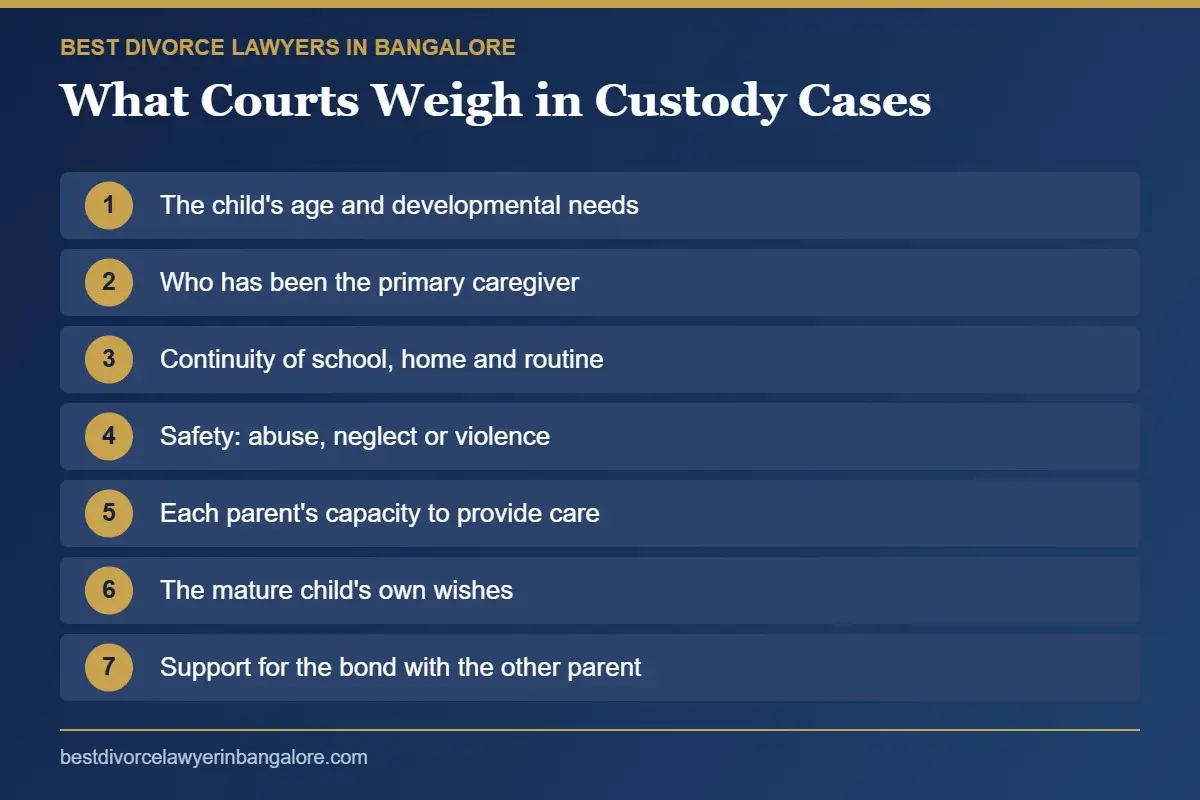
Factors courts consider
1. The child’s age and needs
Very young children need continuous, consistent care, and the law reflects this: under Section 6(a) of the Hindu Minority and Guardianship Act, custody of a child under five is ordinarily with the mother. “Ordinarily” is not “always”; if the mother cannot care for the child safely, the court can decide otherwise. As children grow, school, friendships and their own views carry more weight.
2. Who has been the primary caregiver
Courts look at who has actually raised the child: who handles school, homework, doctor visits, meals and bedtime. A strong existing bond, and the disruption that breaking it would cause, matters a great deal.
3. Continuity and stability
Judges avoid uprooting a child without good reason. They consider the child’s current school, home, routine, extended family and friends, and whether the proposed arrangement keeps them stable. Siblings are usually kept together.
4. Safety
Credible evidence of abuse, neglect, domestic violence, substance abuse or a parent’s serious instability weighs heavily and can lead to restricted or supervised contact. Allegations need evidence; unsupported accusations can backfire.
5. Each parent’s capacity to provide care
The court looks at housing, working hours, health, family support and the time each parent can actually give the child. Income is relevant but not decisive: the court can order the better-off parent to pay maintenance for the child instead of moving the child to them.
6. The child’s wishes
Under Section 17(3) of the Guardians and Wards Act, if the minor is old enough to form an intelligent preference, the court may consider it. Judges often speak to the child privately in chambers. The preference is not binding: the court checks whether it is genuine or the result of coaching or pressure, as the Supreme Court cautioned in Vivek Singh v. Romani Singh (2017).
7. Willingness to support the child’s relationship with the other parent
A parent who encourages contact with the other parent, communicates sensibly and keeps the child out of adult conflict usually presents a stronger case than one who tries to cut the other parent out.
What does not decide custody on its own
- Gender: neither parent has an automatic right. Fathers win custody where it serves the child (see our guide to father’s rights in child custody), and the “tender years” rule is a starting point, not a guarantee.
- Income alone: a modest income does not disqualify a loving, involved parent.
- Remarriage alone: in Vivek Kumar Chaturvedi v. State of U.P. (2025), the Supreme Court held that a father’s remarriage did not stand against his custody claim.
- Who caused the marriage to break down: fault in the marriage matters only if it affects the child.
How a custody case runs in Bangalore
Custody can be decided in two ways. If a divorce or judicial separation case is pending, either parent can apply for interim and final custody within it under Section 26 of the Hindu Marriage Act (or the equivalent section of their personal law). Otherwise, a parent files a guardianship and custody petition under the Guardians and Wards Act before the Family Court where the child ordinarily lives. In either route, the court can pass interim orders on custody and visitation early on, refers the parents to counselling or mediation, may interact with the child, takes evidence and then passes a final order. How long this takes depends on how much is disputed; cases that settle in mediation are far quicker.
Can a custody order be changed later?
Yes. Custody orders are never truly final. In Rosy Jacob v. Jacob A. Chakramakkal (1973), the Supreme Court held that custody orders can be modified whenever the child’s welfare requires it. A parent’s relocation, a change in the child’s schooling or health, safety concerns or an older child’s settled wishes can all justify a fresh look. Until the court changes an order, both parents must follow it.
Related guides explain mother’s rights in child custody, joint custody in India and child visitation rights in India.
How this guide was prepared
This guide is based on the bare acts published on India Code and on judgments of the Supreme Court of India and the Karnataka High Court. Section numbers, case citations and time limits were fact-checked in November 2026, and criminal-law references use the Bharatiya Nyaya Sanhita (BNS) and Bharatiya Nagarik Suraksha Sanhita (BNSS) in force since 1 July 2024. It is general information, not legal advice. For advice on your own case, speak to an advocate. Read our editorial standards and disclaimer.
Frequently Asked Questions
Who gets custody of a child below five years in India?
For Hindu children, Section 6 of the Hindu Minority and Guardianship Act says custody of a child under five shall ordinarily be with the mother. Courts can depart from this if the mother cannot care for the child safely, because welfare is the paramount consideration.
Does the parent with the higher income get custody?
No. Income is only one factor. A court can leave the child with the parent who provides better day-to-day care and order the other parent to pay maintenance for the child.
Does the judge speak to the child in a custody case?
Often, yes. Judges commonly interact with the child privately in chambers to understand the child’s wishes and comfort with each parent, but the child’s view is not binding.
Where do I file a child custody case in Bangalore?
A guardianship and custody petition under the Guardians and Wards Act is filed in the Family Court where the child ordinarily resides. If a divorce case is already pending, custody can be sought within that case.
Speak to a child custody lawyer in Bangalore
Custody law in India is built around the child, not the parents. Courts weigh the child’s age, existing bonds, stability, safety and wishes, and they keep the power to revisit their orders as the child grows. Parents who focus on the child’s actual needs, keep good records of their involvement and stay out of point-scoring usually fare best. If you need advice on your own situation, consult an experienced child custody lawyer in Bangalore, or compare the top family and divorce lawyers in Bangalore on our list. The first consultation is free.