Child visitation rights in India let the parent who does not have physical custody keep spending time with their child after separation or divorce, through weekend and weekday visits, holidays, festivals, overnight stays and phone or video calls. Family Courts grant visitation in almost every custody case because the Supreme Court treats a child’s relationship with both parents as part of the child’s welfare. Contact is restricted or supervised only when it would be unsafe or harmful for the child.
What visitation rights mean
Visitation (also called access or contact) is the court-authorised time a non-custodial parent spends with the child. It may include alternate weekends, a weekday evening, half of the school holidays, birthdays and festivals, and regular calls. For example, if a child lives with the mother after divorce, the court may let the father have the child from Saturday morning to Sunday evening every alternate week, half of the summer and Dussehra holidays, and a video call three evenings a week. Visitation exists for the child’s benefit, not to satisfy either parent.
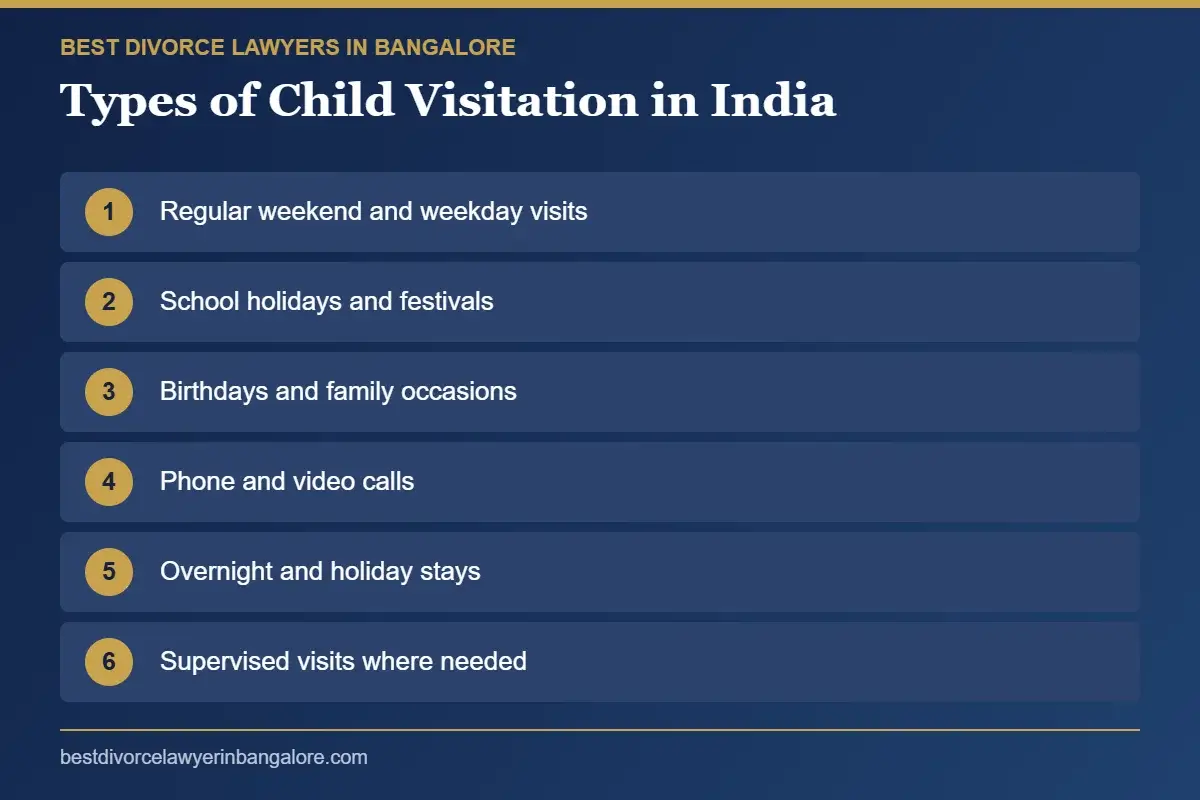
Types of visitation
Regular visitation
Fixed, predictable time such as weekends or particular weekdays. Predictability helps children feel secure and reduces arguments between parents.
Holiday and special-occasion visitation
Arrangements for school vacations, festivals, birthdays and family events, often alternating each year so the child celebrates major occasions with both sides of the family.
Virtual visitation
Phone and video calls, essential when a parent lives in another city or abroad. In Yashita Sahu v. State of Rajasthan (2020), the Supreme Court said that where parents live apart, video contact should be part of the arrangement and that a child has a right to the love and company of both parents.
Supervised visitation
Visits in the presence of a third party or at a neutral venue, such as a child-friendly room at the Family Court, where there are concerns about safety, the child’s emotional state, or a parent who has been out of the child’s life for a long time. Supervision is often a step towards unsupervised contact once trust is rebuilt.
Laws governing visitation in India
- Hindu Marriage Act, 1955, Section 26: lets the court make interim and final orders on custody in matrimonial cases, which include visitation, and vary them later. Similar provisions exist in the Special Marriage Act, 1954, the Divorce Act, 1869 and the Parsi Marriage and Divorce Act, 1936.
- Guardians and Wards Act, 1890: Family Courts use their powers under this Act, guided by the welfare factors in Section 17, to fix access for a non-custodial parent of any community.
- Hindu Minority and Guardianship Act, 1956, Section 13: makes the child’s welfare the paramount consideration in guardianship matters, which shapes how contact is arranged.
- Protection of Women from Domestic Violence Act, 2005, Section 21: lets a magistrate grant temporary custody and refuse visits by a parent if they would harm the child.
Factors courts consider
When setting visitation, Bengaluru’s Family Courts look at the child’s age (younger children often get shorter, more frequent visits, while older children can manage overnights and longer holidays), the bond between the child and the visiting parent, the school timetable and activities, the distance between homes, any safety concerns, and the wishes of a mature child. The aim is regular, meaningful contact that does not disrupt the child’s routine. Our guide on how courts decide child custody covers the wider welfare test.
Important court decisions
- Yashita Sahu v. State of Rajasthan (2020): a child is entitled to the love, affection and company of both parents; the Court laid down that video contact should be part of access where parents live in different places.
- Gaurav Nagpal v. Sumedha Nagpal (2009): welfare includes the child’s emotional, moral and psychological development, not just material comfort.
- Vivek Kumar Chaturvedi v. State of U.P. (2025): while giving custody to the father, the Supreme Court granted visitation to the maternal grandparents, showing that access can extend beyond parents where it benefits the child.
Can a parent with custody refuse visitation?
No. Once the court fixes visitation, the custodial parent must comply. If visits are being blocked, the visiting parent can apply to the same court for enforcement; repeated, wilful breaches can lead to a change in custody and, in serious cases, contempt. Keep a calm, factual record of every refused or cancelled visit. If you are the custodial parent and have real safety concerns, raise them with the court and ask for supervision or a change, rather than stopping visits on your own.
Changing a visitation order
Visitation can be changed when circumstances change, for example when the child starts a new school, a parent relocates, the child grows old enough for overnight stays, or new safety concerns arise. Either parent can apply to the court that made the order. Courts can expand contact, add conditions, require supervision or, rarely, suspend it, always on the child’s welfare and never to punish a parent.
Making visitation work for the child
- Be on time for handovers, and use school or a neutral place if handovers are tense.
- Never discuss the case or criticise the other parent in front of the child.
- Keep communication about logistics brief and in writing.
- Support calls and video chats; do not monitor or cut them short.
- Agree on make-up time when illness or exams disrupt a visit.
If you are the parent seeking contact, our guides on a father’s rights and a mother’s rights in child custody explain how to present your case.
For the full legal framework, see our guide to child custody laws in India.
How this guide was prepared
This guide is based on the bare acts published on India Code and on judgments of the Supreme Court of India and the Karnataka High Court. Section numbers, case citations and time limits were fact-checked in November 2026, and criminal-law references use the Bharatiya Nyaya Sanhita (BNS) and Bharatiya Nagarik Suraksha Sanhita (BNSS) in force since 1 July 2024. It is general information, not legal advice. For advice on your own case, speak to an advocate. Read our editorial standards and disclaimer.
Frequently Asked Questions
Can a father get visitation rights in India?
Yes. Courts grant visitation to the non-custodial parent, whether father or mother, in almost every case unless contact would be unsafe or harmful for the child.
What can I do if my ex is not allowing court-ordered visitation?
Apply to the court that made the order for enforcement. Repeated, wilful breaches can lead to a change of custody and, in serious cases, contempt proceedings.
What is supervised visitation?
Visits that take place in the presence of a third party or at a neutral venue, ordered where there are concerns about the child’s safety or wellbeing. It is often a step towards normal contact.
Are video calls part of visitation in India?
Yes. In Yashita Sahu v. State of Rajasthan (2020), the Supreme Court said video contact should be part of access where parents live in different places.
Speak to a child custody lawyer in Bangalore
Visitation rights protect the bond between a child and the parent they do not live with. Courts set them around the child’s needs, safety and routine, expect both parents to respect them, and can adjust them as the child grows. If you need advice on your own situation, consult an experienced child custody lawyer in Bangalore, or compare the top family and divorce lawyers in Bangalore on our list. The first consultation is free.