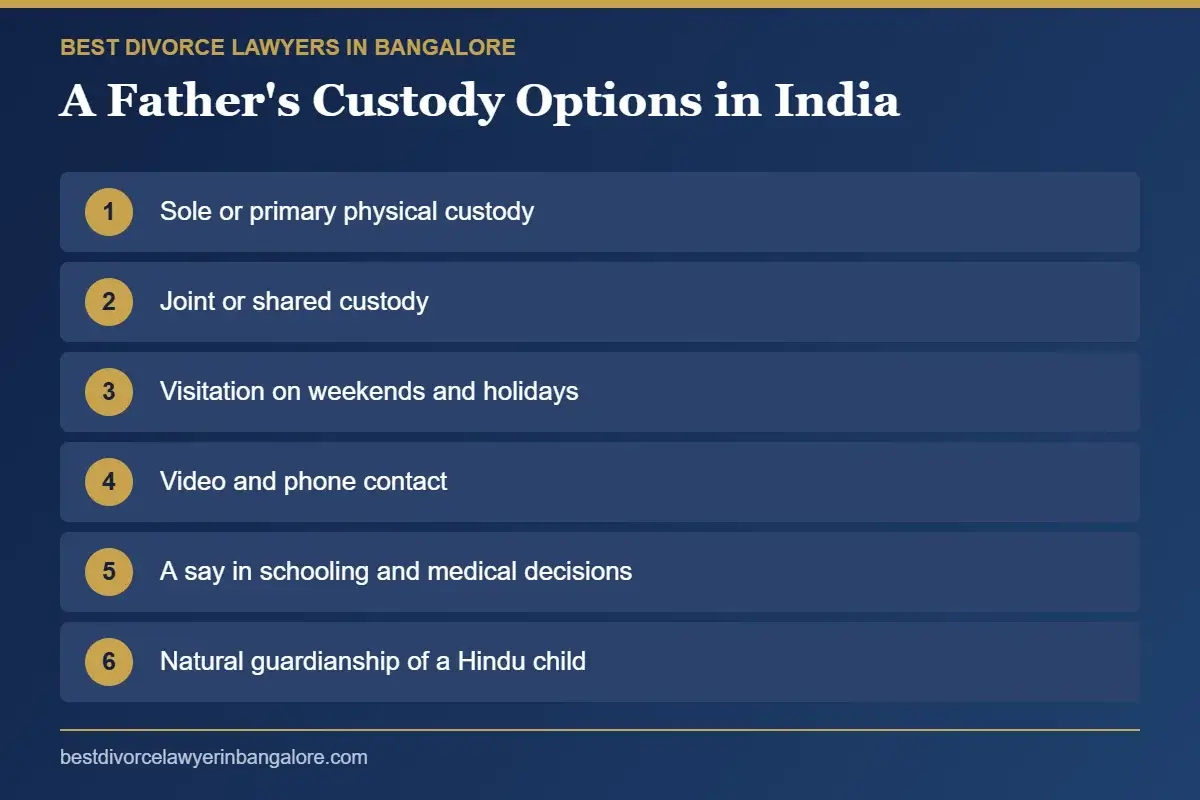
Fathers in India have real rights in child custody. A father can ask for physical custody, joint custody, guardianship or regular visitation, and he remains the natural guardian of a Hindu child under Section 6 of the Hindu Minority and Guardianship Act, 1956. What he does not have, and what no mother has either, is an automatic right to custody. Courts decide on the child’s welfare, so a father’s strongest case is one that shows, with evidence, how living with him or spending regular time with him serves the child’s emotional, educational and practical needs.
The child’s welfare comes first
Indian courts do not treat custody as a contest one parent wins and the other loses. The question is what arrangement is best for this child, judged by age, health, schooling, emotional needs, the bond with each parent and the stability of the current home. Our guide on how courts decide child custody in India explains every factor. For a father, this means a custody case built on “I am the father, so I have a right” is weak; a case built on “here is what I already do for my child and what I can offer” is strong.
Does a father have a right to custody?
A father can always approach the court for custody, but being the father does not mean custody will be granted. Equally, the fact that the mother has been the main caregiver does not erase the father’s role. Depending on the facts, a court may give the father primary custody, joint custody, or regular visitation along with a say in major decisions about schooling and health. The Supreme Court has repeatedly granted custody to fathers where it served the child, including in Vivek Kumar Chaturvedi v. State of U.P. (2025), where it held that maternal grandparents could not have a better claim than the father, who is the natural guardian, and that his remarriage did not count against him.
The importance of the child’s age
For Hindu families, Section 6(a) of the Hindu Minority and Guardianship Act says custody of a child under five shall ordinarily be with the mother. This is the provision fathers most often worry about, but it is a starting point, not an absolute bar. If there is evidence that the mother cannot care for a young child safely or consistently, the court can place the child with the father. For older children, the tender-years rule falls away and factors like school, the child’s routine and the child’s own wishes become more important.
Custody and guardianship are not the same
Custody is about where the child lives and who handles daily care. Guardianship is broader legal responsibility for the child and the child’s property. Under Section 6 of the Hindu Minority and Guardianship Act, the father is the natural guardian of a Hindu minor, and the mother acts as natural guardian when the father is absent or not looking after the child, following Githa Hariharan v. Reserve Bank of India (1999). So a father without physical custody is still a parent in law, with a continuing role in the child’s life subject to the court’s orders. Our guide to child custody laws in India explains both in more detail.
Visitation and meaningful access
Where the mother has primary custody, a father can ask for structured visitation. Common arrangements in Bengaluru’s Family Courts include alternate weekends, a weekday evening, half of the school holidays, shared festivals and birthdays, and daily or weekly video calls. In Yashita Sahu v. State of Rajasthan (2020), the Supreme Court recognised that a child has a right to the love and company of both parents and that video contact should be part of access where parents live apart. The aim is not a fixed number of hours but a real, continuing relationship.
What if the mother prevents contact?
If a court order already gives you visitation and it is being ignored, you can apply to the court to enforce it; repeated, wilful breach can lead to the order being varied and, in serious cases, to contempt proceedings. If there is no order yet, file for custody or visitation in the Family Court where the child ordinarily resides and ask for interim access while the case is pending. Do not take the child without consent or a court order, and do not respond with confrontation. Self-help almost always harms the father’s case and can expose him to criminal complaints.
Can a father get sole custody?
Yes. A father can seek sole or primary custody, but he needs to show why that arrangement is better for the child, not simply list complaints about the mother. Relevant evidence includes stable accommodation near the child’s school, his availability given his work hours, family support at home, and a record of hands-on involvement in the child’s education, health and daily life. Where there are genuine concerns about the mother’s care, such as neglect, abuse or serious instability, they must be backed by evidence.
Does a father’s income give him an advantage?
Not by itself. Courts look at whether the child’s needs will be met, and a higher-earning parent can meet those needs by paying maintenance rather than taking custody. A father who earns well but travels constantly may be in a weaker position than one who earns less but is present every day. The court weighs time, care and emotional security alongside money.
The child’s wishes
As children grow older, their views matter more. Under Section 17(3) of the Guardians and Wards Act, 1890, the court may consider the preference of a child old enough to form an intelligent one, and judges often speak to the child privately. A child’s preference is not decisive, and courts look closely at whether it has been influenced by either parent. Never pressure a child to choose.
Fathers living in another city or abroad
Distance does not stop a father from seeking custody or access, but it changes what is practical. A father in another city may get longer holiday periods and regular video calls instead of weekly visits. A father living outside India may need a carefully structured plan covering travel, passports, schooling and the child’s return dates, and courts may ask for undertakings before allowing the child to travel abroad.
Child support and custody are separate
A father’s duty to support his child continues whoever has custody. Maintenance for the child can be claimed under Section 26 of the Hindu Marriage Act, Section 20 of the Hindu Adoptions and Maintenance Act, 1956 and Section 144 of the Bharatiya Nagarik Suraksha Sanhita. Paying maintenance does not by itself earn custody, and withholding it to gain leverage damages a father’s case. Keep records of school fees, medical bills and transfers.
How fathers can prepare a strong case
- Show involvement: school communications, parent-teacher meetings, medical visits, activities and photos of everyday care.
- Have a practical plan: where the child will live, which school, who will care for the child while you work.
- Stay child-focused in court and in messages; judges read the WhatsApp chats.
- Follow every interim order exactly, and keep a calm, factual log of missed or refused visits.
- Keep the child out of the dispute: no messages through the child, no criticism of the mother in front of them.
You may also want to read about joint custody in India and child visitation rights in India.
How this guide was prepared
This guide is based on the bare acts published on India Code and on judgments of the Supreme Court of India and the Karnataka High Court. Section numbers, case citations and time limits were fact-checked in November 2026, and criminal-law references use the Bharatiya Nyaya Sanhita (BNS) and Bharatiya Nagarik Suraksha Sanhita (BNSS) in force since 1 July 2024. It is general information, not legal advice. For advice on your own case, speak to an advocate. Read our editorial standards and disclaimer.
Frequently Asked Questions
Can a father get custody of a child under five?
Yes, though it is harder. The law says a Hindu child under five should ordinarily be with the mother, but a court can give custody to the father if that better serves the child, for example where the mother cannot provide safe and consistent care.
What can a father do if the mother is not allowing him to meet the child?
If there is a visitation order, apply to the court to enforce it. If not, file for custody or visitation in the Family Court where the child lives and ask for interim access. Do not take the child without consent or a court order.
Does a father lose custody rights if he remarries?
No. Remarriage alone does not disqualify a father. In Vivek Kumar Chaturvedi v. State of U.P. (2025), the Supreme Court held that a father’s remarriage did not stand against his custody claim.
Does paying child maintenance give a father the right to visitation?
Maintenance and visitation are separate. A father must support his child whoever has custody, and his right to see the child depends on the child’s welfare, not on payments.
Speak to a child custody lawyer in Bangalore
Fathers in India have a full legal role in custody matters and can seek custody, guardianship and meaningful access. Custody is not granted on gender, so a father’s case succeeds by showing what genuinely serves the child: stability, education, health, emotional support and a continuing relationship with both parents where that is safe. If you need advice on your own situation, consult an experienced child custody lawyer in Bangalore, or compare the top family and divorce lawyers in Bangalore on our list. The first consultation is free.