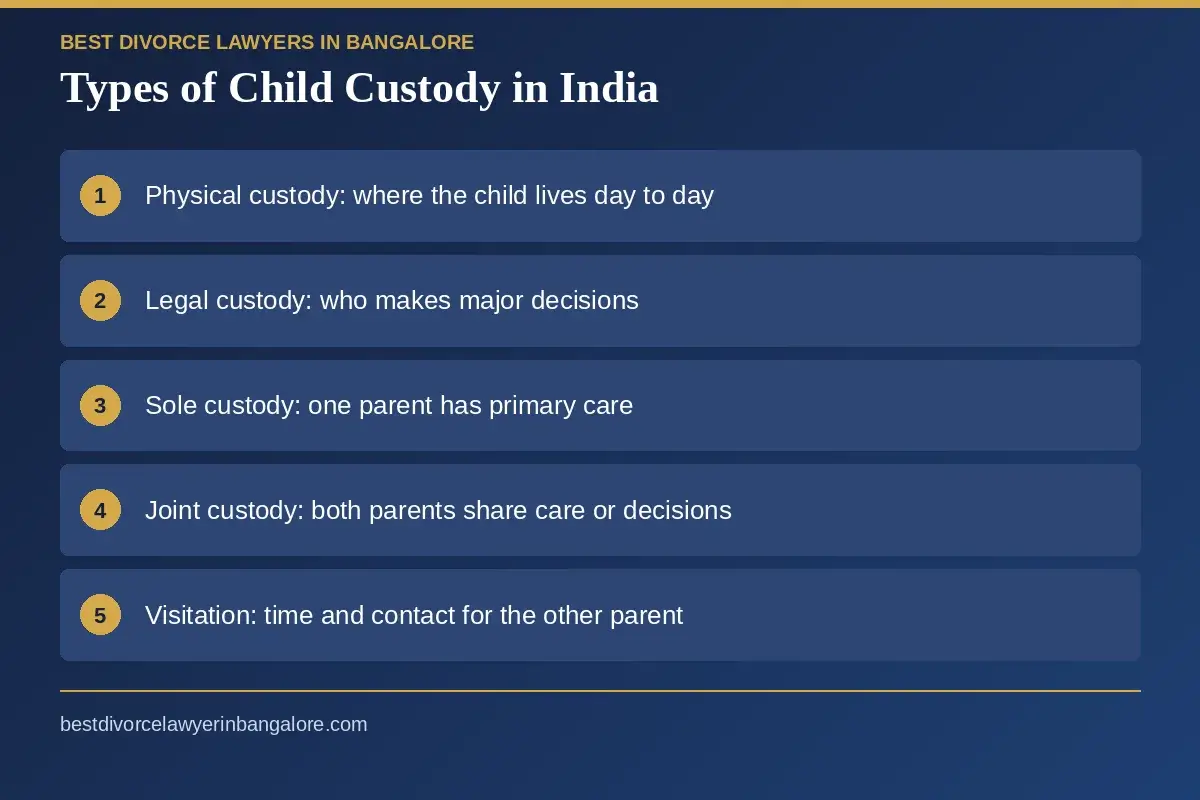
Indian courts mainly use four kinds of custody arrangement. Physical custody decides where the child lives. Legal custody decides who makes the big decisions about schooling, health and religion. Sole custody gives one parent the primary role. Joint custody shares care or decision-making between both parents. The terms come from practice rather than any one statute, so a court can mix them: one parent may have physical custody while both share legal custody, and the other parent usually gets visitation. In every case the deciding test is the welfare of the child.
The laws behind custody orders
- Hindu Marriage Act, 1955, Section 26: in any divorce or matrimonial case, the court can make and later change orders on the custody, maintenance and education of minor children.
- Hindu Minority and Guardianship Act, 1956: Section 6 names the father and then the mother as natural guardians and says custody of a child under five should ordinarily be with the mother. Section 13 makes the minor’s welfare the paramount consideration. In Gita Hariharan v. Reserve Bank of India (1999), the Supreme Court held that the mother can act as natural guardian too.
- Guardians and Wards Act, 1890: applies to every religion. Section 17 directs the court to be guided by the minor’s welfare, including age, sex, the character of the proposed guardian and the child’s own preference if old enough.
- The Special Marriage Act, 1954 (Section 38) and other personal laws give similar powers.
Custody cases in Bengaluru are heard by the Family Courts. For the bigger picture, see our guide to child custody laws in India.
Physical custody
Physical custody means the child lives with that parent, who handles daily care: meals, school runs, homework, routine medical visits and bedtime. It is about residence and day-to-day life, not legal authority. When one parent has physical custody, the other is normally given visitation: weekends, part of the school holidays, festivals and phone or video calls.
In deciding physical custody, courts look at the child’s age, who has been the main carer so far, continuity of school and routine, the home each parent can offer, and any history of violence or neglect. A higher income helps but does not decide the case, because money can be balanced through child maintenance.
Legal custody
Legal custody is the authority to take important decisions for the child: which school, which medical treatment, religious upbringing, passports and travel abroad. It overlaps with guardianship, which is the legal status of a parent as guardian of the child’s person and property.
- Joint legal custody: both parents take part in major decisions even though the child lives mainly with one of them. It works when the parents can communicate without constant conflict.
- Sole legal custody: one parent decides alone. Courts use this where one parent is abusive, absent, or uses every decision as a battleground.
Sole custody
Sole custody means one parent has primary physical care, often with the main decision-making role as well. It is common where the parents live far apart, the conflict is intense, or one parent poses a risk to the child through violence, addiction, neglect or instability. An allegation alone is not enough. The court weighs the evidence.
Sole custody does not cut the other parent out. Unless contact would harm the child, the court will still order visitation, sometimes supervised. A father can get sole custody just as a mother can. The rule that a child under five ordinarily stays with the mother is a starting point, not a guarantee. See our guides on father’s rights in child custody and mother’s rights in child custody.
Joint custody
Joint custody shares the child’s time, decisions or both between the parents. It does not have to mean an exact 50:50 split. Indian courts increasingly prefer arrangements that keep both parents involved where that is safe. Our guide to joint custody in India explains how shared parenting plans work.
How courts choose between them
The Supreme Court has repeatedly said the parents’ rights come second to the child’s welfare. In Gaurav Nagpal v. Sumedha Nagpal (2009), it explained that “welfare” includes the child’s moral, emotional and educational well-being, not just physical comfort. Courts typically consider:
- the child’s age, health and special needs;
- the bond with each parent and with siblings;
- schooling and stability of routine;
- each parent’s ability and willingness to care, and to support the child’s relationship with the other parent;
- the views of a child mature enough to express them, which the judge usually hears in chambers;
- any evidence of abuse, neglect or domestic violence.
Our guide on how courts decide child custody in India looks at these factors in detail.
Custody orders can change
No custody order is final for the whole of childhood. Under Section 26 HMA and the Guardians and Wards Act, either parent can apply for a change if circumstances change significantly: a relocation, a new school, a health issue or a breach of visitation terms. The welfare test is applied afresh each time.
How this guide was prepared
This guide is based on the bare acts published on India Code and on judgments of the Supreme Court of India and the Karnataka High Court. Section numbers, case citations and time limits were fact-checked in November 2026, and criminal-law references use the Bharatiya Nyaya Sanhita (BNS) and Bharatiya Nagarik Suraksha Sanhita (BNSS) in force since 1 July 2024. It is general information, not legal advice. For advice on your own case, speak to an advocate. Read our editorial standards and disclaimer.
Frequently Asked Questions
What is the difference between physical and legal custody?
Physical custody decides where the child lives and who handles daily care. Legal custody decides who takes major decisions such as schooling, medical treatment and travel.
Does sole custody mean the other parent cannot meet the child?
No. Courts usually grant the other parent visitation unless contact would harm the child, in which case visits may be supervised or restricted.
Does the mother always get custody of a young child?
Not always. Section 6 of the Hindu Minority and Guardianship Act says a child under five is ordinarily with the mother, but the child’s welfare decides the case.
Can a custody order be changed later?
Yes. Either parent can apply to change custody or visitation if circumstances change significantly, and the court applies the welfare test again.
Speak to a child custody lawyer in Bangalore
The right type of custody depends on your child’s age, routine and the facts of your family, and the way the case is presented matters. For advice on your situation, consult an experienced child custody lawyer in Bangalore, or compare the top divorce lawyers in Bangalore on our list. The first consultation is free.