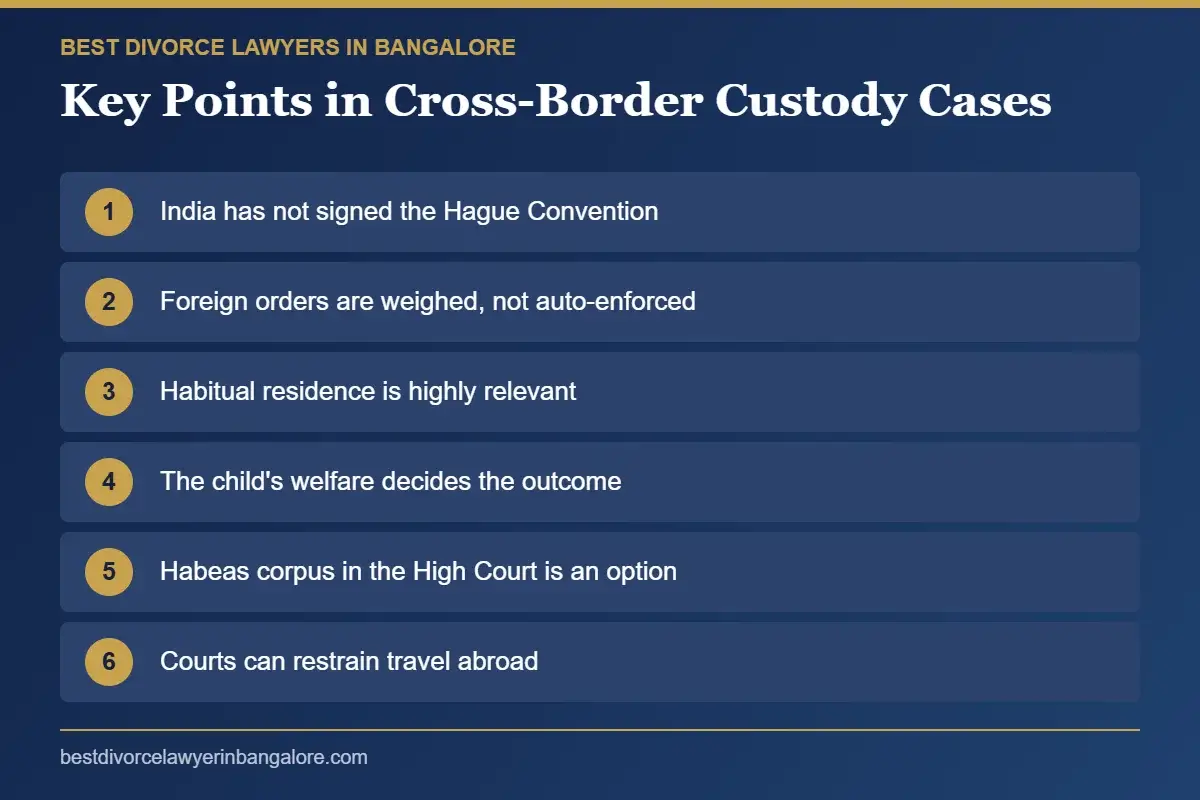
International child custody cases in India usually arise when one parent brings a child to India from abroad, or wants to take a child abroad, without the other parent’s agreement. India has not signed the 1980 Hague Convention on child abduction, so there is no automatic return mechanism. Indian courts treat a foreign custody order as an important factor but not as binding, and decide on the child’s welfare, either by ordering a quick return to the country of habitual residence or by holding a full enquiry, as the Supreme Court explained in Nithya Anand Raghavan v. State (NCT of Delhi) (2017).
When international custody disputes arise
- A parent living abroad brings the child to India and does not return
- A parent in India wants to relocate abroad with the child
- Parents of different nationalities separate while living overseas
- A foreign court has passed a custody order and one parent is in India with the child
- An NRI parent seeks visitation with a child living in Bengaluru
These cases raise questions beyond who should have custody: which country’s courts should decide, what weight a foreign order carries, and whether the child should go back.
Which court can decide?
An Indian court can hear a custody case if the child is within its jurisdiction. Under Section 9 of the Guardians and Wards Act, 1890, a guardianship petition is filed where the child ordinarily resides, and Family Courts in Bengaluru hear such cases under the Family Courts Act, 1984. A parent seeking the child’s return can also file a habeas corpus writ petition in the High Court, which for Bengaluru is the Karnataka High Court. A key question in either route is the child’s habitual residence, meaning where the child had been living a settled life before the dispute. It is highly relevant, but it is not an automatic rule; the court weighs the child’s connections to each country and the practical consequences.
Are foreign custody orders binding in India?
No. A foreign custody order is an important consideration, and Indian courts respect it in the spirit of comity between courts, but it is not enforced automatically. In Nithya Anand Raghavan v. State (NCT of Delhi) (2017) 8 SCC 454, the Supreme Court held that the child’s welfare is paramount and that Indian courts may either order the child’s return through a summary enquiry or hold an elaborate enquiry into welfare, depending on how long the child has been in India, how settled they have become and whether return would harm them. In later cases, including Lahari Sakhamuri v. Sobhan Kodali (2019) and Yashita Sahu v. State of Rajasthan (2020), the Court ordered children returned to the USA where that served their welfare. In Sharmila Velamur v. V. Sanjay (2025), it reiterated that a foreign order must give way to a proper enquiry into the child’s welfare.
International parental child abduction
Parental abduction usually means removing or keeping a child in another country in breach of the other parent’s custody rights. Because India is not a party to the Hague Convention, the Convention’s fast-track return procedure does not apply to children brought to India. The left-behind parent must use Indian law: a custody or guardianship petition in the Family Court, or a habeas corpus petition in the High Court seeking production and return of the child. A writ petition is not a substitute for a full custody case in every situation; the High Court may direct the parties to the Family Court where the facts are disputed.
Stopping a child from being taken abroad
If you fear the other parent will take the child out of India, act early. You can ask the Family Court for an order restraining the child’s removal from India, directing the child’s passport to be deposited in court, and requiring consent and undertakings before any travel. Minors’ passports usually need both parents’ consent, which is itself a safeguard. Where travel is allowed, courts often require the travelling parent to file an undertaking or provide security to return the child by a fixed date.
Visitation for a parent living abroad
A parent living abroad can be given visitation in India during holidays, regular video calls, and sometimes permission to take the child abroad for vacations on strict conditions. In Yashita Sahu, the Supreme Court stressed that video contact should be part of access where parents live in different countries. See child visitation rights in India for how schedules are set.
Documents and evidence to prepare
- Passports, visas and immigration records of the child and both parents
- The child’s birth certificate and citizenship documents
- Any foreign custody orders, pending filings and court correspondence
- School records and proof of residence in each country
- Messages and emails about travel, relocation, consent and return dates
- Evidence of how long the child has lived in each country
Documents issued abroad may need apostille or other authentication before an Indian court will rely on them. Your advocate will advise on the formalities.
What not to do
Do not conceal the child’s whereabouts, ignore court orders in either country, or try to take the child back without legal process. Self-help can lead to criminal complaints, look-out circulars and orders against you in both jurisdictions, and it rarely helps the child. Get coordinated advice from family lawyers in India and in the other country as early as possible to avoid conflicting orders.
For the general principles Indian courts apply, see how courts decide child custody.
For the overall framework, see our guide to child custody laws in India.
How this guide was prepared
This guide is based on the bare acts published on India Code and on judgments of the Supreme Court of India and the Karnataka High Court. Section numbers, case citations and time limits were fact-checked in November 2026, and criminal-law references use the Bharatiya Nyaya Sanhita (BNS) and Bharatiya Nagarik Suraksha Sanhita (BNSS) in force since 1 July 2024. It is general information, not legal advice. For advice on your own case, speak to an advocate. Read our editorial standards and disclaimer.
Frequently Asked Questions
Is India a member of the Hague Convention on child abduction?
No. India has not signed the 1980 Hague Convention, so there is no automatic return procedure. Parents must use custody or habeas corpus proceedings under Indian law.
Will an Indian court enforce a US or UK custody order?
Not automatically. Indian courts treat a foreign order as an important factor but decide on the child’s welfare, sometimes ordering return and sometimes holding a full enquiry.
What can I do if my spouse brought our child to India without consent?
You can file a habeas corpus petition in the High Court seeking the child’s production and return, or a custody petition in the Family Court where the child is living. Act quickly.
How can I stop my spouse taking our child abroad?
Apply to the Family Court for an order restraining the child’s removal from India and directing the child’s passport to be deposited in court.
Speak to a child custody lawyer in Bangalore
Cross-border custody cases turn on the child’s habitual residence, the circumstances of the move, any foreign orders and, above all, the child’s welfare. Because India is outside the Hague Convention, outcomes depend heavily on the facts and on acting quickly through the right court. If you need advice on your own situation, consult an experienced child custody lawyer in Bangalore, or compare the top family and divorce lawyers in Bangalore on our list. The first consultation is free.