A one sided divorce in India is a divorce sought by one spouse without the other’s consent, which the law calls a contested divorce. It is entirely possible: your spouse cannot block a divorce by refusing to sign, but you must prove a legal ground such as cruelty, desertion or adultery before the Family Court. Here is how it works in practice, what it takes, and what to expect if you are filing in Bangalore.
What Does One Sided Divorce in India Mean?
“One sided divorce” is everyday language, not a legal term. It describes a case where only one spouse wants the marriage to end, so a joint petition for mutual consent divorce is not possible. Instead, that spouse files a petition alone, naming the other as the respondent, under the personal law that applies to the marriage: Section 13 of the Hindu Marriage Act, 1955, Section 27 of the Special Marriage Act, 1954, Section 10 of the Divorce Act, 1869, or the corresponding provisions for Muslim and Parsi marriages. Our overview of divorce laws in India explains which law applies to you.
The key difference from a mutual divorce is that the court will not grant a decree just because one person wants it. You must establish a ground recognised by law, through evidence, in a trial. If you want a fuller side-by-side view, see our comparison of mutual divorce vs contested divorce.
When Can You Seek Divorce Without Your Spouse’s Consent?
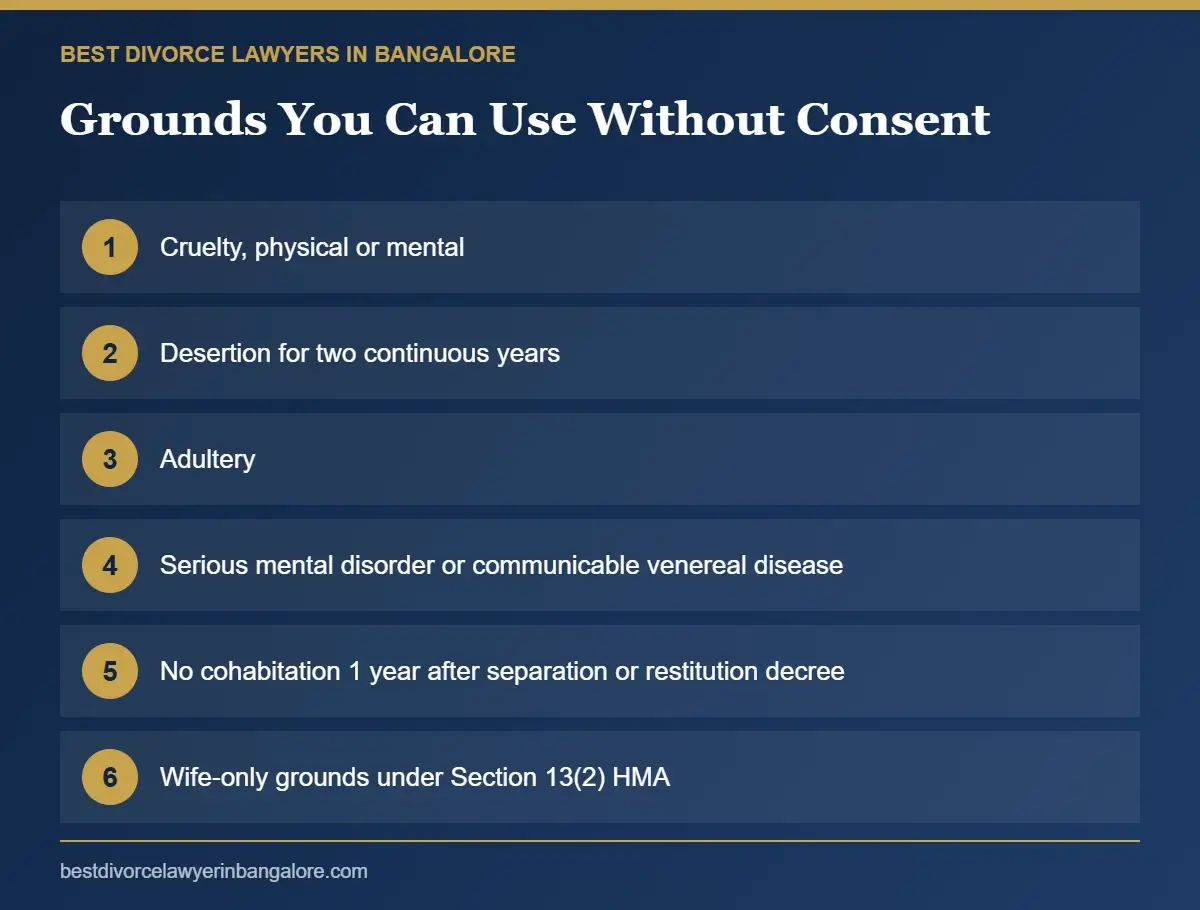
You need at least one statutory ground. Under the Hindu Marriage Act, the most commonly used are:
- Cruelty, physical or mental, of a kind that makes it unreasonable to expect you to continue living together.
- Desertion for a continuous period of at least two years before filing, without reasonable cause and without your consent.
- Adultery after marriage.
- Serious mental disorder, conversion to another religion, communicable venereal disease, renunciation, or not being heard of for seven years.
- Non-compliance with an earlier decree: no cohabitation for a year after a judicial separation decree, or no restitution for a year after a restitution decree.
A wife also has additional grounds under Section 13(2), for example where she obtained a maintenance order and cohabitation has not resumed for a year since. Each of these is explained in detail in our guide to the grounds for divorce in India.
What is not enough on its own
“We are incompatible” or “I no longer love my spouse” are not grounds in themselves. Irretrievable breakdown of marriage is also not a statutory ground. The Supreme Court held in Shilpa Sailesh v. Varun Sreenivasan (2023) that it can dissolve a broken marriage under Article 142 of the Constitution, but that power belongs only to the Supreme Court, is used sparingly, and is not something a Family Court in Bangalore can apply. The facts behind a breakdown, such as a long separation with hostility or false complaints, may still amount to cruelty or desertion if properly pleaded and proved.
Timing rules
Under Section 14 of the Hindu Marriage Act, you generally cannot file for divorce within the first year of marriage unless the court permits it for exceptional hardship or exceptional depravity. Desertion requires the two-year period to be complete before you file.
How a One Sided Divorce Case Is Started
- Legal consultation and evidence review. Your lawyer identifies the strongest ground and checks what evidence supports it.
- Drafting the petition. The petition sets out the marriage details, the facts relied on, the ground, and the reliefs you seek, such as custody, permanent alimony or return of articles.
- Filing in the right court. Under Section 19 of the Hindu Marriage Act, you can file where the marriage took place, where the respondent lives, where you last lived together, or, for a wife, where she now lives. In Bangalore Urban, this is the Family Court complex near Lalbagh Main Gate on Siddaiah Road.
- Notice to the spouse. The court issues summons. The respondent files a written statement and may make counter-claims.
- Mediation and reconciliation. The court will usually refer you to mediation before trial.
- Trial and judgment. Evidence, cross-examination and arguments follow, then the decree.
For the paperwork and stages in more depth, read how to file for divorce in India and our guide to the divorce process in Bangalore.
Does the Other Spouse Have to Sign Anything?
No. In a contested case, the respondent’s signature or agreement is not required at any stage. Refusing to sign, refusing to accept notice, or simply staying silent does not stop the case. What the respondent can do is defend: deny the allegations, lead their own evidence, and cross-examine you and your witnesses. The court then decides on the evidence.
What If Your Spouse Avoids the Court?
Some respondents try to delay by dodging summons. Courts deal with this routinely. If ordinary service fails, the court can order substituted service, for example by affixing the notice at the last known address or publishing it in a newspaper. Once the court is satisfied that the respondent has been duly served and still does not appear, it can set them ex parte and proceed to hear your evidence. You still need to prove your ground, but without opposition.
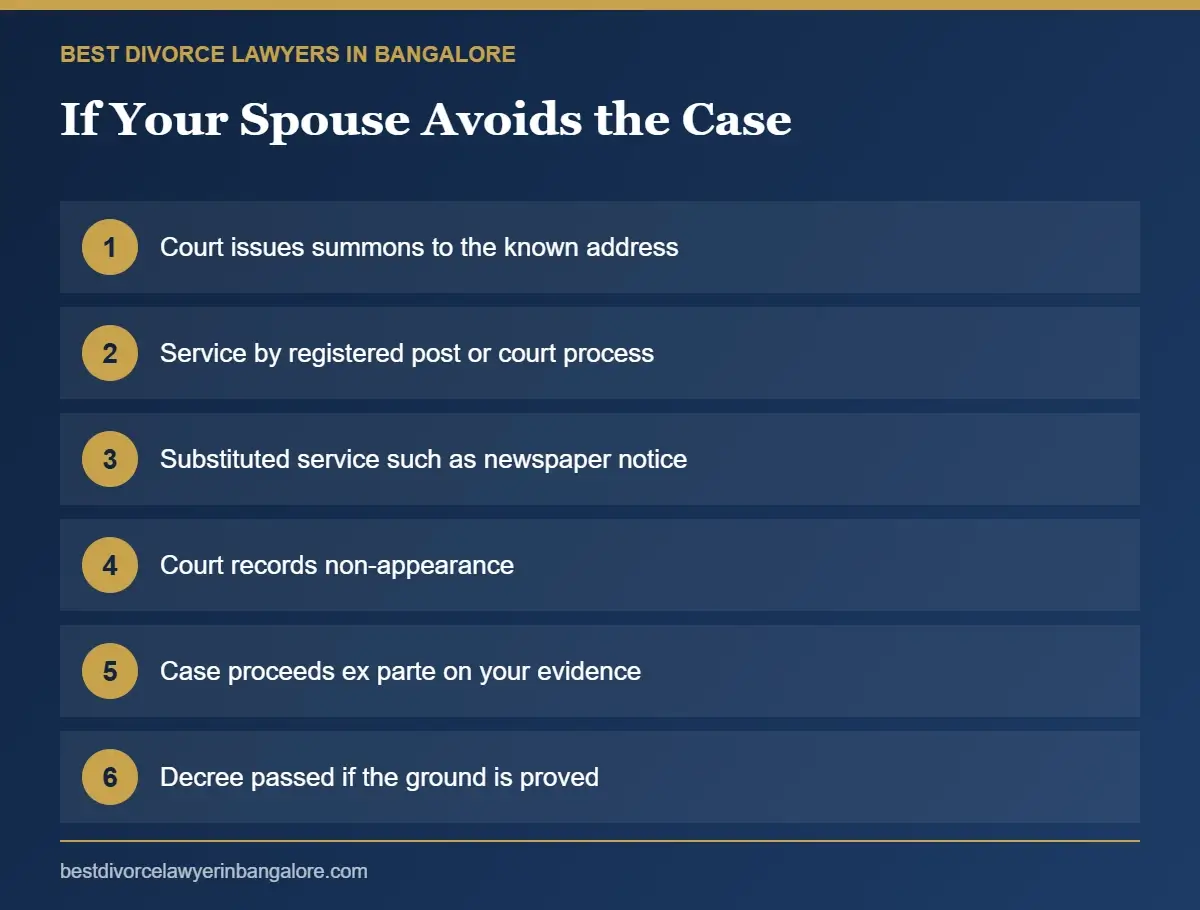
An ex parte decree can be challenged by the respondent if they show they were not duly served or had sufficient cause for not appearing, so proper service matters.
How Long Does a One Sided Divorce Take?
There is no fixed timeline. Section 21B of the Hindu Marriage Act asks courts to try to finish divorce trials within six months of notice, but contested cases in Bangalore commonly take much longer, often a few years, depending on how many witnesses there are, how many interim applications are filed and how often matters are adjourned. Cases where the respondent does not appear can move faster. A decree can also be appealed to the Karnataka High Court.
Children, Maintenance and Property
A one sided divorce case does not freeze everything else. While the case is pending:
- Either spouse can seek interim maintenance and litigation expenses under Section 24 of the Hindu Marriage Act if they lack independent income.
- A wife, children or dependent parents can also claim maintenance under Section 144 of the Bharatiya Nagarik Suraksha Sanhita, 2023 (formerly Section 125 CrPC).
- Interim custody and visitation can be decided, always guided by the welfare of the child.
- At the end, the court can award permanent alimony under Section 25 and decide custody under Section 26.
Practical Tips Before You File
- Write down a dated timeline of key events while your memory is fresh.
- Keep copies of messages, emails, medical records and any police complaints.
- Do not exaggerate. Allegations you cannot prove may hurt your credibility and can even be used against you.
- Keep the door to settlement open. Many one sided cases end with a negotiated mutual consent divorce.
A contested divorce lawyer in Bangalore can assess whether your facts support a ground and how strong your evidence is.
How this guide was prepared
This guide is based on the bare acts published on India Code and on judgments of the Supreme Court of India and the Karnataka High Court. Section numbers, case citations and time limits were fact-checked in October 2026, and criminal-law references use the Bharatiya Nyaya Sanhita (BNS) and Bharatiya Nagarik Suraksha Sanhita (BNSS) in force since 1 July 2024. It is general information, not legal advice. For advice on your own case, speak to an advocate. Read our editorial standards and disclaimer.
Frequently Asked Questions
Can a wife get a one sided divorce in India?
Yes. A wife can file a contested petition on any ground available to either spouse, and also on the additional wife-only grounds in Section 13(2) of the Hindu Marriage Act.
Can a husband get a divorce if the wife refuses?
Yes. A husband can file a contested petition on grounds such as cruelty, desertion or adultery. The wife’s refusal does not stop the case, though she can defend it.
Can I get a one sided divorce if my spouse lives abroad?
Yes. The petition can be filed in India in a court with jurisdiction, and notice is served abroad through permitted modes. If the spouse does not appear after due service, the court may proceed ex parte.
Is long separation enough for a one sided divorce?
Separation alone is not a ground under the Hindu Marriage Act. However, long separation may support desertion or, combined with other conduct, mental cruelty, depending on the facts.
Can I withdraw a one sided divorce petition later?
Yes, the petitioner can usually withdraw the petition with the court’s permission, for example after reconciliation or a mutual settlement.
If your spouse will not agree to a divorce, you still have a clear legal path. Speak to a divorce lawyer in Bangalore to review your facts and plan the strongest way forward.