Divorce mediation in India is a confidential, voluntary process in which a trained neutral mediator helps spouses negotiate their own settlement on divorce, alimony, child custody and property, usually after a family court refers the case. If mediation succeeds, the agreed terms are placed before the court and can become the basis of a mutual consent decree; if it fails, the case simply returns to court.
What Is Divorce Mediation?
Mediation is not a court hearing and the mediator is not a judge. The mediator does not decide who is right, does not record evidence and cannot impose a result. Their job is to help both spouses talk productively, understand each other’s priorities and explore practical options. Everything said in mediation is confidential and, as a rule, cannot later be used as evidence in court.
Because the spouses design the outcome themselves, mediated settlements tend to be more workable than orders imposed after a long trial, particularly where children are involved and the parents will need to cooperate for years. If mediation leads to a reconciliation instead, see whether a divorce petition can be withdrawn.
The Legal Basis for Divorce Mediation in India
- Section 89 of the Code of Civil Procedure allows courts to refer disputes to mediation and other settlement methods. The Supreme Court in Afcons Infrastructure v. Cherian Varkey Construction (2010) identified matrimonial disputes as well suited to mediation.
- Section 23(2) of the Hindu Marriage Act requires the court, in the first instance and where possible, to make every effort to bring about reconciliation between the parties.
- Section 9 of the Family Courts Act, 1984 places a duty on family courts to try to persuade parties to settle.
- K. Srinivas Rao v. D.A. Deepa (2013): the Supreme Court urged courts to refer matrimonial disputes to mediation at the earliest stage and encouraged pre-litigation mediation.
- The Mediation Act, 2023 creates a broader statutory framework for mediation in India. Its provisions are being brought into force in stages, so family court mediation continues to rely heavily on the CPC and court rules as well.
For an overview of how mediation fits into the wider system, see our hub on divorce laws in India.
Where Divorce Mediation Happens in Bengaluru
In Bengaluru, most matrimonial mediation is court-annexed. When a petition is filed in the Family Courts near Lalbagh Main Gate on Siddaiah Road, the judge will often refer the parties to counselling or to the Bangalore Mediation Centre. The Centre also runs a pre-litigation desk where spouses can attempt mediation of matrimonial disputes before any case is filed. Cases pending in the Karnataka High Court, for example appeals or transfer petitions, can also be referred to mediation, and the Supreme Court regularly refers matrimonial transfer petitions to mediation as well.
Private mediation by trained mediators is another option. The settlement still has to be placed before the court to become binding as a divorce decree.
The Divorce Mediation Process, Step by Step
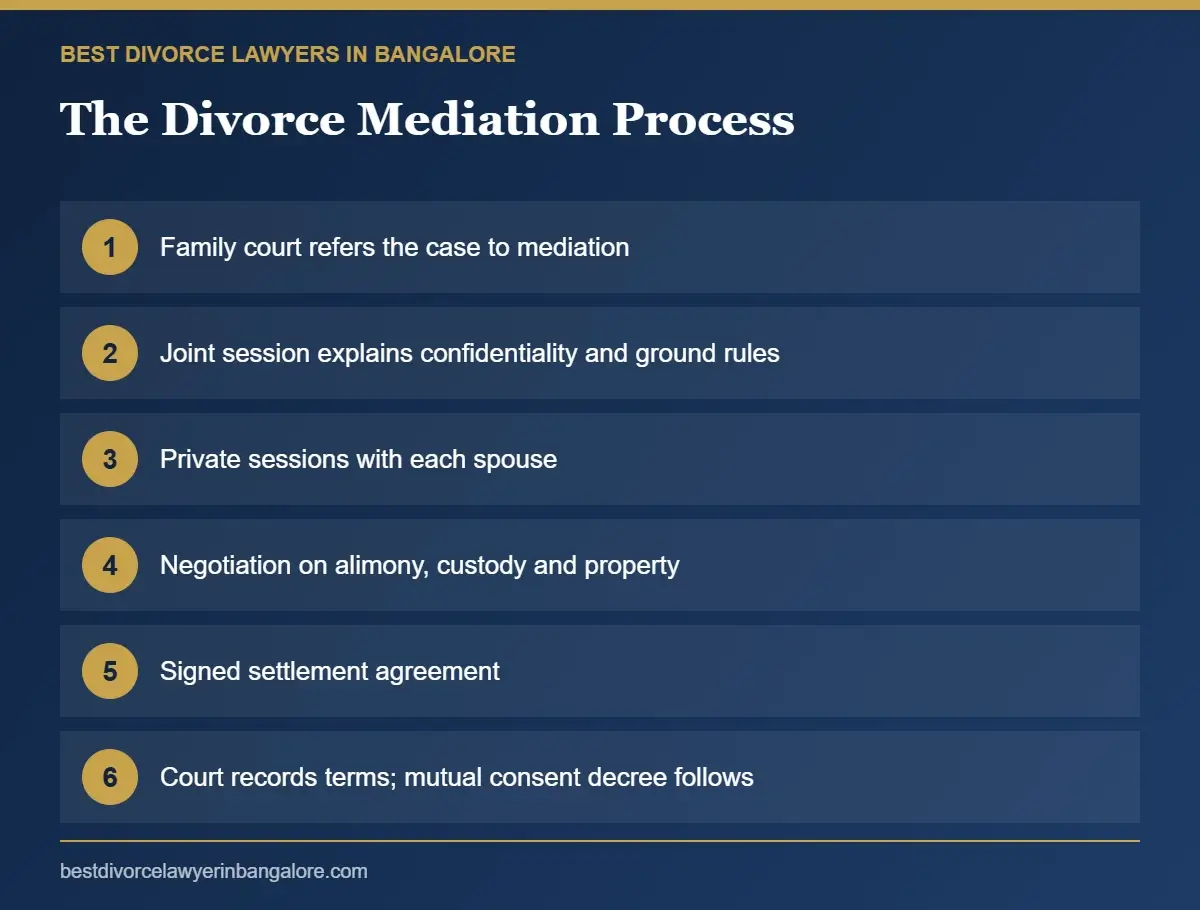
- Referral: the family court refers the matter, or the spouses approach a mediation centre themselves.
- Joint session: the mediator explains the ground rules, confidentiality and the voluntary nature of the process.
- Separate sessions: the mediator meets each spouse privately (a “caucus”) to understand their real concerns and what they can accept.
- Negotiation: proposals on alimony, custody, visitation, property and pending cases go back and forth, often across several sittings.
- Settlement agreement: if both agree, the mediator records the terms in writing and both spouses and their advocates sign.
- Court stage: the agreement goes back to the referring court, and where the parties have agreed to divorce, a petition for mutual consent divorce is filed or the pending petition is converted to one.
What Can Be Settled in Mediation?
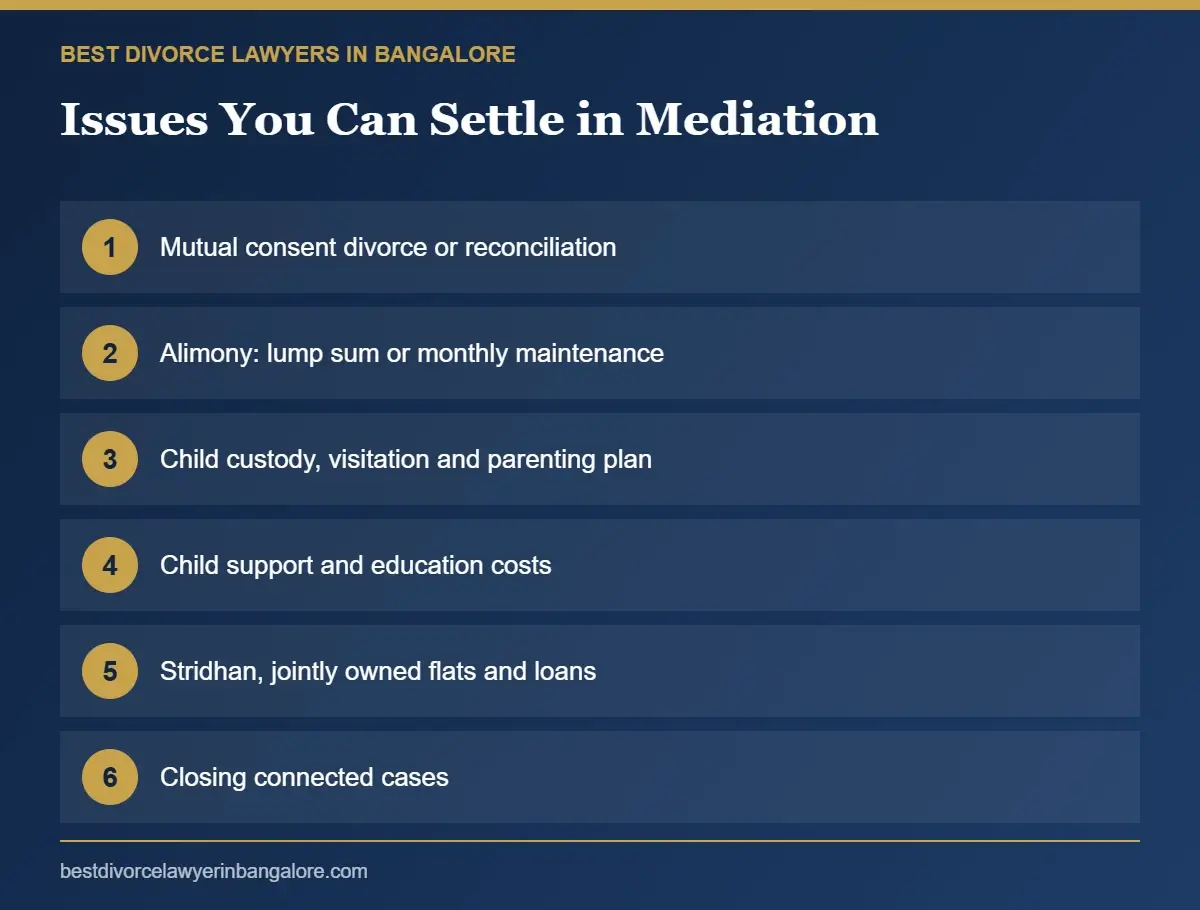
Almost every issue connected with the breakdown of a marriage can be negotiated in mediation:
| Issue | Typical points agreed |
|---|---|
| The divorce itself | Whether to divorce by mutual consent, or attempt reconciliation |
| Alimony | One-time settlement or monthly maintenance, and payment schedule |
| Child custody | Physical custody, visitation, holidays, schooling, travel abroad |
| Child support | School fees, medical costs, monthly support |
| Property | Stridhan and jewellery, jointly owned flats, home loans, vehicles |
| Other cases | Withdrawal of domestic violence, maintenance or other connected cases |
Criminal cases need care. A complaint of cruelty under Sections 85 and 86 of the Bharatiya Nyaya Sanhita (formerly Section 498A IPC) cannot simply be “withdrawn” by agreement, because it is a non-compoundable offence. Where spouses settle, the usual route is a joint petition before the High Court to quash the proceedings under its inherent powers, now preserved in Section 528 of the Bharatiya Nagarik Suraksha Sanhita. The Supreme Court recognised this approach for matrimonial disputes in Gian Singh v. State of Punjab (2012). Settlement terms should state clearly who will file what, and when.
Benefits and Limits of Mediation
Why Mediation Often Works
- Speed: a settled case can move to a mutual consent decree in months rather than years. Our guide on how long divorce takes in India compares realistic timelines.
- Cost: fewer hearings means lower legal fees; see our breakdown of the cost of divorce in Bangalore.
- Control: the spouses, not a judge, decide the outcome.
- Privacy: sessions are confidential and personal details stay out of court records.
- Children: parents who agree a parenting plan usually find it easier to co-parent afterwards.
When Mediation May Not Be Suitable
Mediation depends on both people being able to negotiate freely. It may not be appropriate where there is serious domestic violence, threats or a strong imbalance of power, or where one spouse is hiding assets. Tell the court or mediator about safety concerns at the outset; you can ask for separate sessions, or for the matter to proceed in court. No one can be forced to settle.
What Happens If Mediation Fails?
If no settlement is reached, the mediator sends a short report to the court stating only that mediation was unsuccessful, without revealing what was discussed. The case then continues as a contested matter with pleadings, evidence and arguments. Our comparison of mutual divorce vs contested divorce explains what that path involves. Partial settlements are possible too: spouses sometimes agree on custody in mediation and leave only the financial issues for the court.
Preparing for Divorce Mediation
- List your priorities and the points you can be flexible on.
- Collect income, asset and expense details so offers are realistic.
- Think about a detailed parenting plan, not just “custody”.
- Discuss your bottom line with your lawyer before each session.
- Do not sign anything you do not fully understand; ask for time if needed.
Once the settlement is signed, the divorce usually proceeds by mutual consent, as explained in our guide to the divorce process in Bangalore.
How this guide was prepared
This guide is based on the bare acts published on India Code and on judgments of the Supreme Court of India and the Karnataka High Court. Section numbers, case citations and time limits were fact-checked in October 2026, and criminal-law references use the Bharatiya Nyaya Sanhita (BNS) and Bharatiya Nagarik Suraksha Sanhita (BNSS) in force since 1 July 2024. It is general information, not legal advice. For advice on your own case, speak to an advocate. Read our editorial standards and disclaimer.
Frequently Asked Questions
Is divorce mediation compulsory in India?
Settling is never compulsory, but family courts are required to attempt reconciliation and settlement, so most Bengaluru judges will refer spouses to counselling or mediation early in the case. Attending in good faith is expected; agreeing is not.
Do I need a lawyer during mediation?
Mediators often meet the spouses directly, but having your advocate review proposals and the final agreement is strongly advisable, because the settlement will usually become the basis of a binding court decree.
How many mediation sessions does it take?
It varies. Simple cases may settle in two or three sittings, while cases involving children, property and pending criminal complaints can take several sessions over a few months.
Can a mediated settlement be challenged later?
A settlement recorded by the court and followed by a decree is difficult to undo. It can be questioned mainly on grounds like fraud or coercion, so read every clause carefully before signing.
Can mediation happen online if my spouse lives in another city or abroad?
Yes. Mediation centres and courts increasingly allow sessions by video conference, which is especially useful in NRI and inter-city cases.
Get Support Through Mediation
A good settlement starts with knowing your rights before you sit down to negotiate. The top divorce lawyers in Bangalore can prepare you for mediation, review proposals and make sure the final terms protect you and your children. Once you reach agreement, our mutual divorce lawyers in Bangalore can take the settlement through to a final decree.