How long does divorce take in India? A mutual consent divorce typically takes around six to eighteen months from filing, and can be quicker if the court waives the six-month cooling-off period. A contested divorce has no fixed timeline and commonly runs for a few years, depending on the court, the evidence and how hard each side fights. Below is a stage-by-stage picture of both routes, with practical notes for cases in Bangalore.
How Long Does Divorce Take in India? The Short Answer
| Type of divorce | Legal minimums | Realistic range |
|---|---|---|
| Mutual consent (Hindu Marriage Act s.13B / Special Marriage Act s.28) | 1 year of separation before filing; 6 months between first and second motion (waivable) | Often about 6 to 18 months after filing; sometimes a few weeks to a few months if waiver is granted |
| Mutual consent (Christians, Divorce Act s.10A) | 2 years of separation before filing; 6 months between motions | Similar to the above after filing |
| Contested divorce | Generally no petition within 1 year of marriage; ground must be proved | Commonly a few years, plus any appeal |
| Contested case where respondent does not appear | Due service must be proved | Often faster than a fully contested trial |
These ranges are general experience, not guarantees. Court workload, adjournments and the parties’ own conduct make a large difference. For background on the two routes, see our comparison of mutual divorce vs contested divorce.
Mutual Consent Divorce Timeline
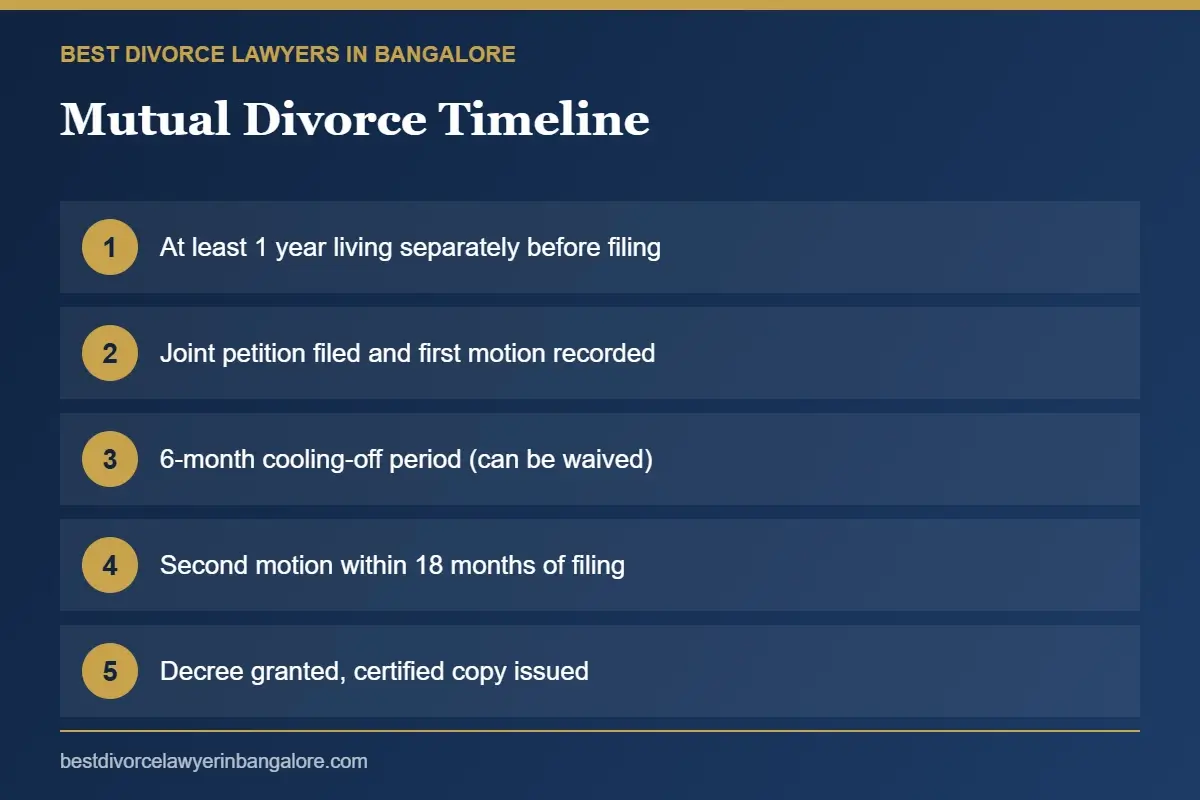
Before filing: one year of separation
Section 13B of the Hindu Marriage Act requires that the spouses have lived separately for at least one year before presenting the joint petition. This period is counted before filing; it is not part of the court process. Use it to settle alimony, custody, stridhan and property, because a complete written settlement is the single biggest factor in a fast mutual divorce.
First motion
The joint petition is filed in the Family Court. In Bangalore Urban, that is the Family Court complex near Lalbagh Main Gate on Siddaiah Road. Both spouses appear, the court may briefly explore reconciliation, and their statements are recorded. This usually takes one or a few hearings over a few weeks, depending on listing.
The six-month cooling-off period
Section 13B(2) says the second motion cannot be moved earlier than six months from the date the petition was presented, and not later than eighteen months. If neither spouse moves within eighteen months, the petition can lapse.
Waiver of the waiting period
In Amardeep Singh v. Harveen Kaur (2017), the Supreme Court held that the six-month period is not mandatory. A Family Court may waive it where the spouses have been separated for more than eighteen months in total, mediation has failed, and every issue is settled. Where a waiver is granted, the whole process can sometimes be completed within weeks or a few months of filing.
Second motion and decree
At the second motion, the court confirms that both spouses still consent and that agreed terms have been honoured, then passes the decree. Certified copies follow, which can take some days or weeks.
Contested Divorce Timeline, Stage by Stage
A contested divorce, sometimes called a one sided divorce in India, follows a trial process. The table shows the usual stages and how long each tends to take in practice.
| Stage | What happens | Typical duration |
|---|---|---|
| Filing and notice | Petition on a legal ground filed; summons served on the spouse | A few weeks to several months; longer if the spouse is abroad or evading service |
| Written statement | Respondent replies and may make counter-claims | Usually a few months, with adjournments |
| Mediation | Court refers the parties to mediation or counselling | A few sessions over weeks to months |
| Interim applications | Interim maintenance (s.24 HMA), interim custody, visitation | Runs alongside; can take months if heavily contested |
| Issues and evidence | Affidavits of evidence, documents, cross-examination of each witness | Often the longest stage, sometimes a year or more |
| Arguments and judgment | Final arguments and decree | A few months |
| Appeal (if any) | Appeal to the Karnataka High Court | Can add a year or more |
Section 21B of the Hindu Marriage Act asks courts to hear divorce trials day to day as far as possible and to try to conclude them within six months of notice. That is a goal, not a guarantee, and most contested cases in large cities take considerably longer. If the respondent does not appear after due service, the court can proceed ex parte, which often shortens the case; our guide to ex parte divorce in India explains how that works.
What Can Delay a Divorce Case?
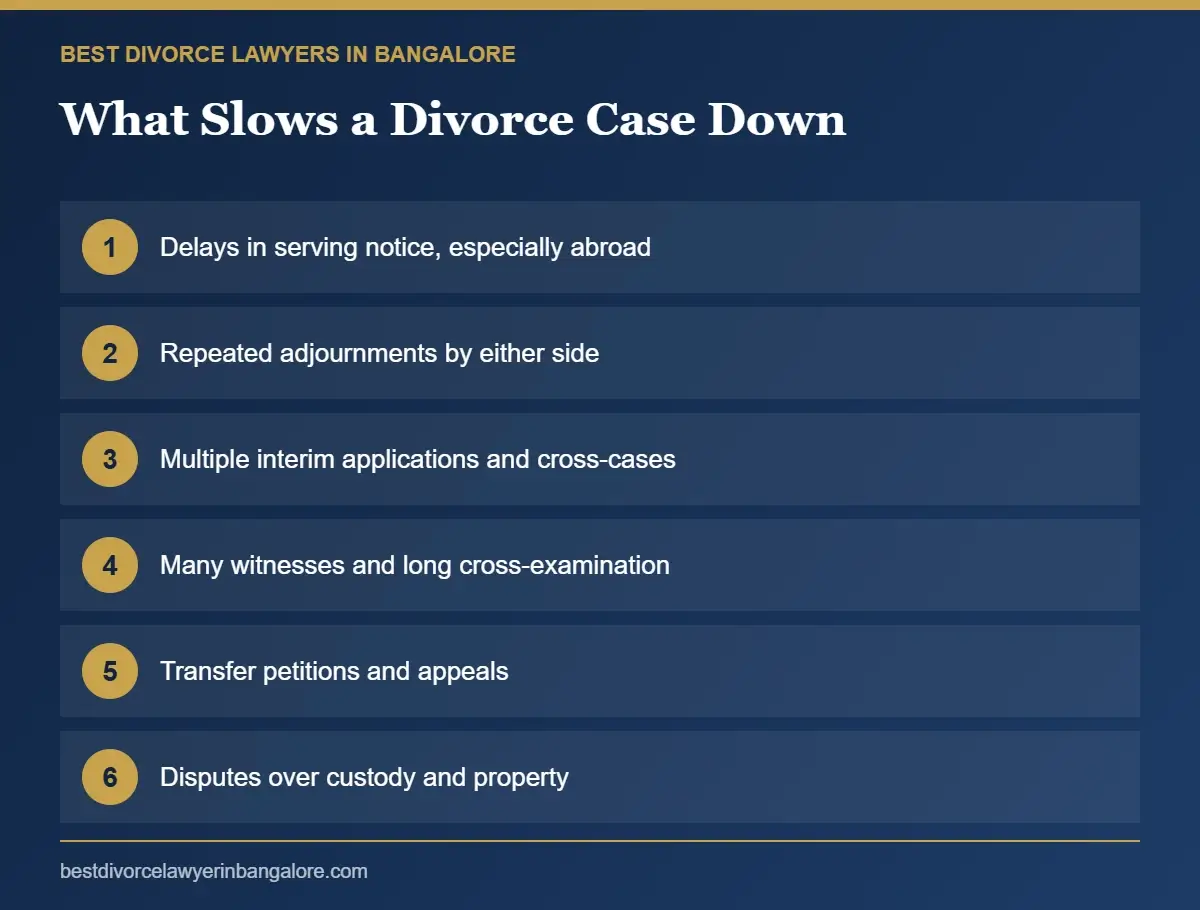
Delays usually come from a handful of sources. Service on a spouse living in another state or country can take months. Each side may seek adjournments. Parallel litigation, such as domestic violence cases, maintenance petitions under Section 144 of the Bharatiya Nagarik Suraksha Sanhita, 2023 (formerly Section 125 CrPC) or criminal complaints under Section 85 of the Bharatiya Nyaya Sanhita, 2023 (formerly IPC 498A), can slow everything down. Transfer petitions, where one spouse asks a higher court to move the case to another city, add further time.
How to Speed Up Your Divorce
- Settle if you can. Converting a contested case into a mutual petition is by far the quickest route.
- Prepare documents early. Marriage certificate, address proof, photographs, income and asset records, and any evidence for your ground.
- Choose the right ground. A well-chosen ground that you can prove avoids long, unproductive trials. Our guide to the grounds for divorce in India can help.
- File in the correct court. Jurisdiction mistakes can lead to the petition being returned.
- Apply for waiver where eligible. In mutual cases, a well-reasoned waiver application can save months.
- Attend every hearing. Missed dates are one of the most avoidable causes of delay.
A mutual divorce lawyer in Bangalore can help you structure a settlement and waiver application so your case moves as fast as the law allows. For the overall picture, read our overview of divorce laws in India.
After the Decree
Once the decree is passed, apply for a certified copy, which you will need for changing records and for any future marriage. Under Section 15 of the Hindu Marriage Act, remarriage is permitted once the appeal period has passed without an appeal, or any appeal has been dismissed. In contested cases, it is wise to wait until that period has clearly ended.
How this guide was prepared
This guide is based on the bare acts published on India Code and on judgments of the Supreme Court of India and the Karnataka High Court. Section numbers, case citations and time limits were fact-checked in October 2026, and criminal-law references use the Bharatiya Nyaya Sanhita (BNS) and Bharatiya Nagarik Suraksha Sanhita (BNSS) in force since 1 July 2024. It is general information, not legal advice. For advice on your own case, speak to an advocate. Read our editorial standards and disclaimer.
Frequently Asked Questions
Can a divorce be completed in one month in India?
Very rarely. Even with a waiver of the cooling-off period in a mutual divorce, you need at least one year of separation before filing and the court must list both motions. A few weeks after filing is possible in exceptional cases, but it should not be expected.
Does the one-year separation have to be in different homes?
Not necessarily. Courts have accepted that spouses can be living separately while under the same roof, if they are no longer living as husband and wife. You must still be able to explain this to the court.
Is there a time limit within which the court must decide a contested divorce?
There is no strict deadline. Section 21B of the Hindu Marriage Act sets a six-month target for trials, but it is directory, and actual duration depends heavily on the court and the parties.
Does a divorce take longer if children are involved?
It can, if custody and visitation are disputed, because the court must assess the child’s welfare and may interview the child or seek reports. Agreed parenting plans reduce this delay considerably.
Can I move court to transfer my divorce case to Bangalore?
A spouse can seek transfer of a case to another court, including from another state to Bangalore, through a transfer petition in the High Court or Supreme Court. Such petitions are decided on convenience and fairness, and they add time.
Every case moves at its own pace, but good preparation and sound advice make a real difference. Speak to one of the good divorce lawyers in Bangalore for a realistic estimate based on your facts.