Yes, you can withdraw a divorce petition in India at any stage before the court passes the final decree. In a contested case, the petitioner files a withdrawal memo or application under Order XXIII Rule 1 of the Code of Civil Procedure, and in a mutual consent case either spouse can withdraw consent before the second motion. What matters is whether you withdraw with or without the court’s permission to file again, and what happens to connected cases and settlement terms.
Why People Withdraw a Divorce Petition
Spouses withdraw divorce cases for many reasons: reconciliation after counselling or mediation, a change of heart for the children’s sake, a better settlement offer, a mistake in the petition, a wrong choice of court, or a decision to file on different grounds or by mutual consent instead. Whatever the reason, take legal advice before you file anything, because the way you withdraw can affect your right to file again later. Our hub on divorce laws in India gives the wider context.
How to Withdraw Divorce Petition Filed as a Contested Case
Divorce petitions under the Hindu Marriage Act are governed by the Code of Civil Procedure as far as possible (Section 21 of the Act). Order XXIII Rule 1 CPC sets out two kinds of withdrawal:
| Type | When it is used | Effect |
|---|---|---|
| Simple withdrawal (abandonment) | You no longer want to pursue the case, for example after reconciliation | You are generally barred from filing a fresh petition on the same subject matter and cause of action |
| Withdrawal with liberty to file afresh | The petition has a formal defect (wrong court, missing facts, defective verification) or there are other sufficient grounds | The court permits a fresh petition on the same cause of action, on terms it considers fit, including costs |
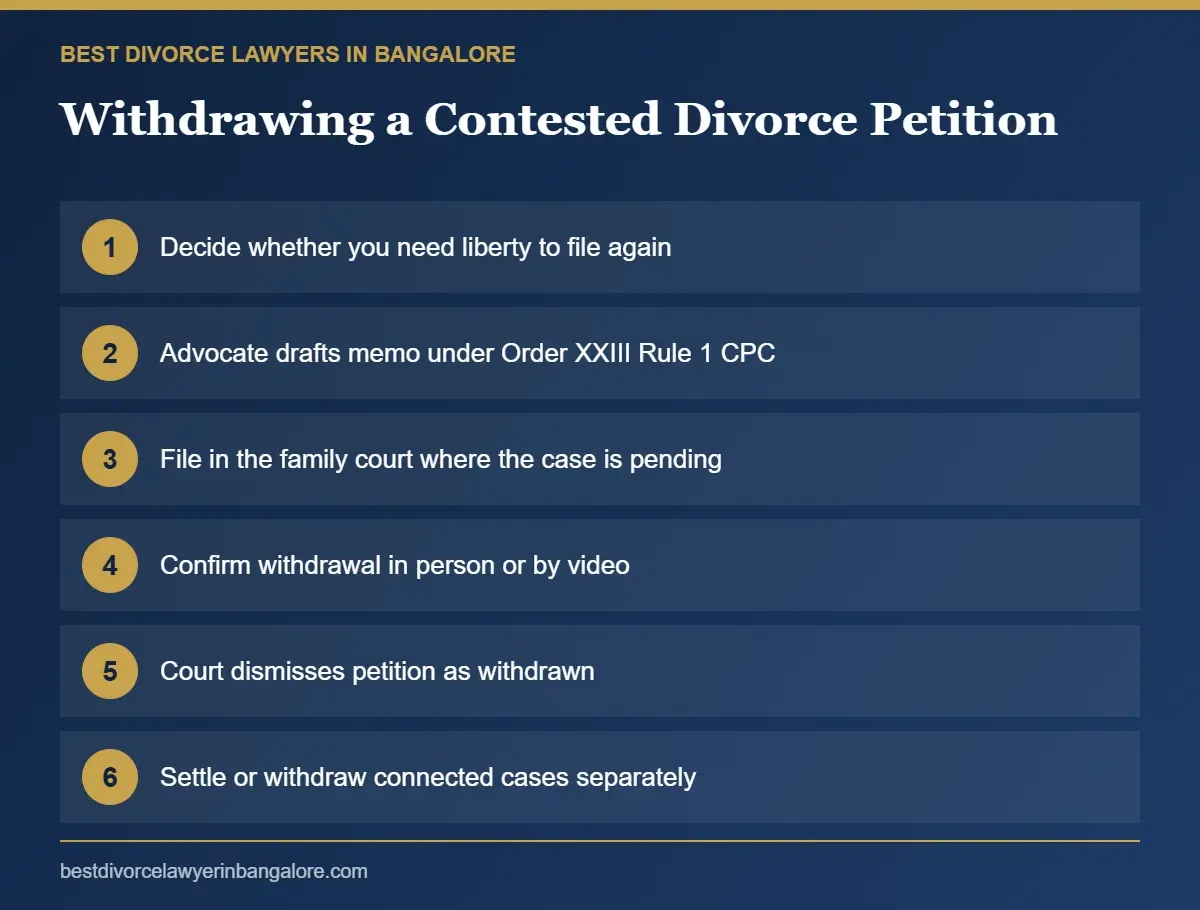
In practice, the petitioner’s advocate files a memo or application for withdrawal, usually signed by the petitioner personally. Family courts often want the petitioner present, in person or by video, to confirm the decision is voluntary. The court then dismisses the petition “as withdrawn”, with or without liberty, and may award costs to the other side.
Can You File Again After Withdrawing?
If you withdrew without the court’s permission, Order XXIII Rule 1(4) bars a fresh petition on the same subject matter. Matrimonial disputes are different from ordinary suits, though, because conduct continues over time. If new facts arise after the withdrawal, such as fresh acts of cruelty or a new period of desertion, they can give rise to a new cause of action. Whether a later petition is maintainable depends on its facts, so ask your lawyer to frame the withdrawal carefully, and seek liberty whenever there is a genuine reason to do so.
Before re-filing, you may want to reconsider the route. Our guides on mutual divorce vs contested divorce and how to file for divorce in India can help you choose.
What Happens to a Counter-Claim?
If the respondent has filed a counter-claim, for example for divorce on their own grounds, Order VIII Rule 6D CPC allows the counter-claim to continue even if the original petition is withdrawn. Withdrawing your petition therefore does not necessarily end the litigation.
Withdrawing From a Mutual Consent Divorce
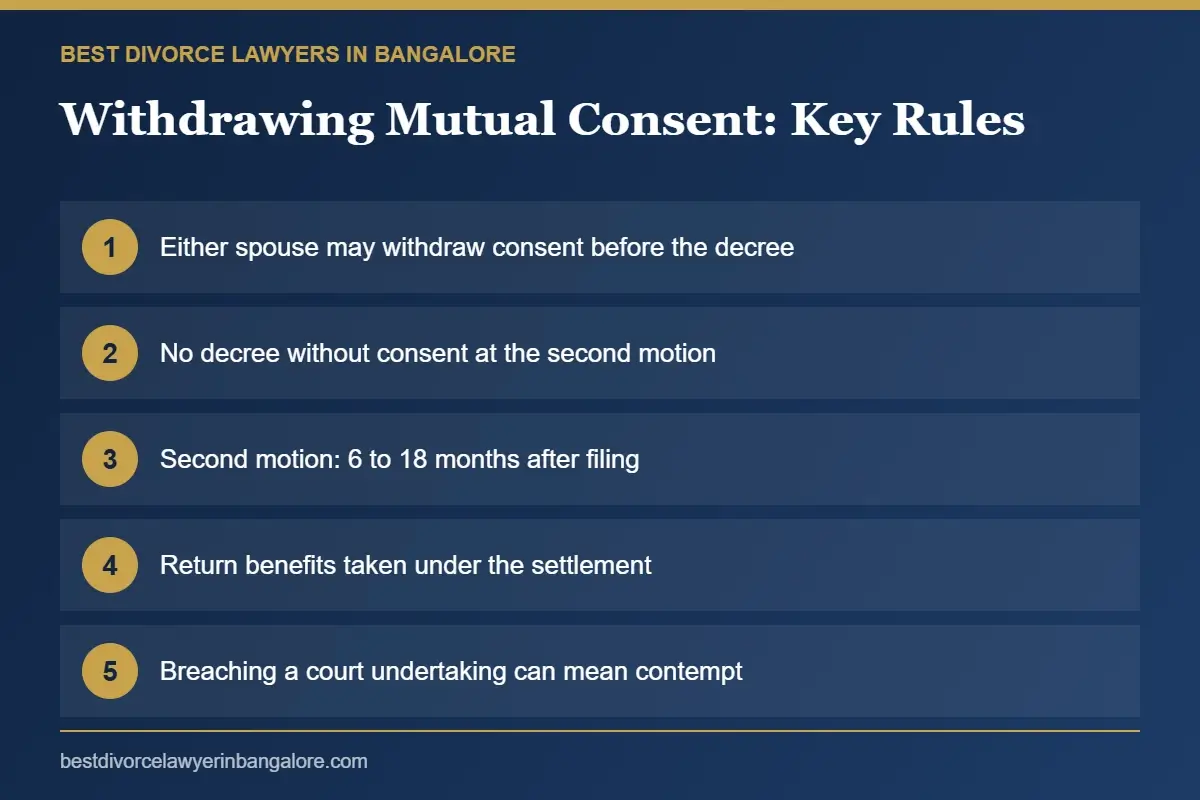
A mutual consent divorce under Section 13B of the Hindu Marriage Act happens in two stages: a joint first motion, and a second motion made not earlier than six months (unless waived) and not later than eighteen months after the petition is presented. The decree depends on both spouses still consenting at the second motion.
- In Sureshta Devi v. Om Prakash (1991), the Supreme Court held that either spouse can unilaterally withdraw consent at any time before the decree is passed.
- In Smruti Pahariya v. Sanjay Pahariya (2009), the Court confirmed that a family court cannot pass a mutual consent decree unless consent continues at the time of the second motion.
So if your spouse changes their mind before the second motion, the family court cannot grant a mutual consent divorce. You would then need to pursue a contested divorce on a statutory ground, or explore whether the other options in our guide to one sided divorce in India apply. In Shilpa Sailesh v. Varun Sreenivasan (2023), a Constitution Bench held that the Supreme Court itself can dissolve a marriage on irretrievable breakdown under Article 142 of the Constitution, but this is a discretionary power used sparingly and is not available in the family court.
Withdrawal After a Settlement
Many mutual consent petitions rest on settlement terms, often reached in mediation, under which money is paid in instalments, jewellery is returned or other cases are withdrawn. If one spouse takes the benefit of the first instalment and then withdraws consent, courts take a dim view. Depending on how the settlement was recorded, the court may direct the return of money or property received, and where a party breaches an undertaking given to the court, contempt proceedings may follow. To reduce risk, structure the settlement so that most payments are made at the second motion. Our guide to divorce mediation in India explains how these terms are usually drafted.
What Happens to Related Cases and Orders?
- Interim maintenance: an order under Section 24 of the Hindu Marriage Act lasts only while the divorce case is pending, so it ends when the petition is withdrawn.
- Separate maintenance cases: maintenance under Section 144 of the Bharatiya Nagarik Suraksha Sanhita or the Domestic Violence Act is independent and continues unless separately withdrawn or modified.
- Custody orders: interim custody arrangements made in the divorce case lapse with it; separate guardianship proceedings may be needed.
- Criminal complaints: a cruelty case under Sections 85 and 86 of the Bharatiya Nyaya Sanhita is non-compoundable, so withdrawing the divorce does not end it. Quashing requires a separate application to the High Court.
Can You Withdraw After the Divorce Decree?
No. Once the decree is passed, the petition cannot be withdrawn. A party aggrieved by a contested decree can appeal within the time allowed: 90 days under Section 28 of the Hindu Marriage Act, though some High Courts apply the 30-day limit in Section 19 of the Family Courts Act to Family Court decrees, so act promptly. If the spouses reconcile after the decree has become final, they cannot “cancel” the divorce; they must marry each other again. Mutual consent decrees are rarely appealable, because both parties agreed to them.
Steps to Withdraw a Divorce Petition in Bengaluru
- Discuss the reasons with your advocate and decide whether you need liberty to re-file.
- Your advocate drafts a withdrawal memo or application under Order XXIII Rule 1 CPC.
- File it in the Family Court where the case is pending (in Bengaluru, near Lalbagh Main Gate on Siddaiah Road).
- Appear on the listed date, in person or by video if permitted, and confirm the withdrawal is voluntary.
- Collect a certified copy of the order dismissing the petition as withdrawn.
- Withdraw or settle any connected cases separately, as agreed.
How this guide was prepared
This guide is based on the bare acts published on India Code and on judgments of the Supreme Court of India and the Karnataka High Court. Section numbers, case citations and time limits were fact-checked in October 2026, and criminal-law references use the Bharatiya Nyaya Sanhita (BNS) and Bharatiya Nagarik Suraksha Sanhita (BNSS) in force since 1 July 2024. It is general information, not legal advice. For advice on your own case, speak to an advocate. Read our editorial standards and disclaimer.
Frequently Asked Questions
Does the other spouse have to agree before I withdraw my contested divorce petition?
No. The petitioner can withdraw a contested petition without the respondent’s consent, although the court may award costs and the respondent’s counter-claim, if any, can continue.
Can I withdraw my petition if my spouse has not yet been served notice?
Yes. You can withdraw at any stage before the decree, including before notice is served. Withdrawing early usually keeps costs low.
Will withdrawing a divorce petition affect a domestic violence case?
Not automatically. A case under the Protection of Women from Domestic Violence Act, 2005 is separate and continues unless it is withdrawn or disposed of on its own.
Is there a fee to withdraw a divorce petition?
There is no significant court fee for a withdrawal memo, but you will still pay your advocate, and the court can order you to pay the other side’s costs if the withdrawal causes them hardship.
We reconciled after the first motion of our mutual consent divorce. What should we do?
Simply do not move the second motion, or file a joint memo informing the court. The petition will lapse or be dismissed, and your marriage continues as before.
Talk to a Lawyer Before You Withdraw
A withdrawal that is worded carelessly can stop you from filing again or leave connected cases hanging. Speak to one of the famous divorce lawyers in Bangalore before you sign anything. If you and your spouse would rather end the marriage amicably than fight, our mutual divorce lawyers in Bangalore can help you switch to a mutual consent petition.