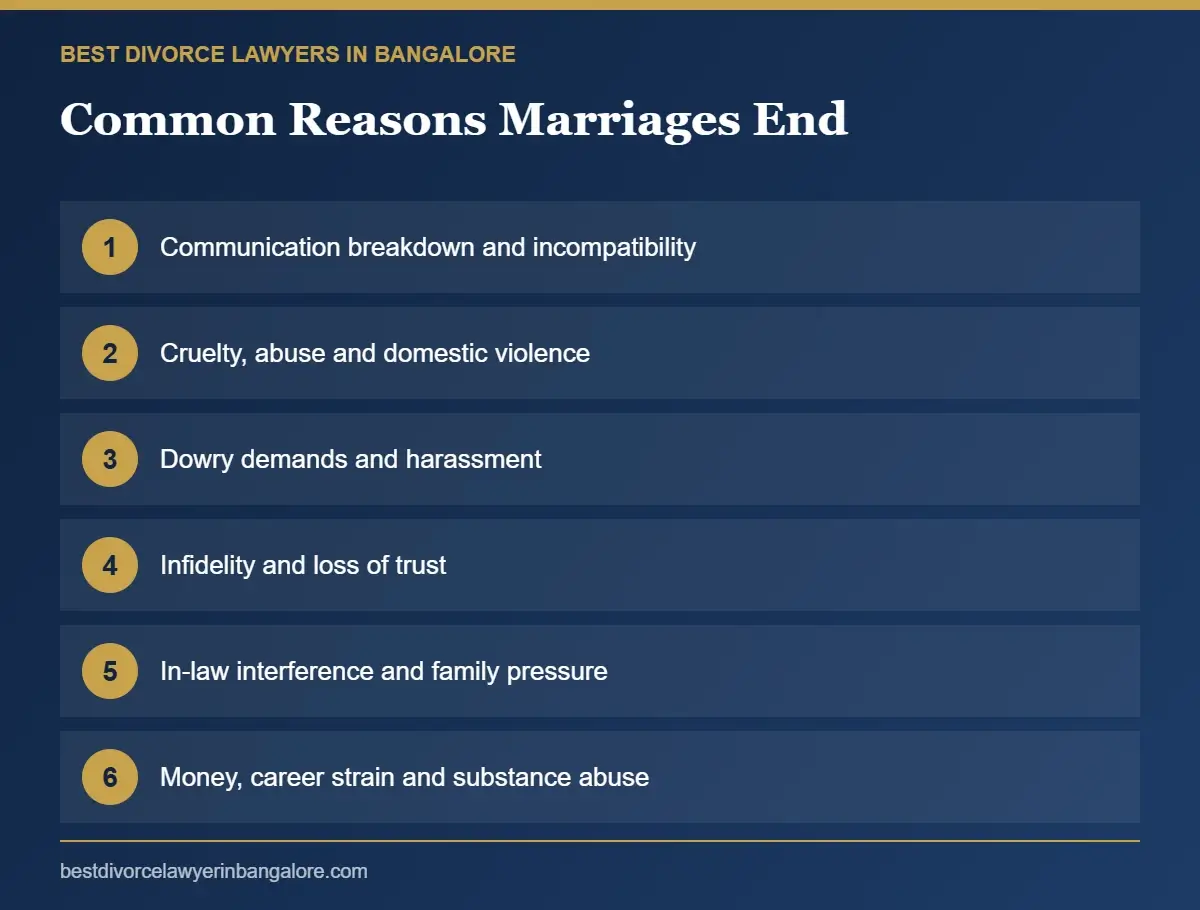
The most common reasons for divorce in India are breakdown of communication and compatibility, cruelty and domestic violence, infidelity, dowry and money disputes, interference from extended family, and the strain of careers and relocation. Not every reason is a legal ground, though: Indian courts grant divorce only on grounds the law recognises, or by mutual consent. This guide explains the real-life reasons couples separate and how each one maps onto the law.
Reasons for divorce vs legal grounds
A reason is why a marriage fails. A ground is what you must prove to a court if your spouse does not agree to the divorce. Under the Hindu Marriage Act, for example, the grounds include cruelty, desertion for two years, adultery, conversion, serious mental disorder and a few others. If both spouses simply agree that the marriage is over, they do not need a ground at all: they can file for mutual consent after a year of living separately. Our guide to grounds for divorce in India sets out every statutory ground under each personal law.
Common reasons for divorce in India
1. Communication breakdown and incompatibility
Many marriages end not with one dramatic event but with a slow erosion: constant arguments, silence, unrealistic expectations, or simply growing in different directions. Incompatibility is a very real reason for separation, but it is not by itself a ground for contested divorce. Couples in this situation usually choose mutual consent.
2. Cruelty and domestic violence
Physical violence, threats, humiliation, persistent abuse and controlling behaviour are among the most serious reasons for divorce. In law, cruelty covers both physical and mental cruelty. In Samar Ghosh v. Jaya Ghosh (2007), the Supreme Court gave an illustrative list of conduct that may amount to mental cruelty, such as sustained abusive treatment and a long, unilateral refusal of marital relations without good reason. In K. Srinivas Rao v. D.A. Deepa (2013), it held that making false and defamatory allegations against a spouse can itself be mental cruelty. Survivors can also seek immediate protection under the Protection of Women from Domestic Violence Act, 2005. Read more in our guide on cruelty as a ground for divorce.
3. Dowry demands and harassment
Although giving and taking dowry is an offence under the Dowry Prohibition Act, 1961, dowry-related harassment remains a reason many marriages break down. Cruelty by a husband or his relatives, including harassment to meet unlawful demands for property, is an offence under Sections 85 and 86 of the Bharatiya Nyaya Sanhita, 2023, which replaced Section 498A IPC. Such conduct also supports a divorce petition on the ground of cruelty.
4. Infidelity
An extramarital relationship often destroys trust beyond repair. Since Joseph Shine v. Union of India (2018), adultery is no longer a crime, but it remains a ground for divorce under the Hindu Marriage Act and the Special Marriage Act. Proving it usually depends on circumstantial evidence such as messages, travel records or photographs, gathered lawfully.
5. Interference from in-laws and extended family
Joint-family living, pressure over household roles, and parents taking sides in disputes are frequent triggers. Interference alone is not a ground, but where it amounts to sustained harassment of a spouse, it may form part of a cruelty case. Courts look at the whole picture, not isolated incidents.
6. Money, careers and relocation
Disagreements over spending, debt, property, and who controls income are a steady source of conflict. In a city like Bengaluru, long working hours, night shifts, frequent relocation for jobs, and the pressure of two demanding careers add to the strain. These are reasons rather than grounds, but financial control and deprivation can become part of a cruelty or maintenance case.
7. Alcohol and substance abuse
Addiction often comes with neglect, aggression and financial damage. Courts have treated habitual drunkenness accompanied by abusive behaviour as cruelty in appropriate cases. The focus is on the effect on the other spouse, not the habit alone.
8. Desertion and long-distance marriages
Some marriages end because one spouse simply leaves, or because one spouse moves abroad and never sends for the other. Desertion becomes a legal ground under the Hindu Marriage Act when it has continued for at least two years without reasonable cause and against the other spouse’s wishes. NRI marriages raise special issues of jurisdiction and service of notice.
9. Intimacy problems and non-consummation
Persistent refusal of marital relations without good reason can amount to mental cruelty. Where the marriage was never consummated owing to the respondent’s impotence, the more appropriate remedy under the Hindu Marriage Act may be annulment under Section 12 rather than divorce.
10. Mental illness and differing life goals
Serious mental disorder is a ground only when it is of a kind and degree that the petitioner cannot reasonably be expected to live with the respondent, and courts take care not to penalise ordinary, treatable conditions. Disagreements over having children, parenting, religion or where to live are, again, reasons that usually lead to mutual consent rather than a contested case.
How each reason fits the law
| Reason | Possible legal route |
|---|---|
| Incompatibility, constant conflict | Mutual consent divorce |
| Violence, abuse, harassment, false allegations | Divorce on the ground of cruelty; protection orders under the DV Act |
| Dowry harassment | Divorce on cruelty; criminal complaint under BNS s.85/86 and the Dowry Prohibition Act |
| Extramarital affair | Divorce on the ground of adultery |
| Spouse left and stayed away for 2+ years | Divorce on the ground of desertion |
| Non-consummation due to impotence | Annulment of a voidable marriage |
| Need for space without ending the marriage | Judicial separation |
Where both of you agree, mutual consent is almost always quicker and less damaging than proving a ground in court. Our comparison of mutual divorce vs contested divorce explains the trade-offs.
Irretrievable breakdown: what the law says now
Many marriages end simply because they have broken down beyond repair. Irretrievable breakdown is not a statutory ground under the Hindu Marriage Act. In Shilpa Sailesh v. Varun Sreenivasan (2023), however, the Supreme Court held that it can dissolve such a marriage itself under Article 142 of the Constitution. Family Courts cannot use that power, so in practice the choice remains between mutual consent and a proven ground.
Before you decide
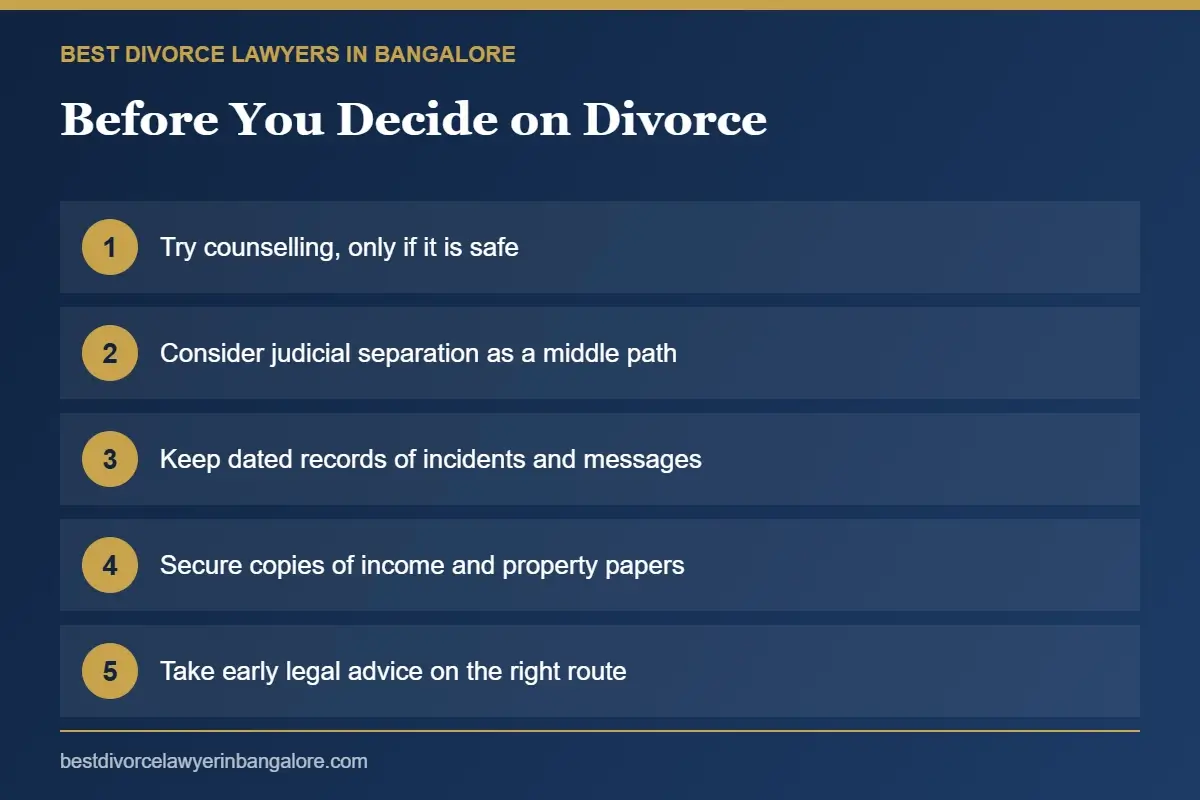
- Try counselling if it is safe. Many couples in Bengaluru benefit from a marriage counsellor or the counselling offered at the Family Courts. Never attempt reconciliation at the cost of your safety. Our guide on coping with divorce covers the emotional side of the process.
- Consider judicial separation. It lets you live apart with legal protection while keeping the marriage intact. See our guide to judicial separation vs divorce.
- Document what is happening. Keep dated notes, messages, medical records and police complaints. They matter if the case is contested.
- Protect yourself financially. Keep copies of income and property documents and know your claims to maintenance.
- Get legal advice early. A short consultation can tell you which route fits your situation. Women can get free legal aid through the Karnataka State Legal Services Authority.
For a wider view of the law, start with our hub on divorce laws in India.
How this guide was prepared
This guide is based on the bare acts published on India Code and on judgments of the Supreme Court of India and the Karnataka High Court. Section numbers, case citations and time limits were fact-checked in October 2026, and criminal-law references use the Bharatiya Nyaya Sanhita (BNS) and Bharatiya Nagarik Suraksha Sanhita (BNSS) in force since 1 July 2024. It is general information, not legal advice. For advice on your own case, speak to an advocate. Read our editorial standards and disclaimer.
Frequently Asked Questions
Can I get a divorce just because we are incompatible?
Not through a contested case, because incompatibility is not a statutory ground. If your spouse agrees, you can file for divorce by mutual consent after living separately for at least a year, which does not require you to give reasons.
Is my spouse’s refusal to live with my parents a reason for divorce?
On its own, no. The court looks at the overall conduct. A disagreement about living arrangements is common in marriages; it becomes relevant only if it is part of a pattern that amounts to cruelty or desertion.
Can I divorce my spouse for not earning or not working?
Not earning is not a ground. However, financial deprivation, wilful neglect or persistent harassment over money can form part of a cruelty case, and the income of each spouse affects maintenance.
Does the reason for divorce affect alimony?
Generally, maintenance and alimony depend on income, needs, standard of living and the conduct of the parties. Conduct can be considered, but alimony is not a penalty for causing the breakdown.
Can a wife seek divorce if her husband marries again?
Yes. A second marriage while the first subsists is void under the Hindu Marriage Act and is the offence of bigamy under Section 82 of the Bharatiya Nyaya Sanhita, 2023. The wife can seek divorce on grounds such as adultery or cruelty and pursue criminal remedies.
Will the court ask for proof of the reason in a mutual divorce?
No. In a mutual consent divorce, the court checks that consent is genuine, the one-year separation requirement is met, and the terms are settled. You do not have to prove fault.
Every marriage breaks down for its own reasons, and the right legal route depends on your facts. To understand your options, speak to an experienced divorce advocate in Bangalore, or, if your spouse is opposing the divorce, consult our contested divorce lawyers in Bangalore.