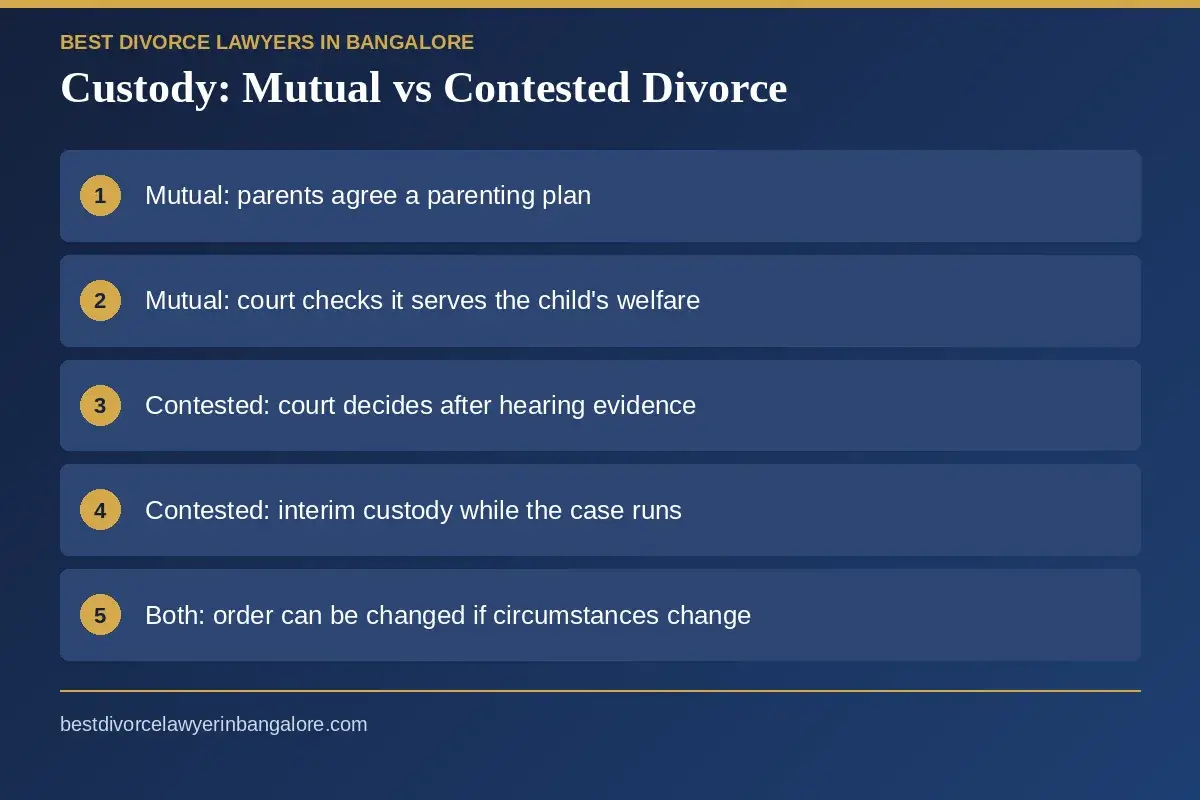
After a divorce in India, custody of a minor child is decided by the parents’ agreement in a mutual divorce, or by the Family Court in a contested one. In both cases the court has the final say, and the child’s welfare is the paramount consideration. Parents who settle custody themselves usually get a faster divorce and a plan that suits their family. Where they cannot agree, the court hears evidence, often talks to the child, and makes an order that can be changed later if circumstances change.
The legal basis
Section 26 of the Hindu Marriage Act, 1955 lets the court make orders on custody, maintenance and education of minor children in any divorce case, at any stage and afterwards. Section 13 of the Hindu Minority and Guardianship Act, 1956 and Section 17 of the Guardians and Wards Act, 1890 make the child’s welfare paramount. Couples married under the Special Marriage Act are covered by Section 38 of that Act. The same welfare test applies whether the divorce is mutual or contested. For background, see child custody laws in India.
Custody in a mutual consent divorce
In a divorce under Section 13B of the Hindu Marriage Act (or Section 28 of the Special Marriage Act), the parents agree custody along with alimony and property, and write it into the joint petition or a settlement deed. A good parenting plan covers:
- who has physical custody and whether legal decisions are shared;
- the visitation schedule: weekends, school holidays, birthdays and festivals;
- phone and video contact;
- child maintenance, school fees and medical costs;
- travel abroad, passports and changing schools or cities;
- how disagreements will be resolved, for example through mediation first.
The court records the agreement but is not bound to accept terms that clearly harm the child. A parent cannot sign away the child’s right to maintenance or to a relationship with the other parent. Where everything is settled, the court may also waive the six-month waiting period, following Amardeep Singh v. Harveen Kaur (2017). Our guide to types of child custody explains the options parents can choose from.
Custody in a contested divorce
When parents cannot agree, either one can apply for custody within the divorce under Section 26 HMA, or file a separate petition under the Guardians and Wards Act. In Bengaluru, both are heard by the Family Courts. The case usually runs like this:
- Interim custody: early in the case, the court decides where the child will live and how the other parent will see the child while the case runs.
- Mediation: the court normally refers the parents to its mediation centre, where many custody disputes settle.
- Evidence: each parent shows their role in the child’s life, home, work hours, support system and any concerns about the other parent.
- Hearing the child: the judge may speak to a child old enough to form a view, usually privately in chambers.
- Final order: physical and legal custody, visitation and child support.
Courts weigh the child’s age, the primary carer so far, schooling, emotional bonds, each parent’s ability to care, and any history of violence or neglect. See how courts decide child custody in India.
Joint custody and visitation after divorce
Whether the divorce is mutual or contested, courts increasingly favour arrangements that keep both parents involved where that is safe. That can mean joint custody with time shared between two homes, or primary custody with one parent and generous contact with the other. The non-custodial parent’s contact is set out in the order. Our guide to child visitation rights in India covers schedules, supervised visits and enforcement.
Mutual vs contested: the practical differences
- Time: a settled mutual divorce can finish in a few months; a contested custody fight can take a year or more.
- Control: in a mutual divorce, parents design their own plan; in a contested case, the court imposes one.
- Cost and stress: contested cases mean more hearings and more strain on the child.
- Flexibility: agreed plans are often more detailed and more likely to be followed.
After the decree
Custody orders can be changed if circumstances change significantly, such as a relocation, remarriage, a health issue or repeated denial of visitation. Either parent can apply to the Family Court. Child maintenance continues until the child becomes an adult, or longer for a child who cannot support themselves.
How this guide was prepared
This guide is based on the bare acts published on India Code and on judgments of the Supreme Court of India and the Karnataka High Court. Section numbers, case citations and time limits were fact-checked in November 2026, and criminal-law references use the Bharatiya Nyaya Sanhita (BNS) and Bharatiya Nagarik Suraksha Sanhita (BNSS) in force since 1 July 2024. It is general information, not legal advice. For advice on your own case, speak to an advocate. Read our editorial standards and disclaimer.
Frequently Asked Questions
Who gets custody of the child in a mutual divorce?
The parents decide together and record the arrangement in the joint petition. The court accepts it unless it is clearly against the child’s welfare.
Can custody terms in a mutual divorce be changed later?
Yes. Either parent can apply to the Family Court if circumstances change significantly, and the court applies the welfare test again.
Who decides custody in a contested divorce?
The Family Court decides, after mediation and evidence, and may talk to the child privately before making its order.
Can a parent give up child maintenance in a mutual divorce?
No. Child maintenance belongs to the child and cannot be waived by either parent, even in a full and final settlement.
Speak to a child custody lawyer in Bangalore
Whether you are drafting a parenting plan for a mutual divorce or preparing for a contested hearing, careful preparation protects both your child and your rights. Speak to an experienced child custody lawyer in Bangalore, or compare the top divorce lawyers in Bangalore on our list. The first consultation is free.