The simplest way to understand annulment vs divorce is this: divorce ends a valid marriage from the date of the decree, while annulment is a court declaration that the marriage was never legally valid in the first place, or was defective from the start. Which one you can seek depends on whether something was wrong at the time of the wedding, or whether the problems arose later in the marriage.
What Is Annulment?
Annulment, called a “decree of nullity” in Indian statutes, is relief for marriages that suffered from a legal defect when they were solemnised. Indian law recognises two categories:
- Void marriages are invalid from the outset. In law they never existed, and a court decree simply declares that fact.
- Voidable marriages are valid until one spouse successfully challenges them. If neither spouse goes to court, the marriage continues as a valid marriage.
What Is Divorce?
Divorce dissolves a marriage that was valid when it began, on grounds that arose afterwards, such as cruelty, desertion or adultery, or by mutual consent. Our guide to grounds for divorce in India covers these in detail, and the hub on divorce laws in India explains how the different personal laws fit together.
Annulment vs Divorce: Main Differences
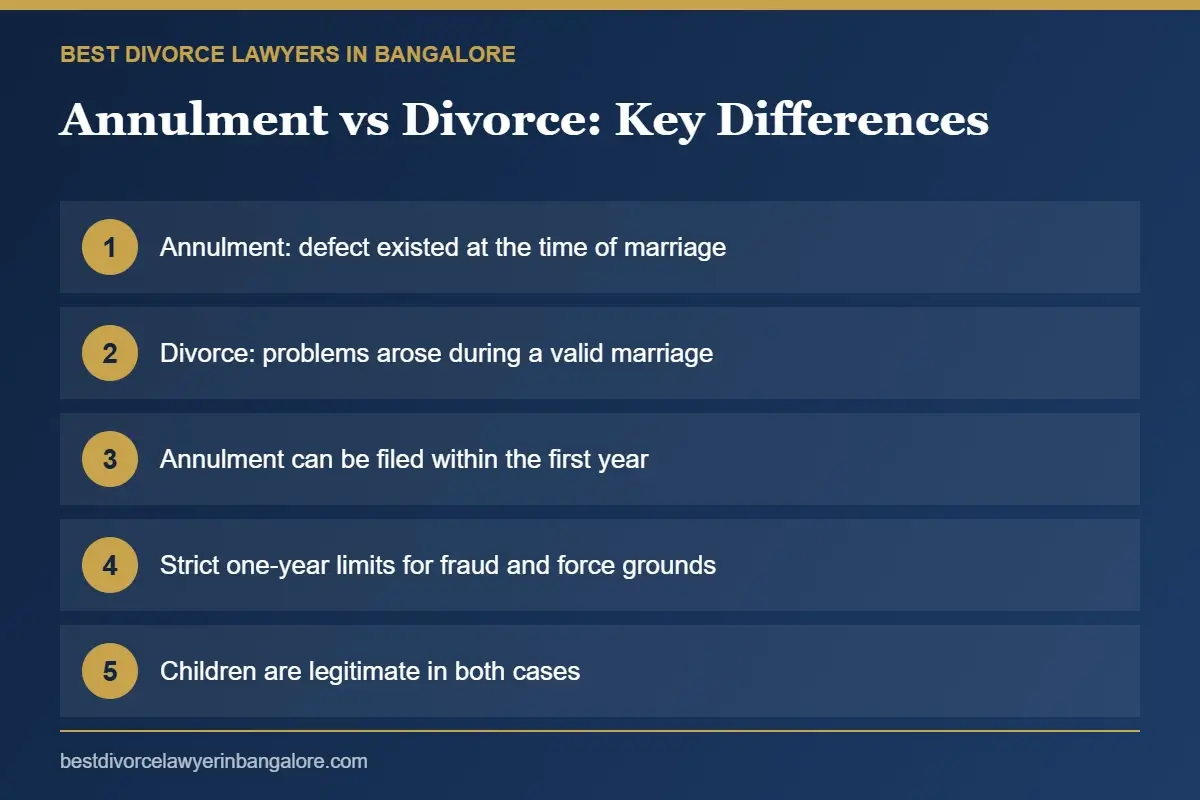
| Point | Annulment (nullity) | Divorce |
|---|---|---|
| What it says about the marriage | It was void, or defective from the start | It was valid but has now ended |
| When the defect arose | At or before the wedding | During the marriage |
| Typical grounds | Bigamy, prohibited relationship, impotence, fraud, force, unsoundness of mind | Cruelty, desertion, adultery, conversion, mutual consent |
| Filing within the first year | Allowed | Generally barred by Section 14 HMA except in exceptional hardship |
| Time limits | Strict limits for some voidable grounds | No general limitation period, but delay can suggest condonation |
| Children | Legitimate under Section 16 HMA | Legitimate |
| Maintenance | Possible, at the court’s discretion | Available |
Grounds for Annulment Under the Hindu Marriage Act
Void Marriages (Section 11)
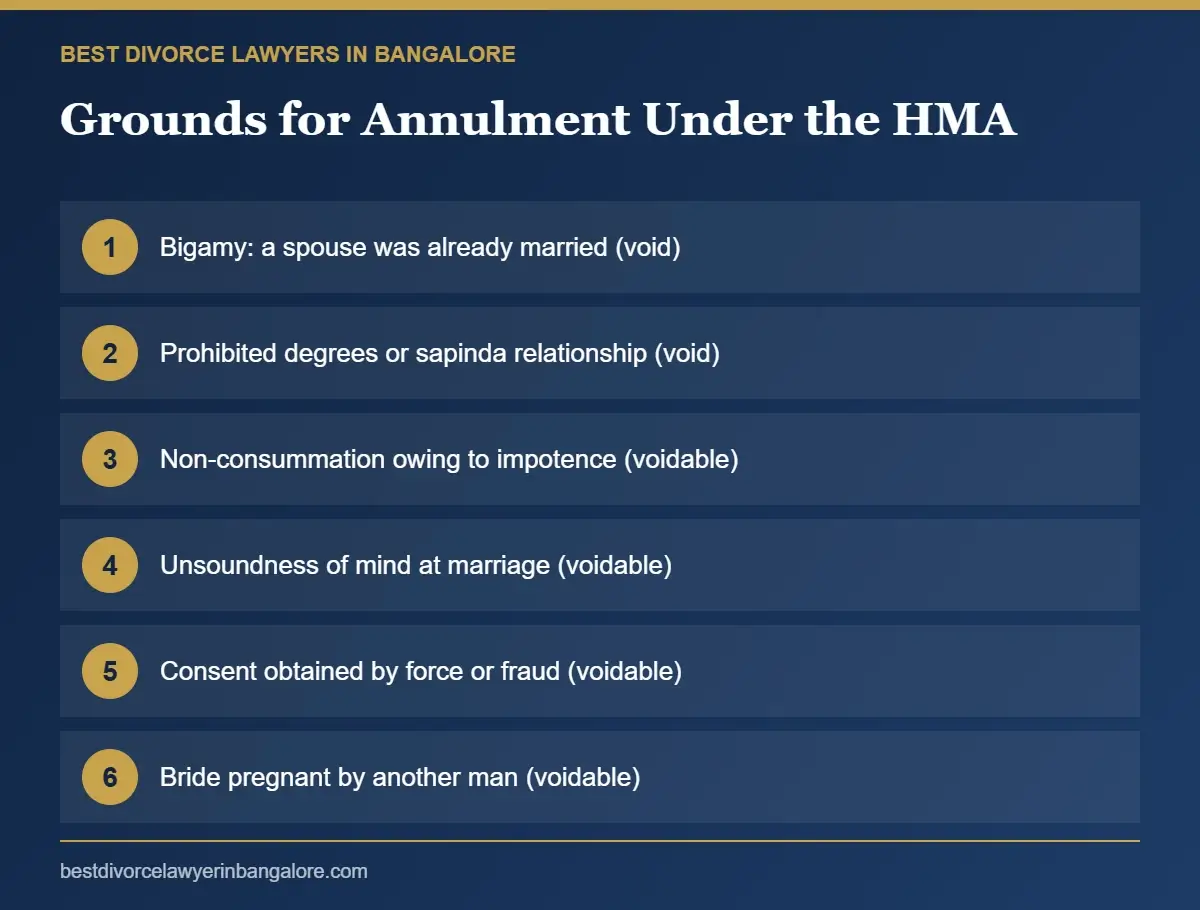
A Hindu marriage is void if it breaches any of these conditions in Section 5:
- Bigamy: either party had a living spouse at the time of the marriage (Section 5(i)).
- Prohibited degrees: the parties are within the degrees of prohibited relationship, unless a custom or usage governing both permits it (Section 5(iv)).
- Sapinda relationship: the parties are sapindas of each other, again unless custom permits (Section 5(v)).
Either spouse can petition for a declaration of nullity, and there is no limitation period. A bigamous marriage can also lead to prosecution under Section 82 of the Bharatiya Nyaya Sanhita (formerly Section 494 IPC).
Voidable Marriages (Section 12)
A marriage is voidable, and can be annulled at the petition of the affected spouse, if:
- the marriage has not been consummated owing to the respondent’s impotence;
- at the time of marriage, a party was incapable of giving valid consent because of unsoundness of mind, or suffered from a mental disorder making them unfit for marriage and procreation (Section 5(ii));
- the petitioner’s consent was obtained by force, or by fraud about the nature of the ceremony or a material fact or circumstance concerning the respondent; or
- the bride was, at the time of marriage, pregnant by someone other than the petitioner.
Time limits are strict. A petition on force or fraud must be filed within one year after the force ceased or the fraud was discovered, and is barred if the petitioner, with full consent, continued living with the other spouse as husband or wife after that. A petition based on pregnancy by another person must be filed within one year of the marriage, the petitioner must not have known the facts at the time of marriage, and there must have been no consensual marital intercourse after discovering them.
Child Marriages
Marrying under the legal age does not make a Hindu marriage void under the Hindu Marriage Act. However, under Section 3 of the Prohibition of Child Marriage Act, 2006, a child marriage is voidable at the option of the party who was a child, who can petition up to two years after attaining majority.
Annulment Under Other Personal Laws
- Special Marriage Act, 1954: a marriage is void under Section 24 if the basic conditions in Section 4 were not met (for example a living spouse, under-age party or prohibited relationship) or if the respondent was impotent at the time of marriage and when the suit was filed. Under Section 25 it is voidable for wilful refusal to consummate, pregnancy by another person, or consent obtained by coercion or fraud. Unlike the Hindu Marriage Act, wilful refusal to consummate is a nullity ground here.
- Indian Divorce Act, 1869 (Christians): Section 19 permits a decree of nullity for impotence, prohibited degrees of relationship, lunacy at the time of marriage, or a former spouse living with the earlier marriage still in force.
- Parsi Marriage and Divorce Act, 1936: Section 30 allows a suit for nullity where consummation is impossible from natural causes, and Section 3 sets out the conditions for a valid Parsi marriage.
- Muslim law: classical law distinguishes a void (batil) marriage, such as one with a close blood relation, from an irregular (fasid) marriage, such as one without proper witnesses, which can be regularised. These questions are often decided by the Family Court on the basis of personal law.
Children, Maintenance and Property After Annulment
Status of Children
Children are protected whichever route the parents take. Under Section 16 of the Hindu Marriage Act, a child of a void or voidable marriage is legitimate. In Revanasiddappa v. Mallikarjun (2023), a three-judge bench of the Supreme Court held that such children are entitled to their parents’ share in Hindu joint family property, determined through a notional partition, though not to the property of other coparceners. Custody and child support are decided on the child’s welfare in both annulment and divorce.
Maintenance
A spouse whose marriage is annulled is not automatically left without support. In Sukhdev Singh v. Sukhbir Kaur (2025), a three-judge bench of the Supreme Court held that a spouse whose marriage is declared void under Section 11 can seek permanent alimony under Section 25, and interim maintenance under Section 24 while the case is pending. The relief is discretionary and depends on the facts and the parties’ conduct.
Property and Gifts
Stridhan, including jewellery and gifts given to the wife, remains her property whether the marriage is annulled or dissolved. Section 27 of the Hindu Marriage Act lets the court deal with property presented at or about the time of marriage that belongs jointly to the spouses.
Annulment or Divorce: Which Should You Seek?
Annulment is the right remedy only when one of the specific statutory defects is present, and for voidable grounds, only if you act in time. If your spouse hid a serious fact before marriage, for example a previous marriage or a serious illness, you may have a nullity case, but if you continued living together after you found out, the court may refuse it. In that situation, the same facts may still support divorce on the ground of cruelty.
Some people prefer annulment for personal or religious reasons, because it records that the marriage was never valid. Others choose divorce because the grounds are broader and easier to prove. If you only need time apart, a third option is discussed in our guide to judicial separation vs divorce.
How a Nullity Petition Works in Bengaluru
A nullity petition follows broadly the same path as a contested divorce: petition, notice to the respondent, counselling or mediation, written statement, evidence and arguments. In Bengaluru, it is filed in the Family Courts near Lalbagh Main Gate on Siddaiah Road. Evidence is especially important: medical evidence in impotence cases, documents proving an earlier marriage in bigamy cases, or messages and witnesses showing fraud. Our step-by-step guide on how to file for divorce in India explains the filing stage, which is similar for nullity petitions.
How this guide was prepared
This guide is based on the bare acts published on India Code and on judgments of the Supreme Court of India and the Karnataka High Court. Section numbers, case citations and time limits were fact-checked in October 2026, and criminal-law references use the Bharatiya Nyaya Sanhita (BNS) and Bharatiya Nagarik Suraksha Sanhita (BNSS) in force since 1 July 2024. It is general information, not legal advice. For advice on your own case, speak to an advocate. Read our editorial standards and disclaimer.
Frequently Asked Questions
Can I get an annulment if my spouse lied about their job or income before marriage?
Possibly. Fraud about a material fact or circumstance concerning the respondent can make a Hindu marriage voidable, but courts look at how serious the misrepresentation was, and the petition must be filed within one year of discovering it, without continuing to cohabit after discovery.
Is there a minimum period of marriage before seeking annulment?
No. Unlike divorce, which generally cannot be filed within the first year of marriage under Section 14 of the Hindu Marriage Act, a nullity petition can be filed at any time, subject to the time limits for specific voidable grounds.
Can both spouses jointly ask for annulment?
There is no joint or mutual consent procedure for annulment. A nullity decree requires proof of a statutory ground. Couples who simply agree to part usually file for mutual consent divorce instead.
Do I need a court decree if my marriage is void anyway?
Strictly, a void marriage is invalid without a decree, but getting a declaration of nullity is strongly advisable. It creates clear proof of your status, which matters for remarriage, property, passports and later disputes. Our guide to second marriage after divorce explains the rules on remarrying.
Does annulment affect a dowry or cruelty complaint already filed?
Not automatically. Criminal complaints for cruelty under Sections 85 and 86 of the Bharatiya Nyaya Sanhita or under the Dowry Prohibition Act are separate proceedings, and your lawyer will advise how the nullity case interacts with them.
Talk to a Lawyer About Your Options
Whether your case is an annulment or a divorce often depends on dates, documents and what you knew when. Speak to one of the good divorce lawyers in Bangalore early, especially if a one-year limit may be running. If your spouse is likely to contest, our contested divorce lawyers in Bangalore handle nullity petitions and contested divorces in the Bengaluru Family Courts.