A second marriage after divorce is completely legal in India once your divorce decree has become final. Under the Hindu Marriage Act, that generally means waiting until the appeal period (90 days under Section 28, though some High Courts apply a 30-day limit to Family Court decrees) has expired without an appeal, or until any appeal has been dismissed. Marrying before then can expose the new marriage to challenge and, in the worst case, a bigamy prosecution.
When Can You Legally Remarry After Divorce?
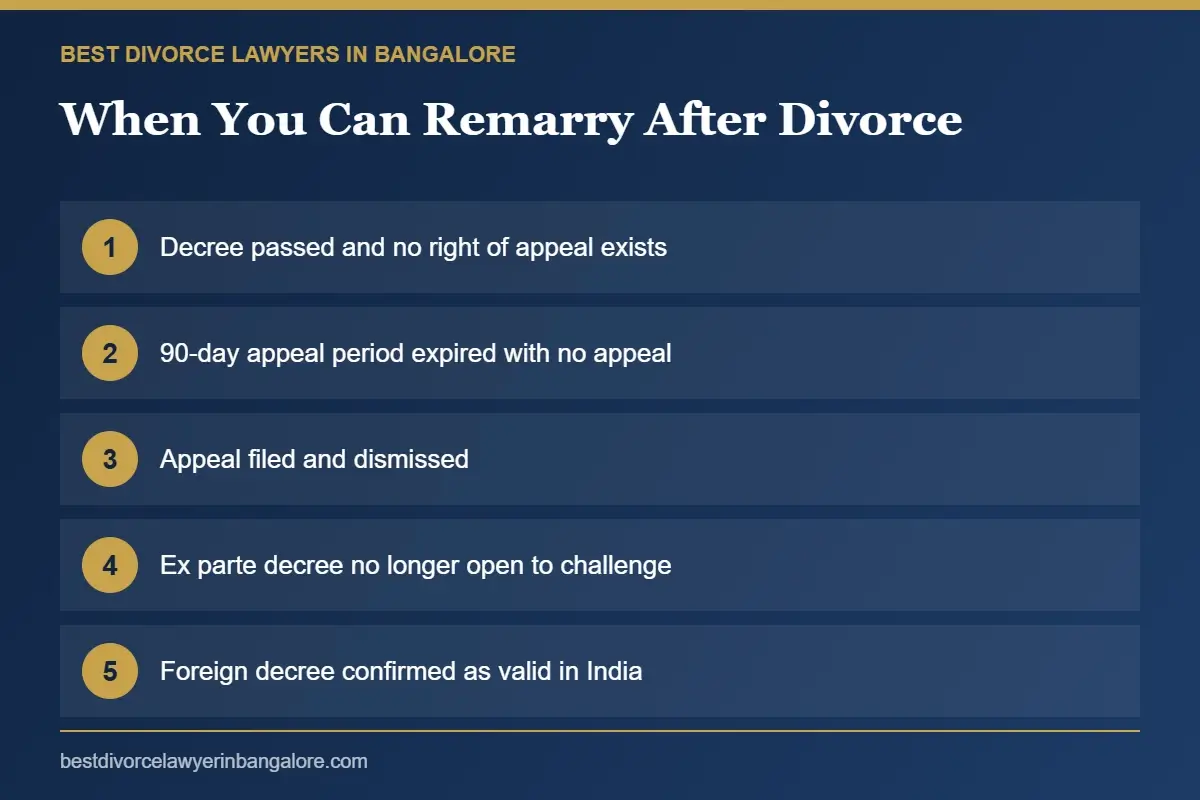
Section 15 of the Hindu Marriage Act, 1955 says that once a marriage has been dissolved by a decree of divorce, either party may marry again when:
- there is no right of appeal against the decree; or
- the time for filing an appeal has expired without an appeal being presented; or
- an appeal has been presented but has been dismissed.
Under Section 28 of the Act, an appeal against a divorce decree must be filed within 90 days of the decree, although some High Courts hold that the 30-day limit in Section 19 of the Family Courts Act applies to appeals from Family Courts. So in a contested case, the safe date to remarry is after the full 90 days have passed with no appeal filed. Before 1976, the law also required a one-year wait after the decree; that proviso was repealed, so there is no longer any extra waiting period.
The Special Marriage Act, 1954 has a similar rule in Section 30. Christian and Parsi divorce laws likewise tie remarriage to the decree becoming final, and a Muslim woman must complete her iddat period before remarrying. For an overview of all these laws, see our hub on divorce laws in India.
Second Marriage After Divorce: Timelines by Type of Decree
| Type of decree | When remarriage is generally safe |
|---|---|
| Contested divorce, no appeal filed | After the 90-day appeal period expires |
| Contested divorce, appeal filed | After the appeal is dismissed (or after a further appeal is decided) |
| Mutual consent divorce | Consent decrees are normally not appealable under Section 96(3) CPC, but many lawyers still advise waiting until you hold a certified copy and the appeal period has passed |
| Ex parte divorce | Wait until the other spouse can no longer apply to set the decree aside, or until any such application is dismissed |
| Foreign divorce decree | Only after confirming it will be recognised in India |
Ex Parte Decrees Need Extra Caution
If your divorce was granted ex parte because your spouse never appeared, they can apply to set the decree aside, for example by showing they were never properly served. If the decree is set aside, a second marriage entered into in the meantime becomes legally precarious. Our guide on ex parte divorce in India explains the timelines and risks.
Foreign Divorces
A divorce obtained abroad is not always valid in India. If the foreign decree does not satisfy the principles laid down by the Supreme Court in Y. Narasimha Rao v. Y. Venkata Lakshmi (1991), a second marriage based on it could be treated as bigamous here. Read our guide to NRI divorce in India before relying on an overseas decree.
What If You Remarry While an Appeal Is Pending?
Remarrying while an appeal against the divorce is pending, or before the appeal period ends, is risky because the decree could still be reversed. Two Supreme Court decisions soften the consequences in particular situations:
- In Lila Gupta v. Laxmi Narain (1978), the Court held that a marriage contracted in breach of the old one-year waiting period was not void, because the Act did not expressly make it so.
- In Anurag Mittal v. Shaily Mishra Mittal (2018), the husband remarried after applying to withdraw his pending appeal following a settlement, but before the withdrawal was formally allowed. The Court held the second marriage was not void, reasoning that the Section 15 bar is meant to protect a party genuinely pursuing an appeal.
These cases turn on their facts. They are not a licence to remarry early. If an appeal is pending, the prudent course is to have it formally withdrawn or decided first. Our guide on how to withdraw a divorce petition also explains what withdrawal does and does not achieve.
Bigamy: The Risk of Remarrying Too Soon
If your first marriage still legally exists when you remarry, the second marriage is void under Section 11 of the Hindu Marriage Act, and you may be prosecuted for bigamy under Section 82 of the Bharatiya Nyaya Sanhita (formerly Section 494 IPC), which carries imprisonment of up to seven years and a fine. Concealing the earlier marriage from the new spouse attracts a higher punishment of up to ten years. Bigamy prosecution is generally started on a complaint by the aggrieved spouse or certain close relatives.
How Remarriage Affects Alimony, Maintenance and Children
Alimony and Maintenance
- Periodic alimony under the HMA: under Section 25(3) of the Hindu Marriage Act, if the spouse receiving maintenance remarries, the paying spouse can ask the court to vary, modify or cancel the order.
- Maintenance under criminal procedure: under Section 146 of the Bharatiya Nagarik Suraksha Sanhita (formerly Section 127 CrPC), a maintenance order in favour of a divorced woman who has remarried is liable to be cancelled from the date of her remarriage.
- One-time settlements: a lump-sum alimony already paid under a mutual consent settlement is generally not refundable because of a later remarriage.
The paying spouse’s own remarriage does not reduce what they owe, although a court considering a modification may look at their changed financial responsibilities. Our alimony lawyers in Bangalore can advise on modification applications.
Children
Remarriage does not by itself change custody. Courts decide custody and visitation on the welfare of the child, so a parent’s remarriage is relevant only insofar as it affects the child’s home, stability or relationships. Child maintenance continues regardless of either parent’s remarriage. If a step-parent wishes to adopt, the consent of the other biological parent is usually required, and the adoption must follow the applicable law.
Registering a Second Marriage in Bengaluru
You register a second marriage in the same way as a first one, with a few extra documents. In Karnataka, Hindu marriages are registered with the jurisdictional Sub-Registrar under the Karnataka Marriages (Registration and Miscellaneous Provisions) Act, 1976, while marriages under the Special Marriage Act require 30 days’ notice to the Marriage Officer before solemnisation. Keep these ready:
- a certified copy of the divorce decree;
- proof that no appeal is pending, where applicable (your lawyer can advise what the office accepts);
- age and identity proof for both parties;
- address proof and photographs;
- wedding invitation and photographs, and witnesses as required.
After registration, update your passport, bank records and other documents to reflect your new marital status.
Can You Remarry Your Former Spouse?
Yes. Divorced spouses who reconcile are free to marry each other again once the decree is final. There is no bar under Hindu law, and the new marriage is registered like any other. Under Muslim law, special rules apply where the divorce was final, so get advice from a lawyer familiar with personal law.
Practical Checklist Before You Remarry
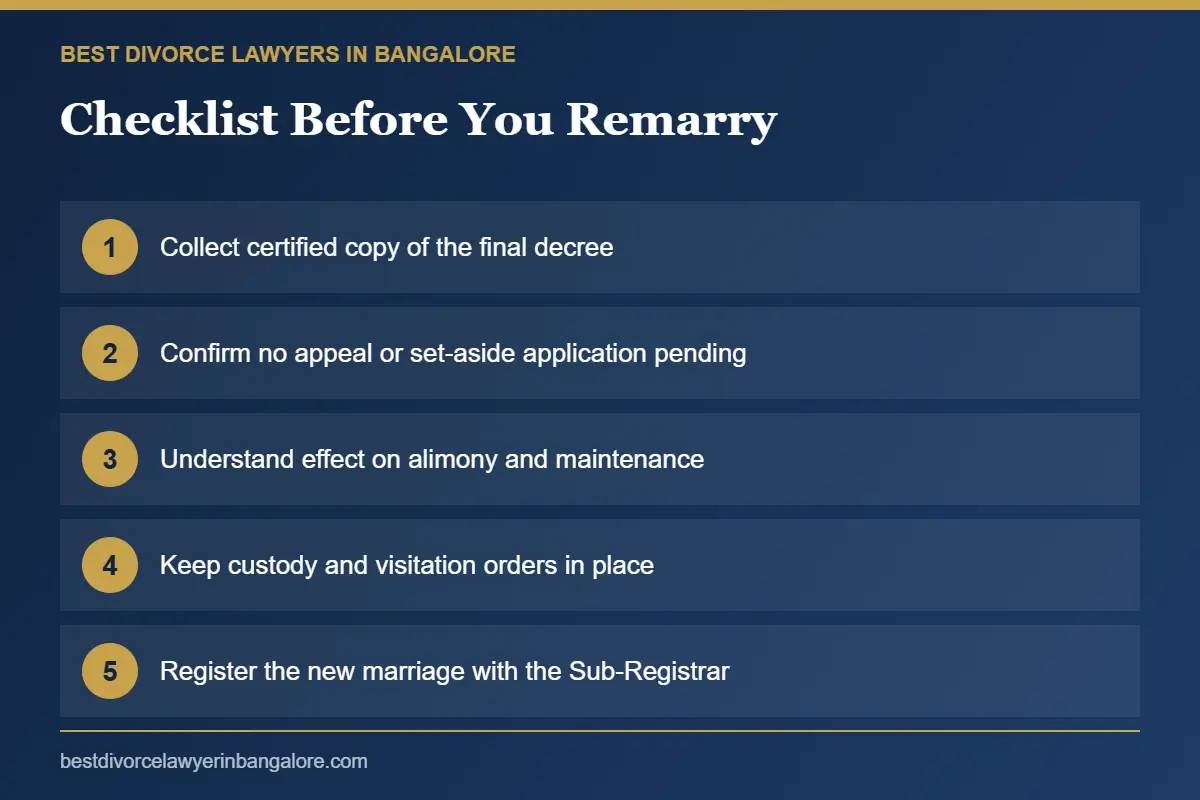
- Get a certified copy of the final decree.
- Confirm the 90-day appeal window has closed and no appeal or set-aside application is pending.
- Resolve pending maintenance, property and custody issues, or at least understand how remarriage will affect them.
- Be open with your future spouse about your divorce and any obligations, such as child support.
- If your decree was granted abroad or ex parte, get specific legal advice first.
If you are still in the middle of the divorce, our guide on how long divorce takes in India will help you plan realistic timelines.
How this guide was prepared
This guide is based on the bare acts published on India Code and on judgments of the Supreme Court of India and the Karnataka High Court. Section numbers, case citations and time limits were fact-checked in October 2026, and criminal-law references use the Bharatiya Nyaya Sanhita (BNS) and Bharatiya Nagarik Suraksha Sanhita (BNSS) in force since 1 July 2024. It is general information, not legal advice. For advice on your own case, speak to an advocate. Read our editorial standards and disclaimer.
Frequently Asked Questions
Do I need to wait 90 days after a mutual consent divorce before remarrying?
A consent decree is generally not appealable, so the strict legal position is that the Section 15 bar has less force. Even so, many advocates recommend collecting the certified decree and waiting out the appeal period, simply to avoid any doubt.
Does my ex-spouse need to be informed before I remarry?
No. Once the decree is final, you do not need your former spouse’s permission or need to notify them, though any custody or visitation arrangements must still be respected.
Can a divorced woman keep receiving maintenance after remarriage?
Usually not for herself. Maintenance orders in her favour can be cancelled or modified on remarriage, but maintenance for the children continues.
Is a second marriage valid if it happened in a temple without registration?
Registration is evidence of marriage, not what creates it. A Hindu marriage performed with the essential ceremonies is valid without registration, but registering it is strongly advisable for passports, visas and property matters.
What if my ex-spouse remarried before our divorce was final?
The second marriage may be void, and you may have remedies including a bigamy complaint under Section 82 of the Bharatiya Nyaya Sanhita. Speak to a lawyer promptly, because evidence and timing matter.
Get Clear Advice Before You Remarry
A few weeks of patience can save years of legal trouble. If you are unsure whether your decree is final, or how remarriage will affect maintenance or custody, speak to one of the experienced lady divorce lawyers in Bangalore before you set a wedding date.