NRI divorce in India is entirely possible: an Indian court can dissolve the marriage of a couple where one or both spouses live abroad, provided the court has jurisdiction under the personal law that governs the marriage. In practice, most NRI cases are filed where the marriage took place, where the couple last lived together, or where the spouse in India now lives, and much of the process can now be handled through a power of attorney and video conferencing.
Can an NRI Get a Divorce in India?
Yes. Living outside India does not take a marriage outside Indian law. If the couple married in India under the Hindu Marriage Act, 1955, the Special Marriage Act, 1954, or another Indian personal law, an Indian family court can hear the divorce, even if one spouse is in Dubai, London or California. The Hindu Marriage Act also applies to Hindus domiciled in India who are living outside the country.
What changes in an NRI case is the logistics: where to file, how to serve court papers on a spouse overseas, how a spouse abroad can sign, appear and give evidence, and whether a foreign divorce will hold up in India. Before getting into those, it is worth understanding the basic divorce laws in India that apply to every marriage, NRI or not.
Which Court Has Jurisdiction in an NRI Divorce?
Under Section 19 of the Hindu Marriage Act, a divorce petition can be filed in the district court (in Bengaluru, the Family Court) within whose local limits:
- the marriage was solemnised;
- the respondent spouse resides at the time of filing;
- the couple last resided together;
- the wife resides, where she is the petitioner; or
- the petitioner resides, where the respondent lives outside the territories to which the Act extends.
That last clause matters most for NRIs. If you live in Bengaluru and your spouse lives abroad, you can usually file in the Bengaluru Family Court near Lalbagh Main Gate on Siddaiah Road. If you married in Bengaluru but both of you now live overseas, the place of marriage still gives the court jurisdiction. The Special Marriage Act has a similar rule in Section 31.
NRI Divorce by Mutual Consent
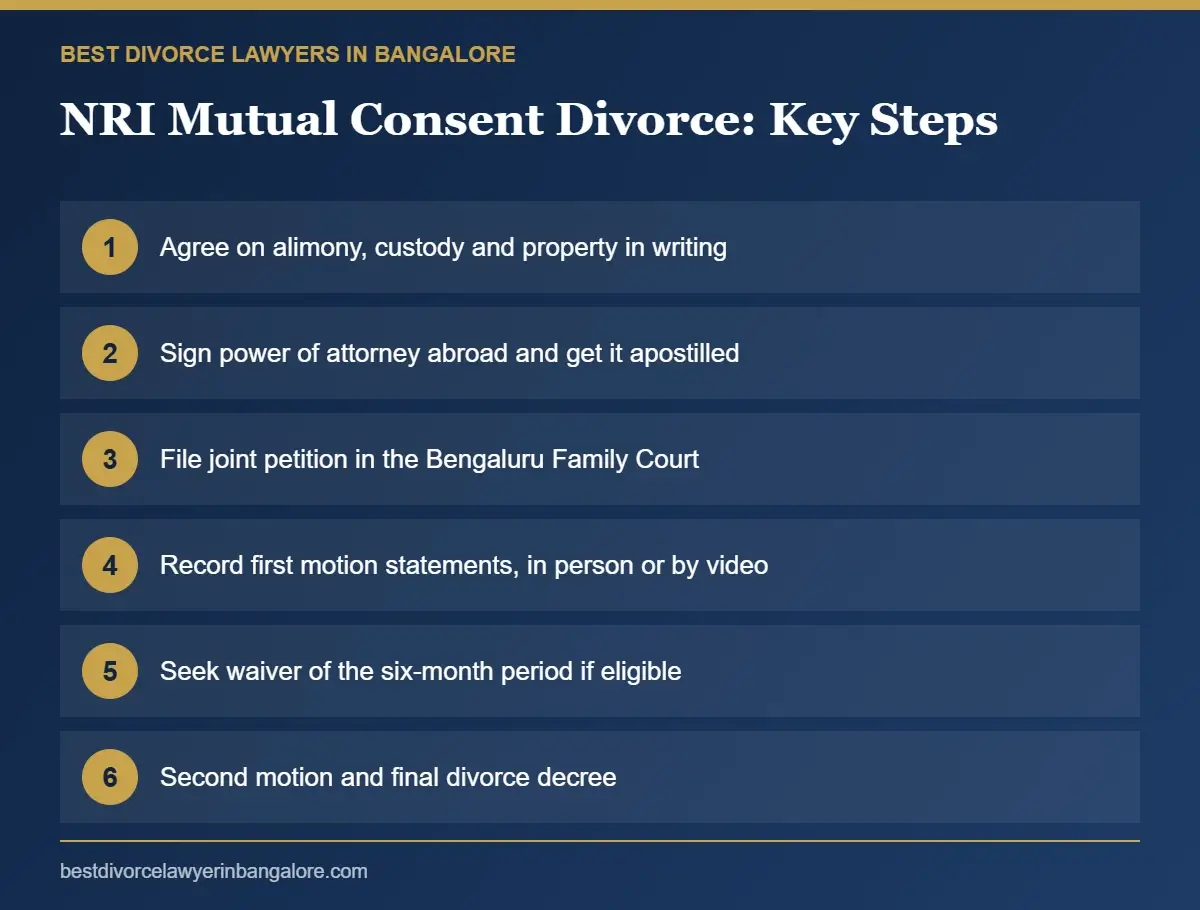
When both spouses agree, mutual consent divorce under Section 13B of the Hindu Marriage Act (or Section 28 of the Special Marriage Act) is by far the quickest and cheapest route. The couple must have lived separately for at least one year, and must agree on alimony, child custody and the return of jewellery or other property. The court records statements at the first motion and the second motion.
For NRIs the key questions are travel and the six-month gap between the two motions:
- Video conferencing: In Amardeep Singh v. Harveen Kaur (2017), the Supreme Court said family courts may use video conferencing so that a party abroad need not fly in for every hearing. Many family courts, including in Bengaluru, now permit this on a suitable application, though the judge decides in each case.
- Waiver of the six-month period: The same judgment held that the six-month cooling-off period is directory, not mandatory, and can be waived where the parties have been separated for long, mediation has failed and all issues are settled.
- Power of attorney: A relative or advocate in India can usually handle filings and routine dates under a properly executed power of attorney, but courts generally want each spouse to confirm consent personally, in court or by video.
Our guide on mutual divorce vs contested divorce explains how the two routes compare on time, cost and stress.
Contested NRI Divorce
If your spouse does not agree, you must prove one of the statutory grounds, such as cruelty, desertion for two years, adultery or conversion. These are explained in detail in our page on grounds for divorce in India. A contested case is a full trial with pleadings, evidence and cross-examination, so it takes longer, and an NRI petitioner will usually need to give evidence personally or through video conferencing if the court allows it.
Serving Notice on a Spouse Abroad
The court cannot proceed until the respondent is properly served. For a spouse living abroad, service may be attempted by registered post and courier to the foreign address, by email or messaging where the court permits, or formally through the Hague Service Convention, to which India is a party. Under the Convention, the Department of Legal Affairs in the Ministry of Law and Justice acts as India’s Central Authority and forwards the papers to the foreign country’s authority. Formal service can take several months, so give your lawyer every address, email and phone number you have.
If the Spouse Abroad Does Not Respond
If the respondent is duly served and still does not appear, the court may proceed ex parte and decide on the petitioner’s evidence. See our explainer on ex parte divorce in India for how this works and how such decrees can later be challenged.
Will a Foreign Divorce Be Valid in India?
Many NRIs wonder whether they can simply divorce in the country where they live. Sometimes the answer is yes, but often a foreign decree will not be recognised in India. Under Section 13 of the Code of Civil Procedure, a foreign judgment is not conclusive if, among other things, it was not given by a court of competent jurisdiction, it was not on the merits, or it was based on a law not recognised in India.
In Y. Narasimha Rao v. Y. Venkata Lakshmi (1991), the Supreme Court held that for a marriage solemnised under Indian law, a foreign divorce will generally be recognised only if:
- the foreign court’s jurisdiction and the ground for divorce match those available under the Indian law under which the couple married; or
- the respondent voluntarily and effectively submitted to the foreign court’s jurisdiction and contested the case on a ground available under Indian law; or
- both spouses consented to the foreign decree.
A divorce granted abroad on a “no-fault” ground, against a spouse in India who never took part, is therefore risky. If either party remarries on the strength of it, the new marriage could be challenged in India, and in the worst case raise bigamy issues under Section 82 of the Bharatiya Nyaya Sanhita (formerly Section 494 IPC). If a foreign decree has already been passed, get it reviewed by an Indian lawyer before relying on it.
Children, Maintenance and Property in NRI Divorces
Child Custody
Indian courts decide custody on the welfare of the child, not on which parent got an order first. India is not a party to the Hague Convention on child abduction, so a foreign custody order is not automatically enforced. In Nithya Anand Raghavan v. State (NCT of Delhi) (2017), the Supreme Court held that a foreign order is a relevant factor, but the Indian court will make its own decision on the child’s best interests. If a child has been brought to Bengaluru, or taken abroad, without the other parent’s consent, act quickly and get advice.
Maintenance and Alimony
A spouse in India can claim interim maintenance and litigation expenses under Section 24 of the Hindu Marriage Act and permanent alimony under Section 25. Maintenance can also be claimed under Section 144 of the Bharatiya Nagarik Suraksha Sanhita (formerly Section 125 CrPC) and under the Protection of Women from Domestic Violence Act, 2005. Courts look at the NRI spouse’s foreign income, but enforcing an Indian maintenance order against assets abroad can be slow, so settlements in mutual consent cases often provide for a lump sum paid before the second motion.
Property
India has no community-property rule. Property generally belongs to the person in whose name it stands, subject to claims about stridhan, jointly owned flats, and loans. In NRI cases, list jointly held assets in both countries early so the settlement can deal with them in one go.
Documents and Power of Attorney for an NRI Divorce
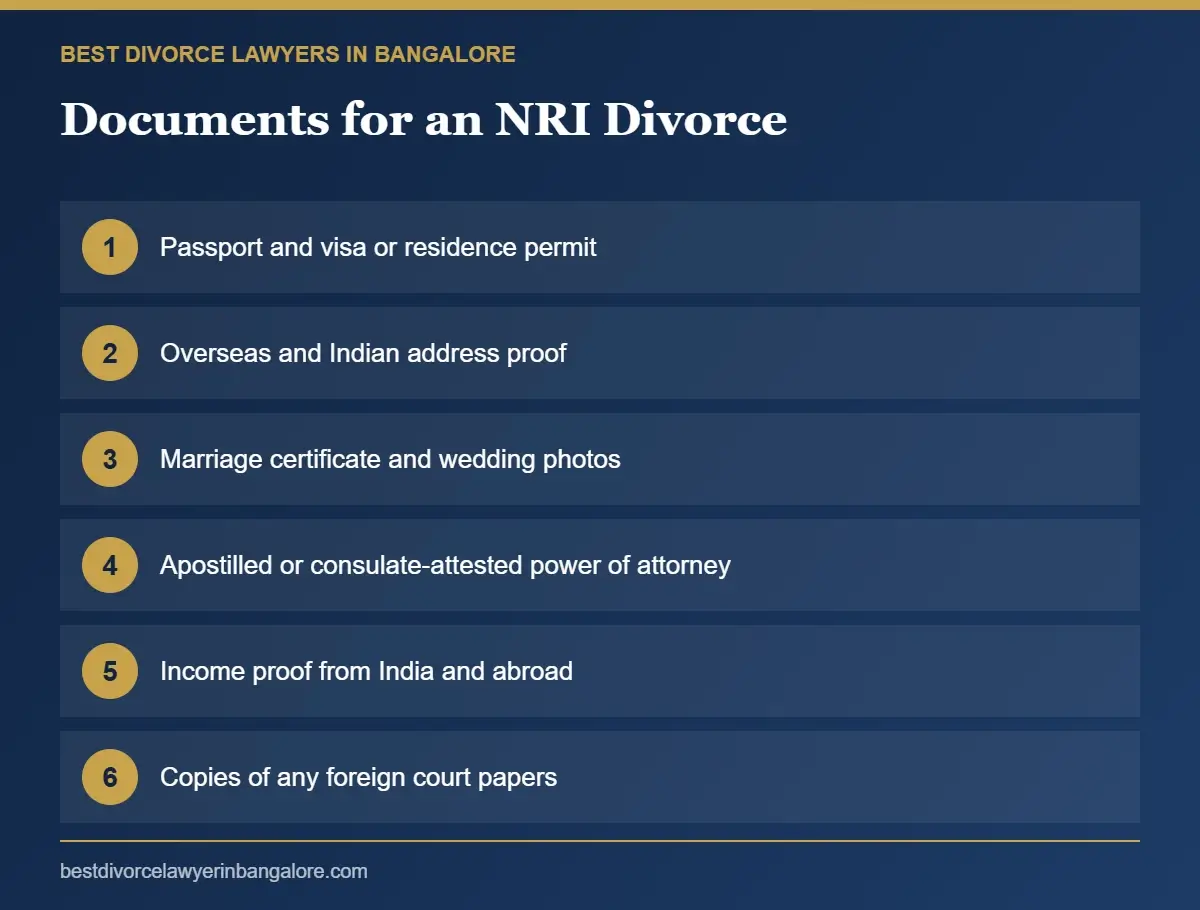
The core paperwork is the same as any divorce, and our checklist of documents required for divorce in India covers it. NRI cases usually also need:
| Document | Why it is needed |
|---|---|
| Passport and visa or residence permit copies | Proof of identity and of residence abroad |
| Overseas address proof | For service of notice and jurisdiction |
| Marriage certificate or wedding invitation and photos | Proof of the marriage and where it took place |
| Power of attorney | Lets a trusted person in India handle filings and routine dates |
| Income proof (salary slips, tax returns abroad) | Needed for maintenance and alimony decisions |
| Any foreign court papers | To avoid conflicting orders and assess recognition |
A power of attorney signed abroad should be notarised and apostilled (in Apostille Convention countries) or attested at the Indian embassy or consulate. Once it reaches India, it generally has to be stamped under the Karnataka Stamp Act within three months. Remember that a power-of-attorney holder can act for you, but cannot give evidence about facts only you personally know, so in a contested case you will still need to testify.
Practical Tips Before an NRI Files
- Get advice in both countries if there is any chance of parallel proceedings abroad.
- File in India first where Indian recognition matters most, for example if you may remarry in India or own property here.
- Keep communication civil and written. Emails and messages may later become evidence.
- Plan your India trips around key dates, and ask your lawyer early whether video appearance will be allowed.
- Do not remarry until the Indian decree is final and the appeal period has run out.
How this guide was prepared
This guide is based on the bare acts published on India Code and on judgments of the Supreme Court of India and the Karnataka High Court. Section numbers, case citations and time limits were fact-checked in October 2026, and criminal-law references use the Bharatiya Nyaya Sanhita (BNS) and Bharatiya Nagarik Suraksha Sanhita (BNSS) in force since 1 July 2024. It is general information, not legal advice. For advice on your own case, speak to an advocate. Read our editorial standards and disclaimer.
Frequently Asked Questions
Can I file for divorce in Bengaluru if I married in Bengaluru but live abroad now?
Usually yes. The place where the marriage was solemnised is one of the grounds of jurisdiction under Section 19 of the Hindu Marriage Act, so the Bengaluru Family Court can hear the case even if both spouses now live overseas.
Does an NRI have to travel to India for a mutual consent divorce?
Not always. Many family courts allow statements to be recorded by video conferencing after the Supreme Court’s 2017 ruling in Amardeep Singh v. Harveen Kaur, but it is at the judge’s discretion, so plan for at least one visit unless your lawyer confirms otherwise.
Can my spouse abroad stop the divorce by refusing to accept the notice?
No. Once the court is satisfied that notice was duly served, including by the methods it has permitted, it can proceed ex parte if the spouse stays away.
Is an online divorce from a US or UK court valid in India?
It may not be. Under the Y. Narasimha Rao principles, a foreign decree is usually recognised only if it matches Indian law on jurisdiction and grounds, or if both spouses consented or the respondent genuinely contested it.
How long does an NRI divorce take in India?
A mutual consent case can finish in a few months if the cooling-off period is waived, and otherwise in roughly six to eighteen months. Contested NRI divorces often take several years because of service abroad and evidence.
Speak to a Lawyer About Your NRI Divorce
Every NRI case turns on where you married, where each of you lives now and whether proceedings have started abroad. A short consultation with an experienced divorce lawyer in Bangalore can tell you where to file, how to avoid unnecessary trips and how to make sure your decree is recognised. If you and your spouse already agree, our mutual divorce lawyers in Bangalore can handle most of the process while you are overseas.