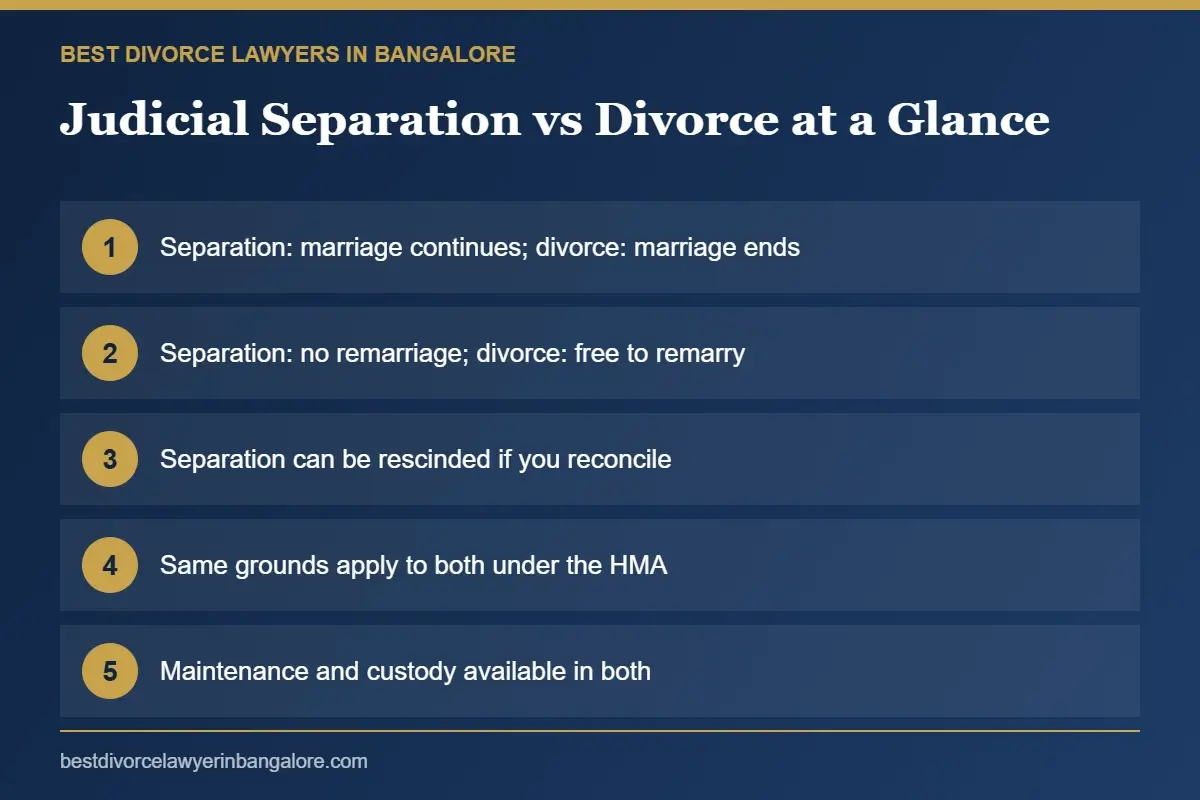
The core difference in judicial separation vs divorce is finality: judicial separation is a court order that lets spouses live apart while the marriage legally continues, whereas divorce ends the marriage completely and frees both people to remarry. Judicial separation suits couples who need distance and legal protection but are not ready, or not willing, to end the marriage for good.
What Is Judicial Separation?
Judicial separation is a decree under Section 10 of the Hindu Marriage Act, 1955 (and equivalent provisions in other personal laws) that relieves the spouses of the duty to live together. After the decree, neither spouse can insist on cohabitation, but they remain husband and wife in law. Either party can apply to have the decree rescinded if they reconcile, and the court may do so if it considers it just and reasonable.
It is a middle path. Some people choose it for religious or family reasons, because of concerns about children, or simply to test whether the separation is permanent before taking the final step. If you believe the marriage was never valid in the first place, compare annulment vs divorce.
What Is Divorce?
Divorce under Section 13 (contested) or Section 13B (mutual consent) of the Hindu Marriage Act dissolves the marriage. Once the decree becomes final, the legal relationship ends, mutual rights of inheritance end, and each spouse is free to marry again. Our hub on divorce laws in India sets out how divorce works across the different personal laws.
Judicial Separation vs Divorce: Key Differences
| Point | Judicial separation | Divorce |
|---|---|---|
| Marital status | Marriage continues | Marriage ends |
| Right to remarry | No; remarrying is bigamy | Yes, once the decree is final and the appeal period is over |
| Duty to cohabit | Suspended | Ends permanently |
| Reversible? | Yes, the decree can be rescinded on reconciliation | No; a divorced couple must remarry to be married again |
| Inheritance | Spouses generally remain each other’s legal heirs | Spouses cease to be legal heirs |
| Filing in the first year of marriage | Permitted | Generally barred by Section 14 except in exceptional hardship |
| Mutual consent route | No mutual consent procedure under the HMA | Available under Section 13B |
| Maintenance and custody | Court can order both | Court can order both |
Grounds for Judicial Separation
Since the 1976 amendment to the Hindu Marriage Act, the grounds for judicial separation are the same as those for divorce. Either spouse can seek it on any ground in Section 13(1), and a wife can also rely on the additional grounds in Section 13(2). The main grounds are:
- cruelty, physical or mental;
- desertion for a continuous period of at least two years;
- adultery;
- conversion to another religion;
- serious and incurable mental disorder;
- venereal disease in a communicable form (leprosy was removed as a ground by the Personal Laws (Amendment) Act, 2019);
- renunciation of the world by entering a religious order; and
- not being heard of as alive for seven years.
Each of these is explained in our guide to grounds for divorce in India. Because the grounds overlap, the real question is usually not “can I get it?” but “which remedy do I actually want?”
Can Judicial Separation Lead to Divorce?
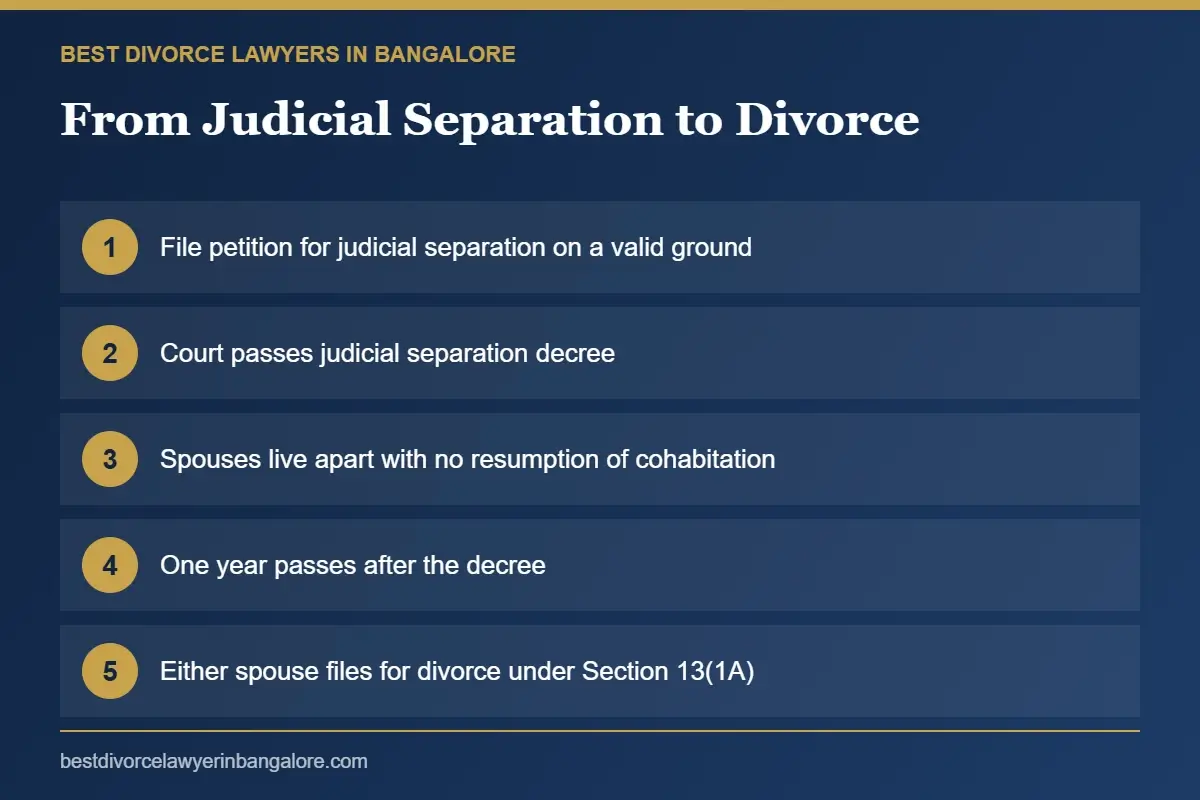
Yes. Under Section 13(1A)(i) of the Hindu Marriage Act, if there has been no resumption of cohabitation between the spouses for one year or more after a decree of judicial separation, either spouse can petition for divorce on that basis alone. Importantly, this right belongs to both parties, including the spouse against whom the separation decree was passed.
This makes judicial separation a useful “two-step” route. A spouse who is unsure can first seek separation; if a year passes without reconciliation, divorce is available without having to prove the original fault again in full. The Special Marriage Act has a similar rule in Section 27(2).
Judicial Separation and Divorce Under Other Laws
- Special Marriage Act, 1954: judicial separation under Section 23; divorce under Section 27 and by mutual consent under Section 28.
- Indian Divorce Act, 1869 (Christians): judicial separation under Section 22; divorce under Section 10 and by mutual consent under Section 10A.
- Parsi Marriage and Divorce Act, 1936: judicial separation under Section 34; divorce under Section 32 and by mutual consent under Section 32B.
- Muslim law: there is no formal judicial separation decree; dissolution is governed by personal law and the Dissolution of Muslim Marriages Act, 1939.
Maintenance, Children and Property After Judicial Separation
Judicial separation does not leave a financially dependent spouse unprotected. The court can grant interim maintenance and litigation costs under Section 24 and permanent alimony under Section 25 of the Hindu Marriage Act, and maintenance can also be claimed under Section 144 of the Bharatiya Nagarik Suraksha Sanhita (formerly Section 125 CrPC). Custody, visitation and child support are decided on the child’s welfare, exactly as in a divorce.
Because the marriage subsists, a judicially separated spouse generally keeps inheritance rights. If that is not what you intend, for example where you want your estate to pass only to your children, discuss a will with your lawyer.
Which Should You Choose?
Judicial separation may suit you if:
- you have religious or personal objections to divorce;
- you are within the first year of marriage and cannot yet file for divorce;
- you want legal protection and maintenance while you decide; or
- you hope reconciliation may still be possible.
Divorce is usually better if the relationship has clearly ended, you want to remarry, or you want a clean financial break. If both of you agree, a mutual consent divorce is often quicker and less stressful than any contested petition; our comparison of mutual divorce vs contested divorce explains why. Remember that a contested judicial separation case takes roughly as long as a contested divorce, and then a further year must pass before divorce under Section 13(1A). Our guide on how long divorce takes in India gives realistic timelines.
Filing for Judicial Separation in Bengaluru
For Hindu and Special Marriage Act marriages in the city, petitions are filed in the Bengaluru Family Courts near Lalbagh Main Gate on Siddaiah Road, which follow the same procedure as divorce: petition, notice, counselling or mediation, pleadings, evidence and decree. If you cannot afford a lawyer, the Karnataka State Legal Services Authority and the district legal services authority can help you check whether you are eligible for free legal aid.
How this guide was prepared
This guide is based on the bare acts published on India Code and on judgments of the Supreme Court of India and the Karnataka High Court. Section numbers, case citations and time limits were fact-checked in October 2026, and criminal-law references use the Bharatiya Nyaya Sanhita (BNS) and Bharatiya Nagarik Suraksha Sanhita (BNSS) in force since 1 July 2024. It is general information, not legal advice. For advice on your own case, speak to an advocate. Read our editorial standards and disclaimer.
Frequently Asked Questions
Can I remarry after a decree of judicial separation?
No. The marriage still exists, so remarrying would be bigamy, an offence under Section 82 of the Bharatiya Nyaya Sanhita, and the second marriage would be void. You must first obtain a divorce.
Can a judicial separation decree be cancelled if we reconcile?
Yes. Under Section 10(2) of the Hindu Marriage Act, either spouse can apply to the court to rescind the decree, and the court may do so if it is satisfied that it is just and reasonable.
Is there a judicial separation by mutual consent?
The Hindu Marriage Act has no separate mutual consent procedure for judicial separation. Couples who agree can sign a private separation agreement, or file for mutual consent divorce if they want the marriage to end.
Does a wife get maintenance during judicial separation?
She can. Courts can award interim and permanent maintenance under Sections 24 and 25 of the Hindu Marriage Act, and maintenance under Section 144 BNSS, depending on income, needs and conduct.
Do we have to live in separate houses after judicial separation?
The decree removes the obligation to cohabit; it does not dictate where you live. In practice, spouses usually live separately, because resuming cohabitation can defeat a later divorce petition under Section 13(1A).
Get Advice Before You Choose
Judicial separation and divorce have very different long-term consequences for remarriage, inheritance and finances. Before filing, talk to an experienced divorce advocate in Bangalore about which remedy fits your situation. If your spouse is likely to oppose either petition, our contested divorce lawyers in Bangalore can help you build the evidence you will need.