You can modify a child custody order in India by applying to the court that made it and showing a material change in circumstances that makes a new arrangement better for the child. Custody orders are never final: Section 26 of the Hindu Marriage Act, 1955 lets the court revoke, suspend or vary them, and the Supreme Court confirmed in Rosy Jacob v. Jacob A. Chakramakkal (1973) that they can always be revisited in the child’s interest. Until the court changes the order, both parents must keep following it.
Why custody orders can be changed
A custody order reflects the family’s situation when it was made. Children grow, parents move, jobs change and new concerns emerge, so an arrangement that suited a four-year-old may not suit a twelve-year-old. Indian law therefore treats custody orders as open to review whenever the child’s welfare requires. This applies to orders made after a contested trial and to custody terms agreed in a mutual consent divorce.
When can a custody order be modified?
You need a material change in circumstances, or new information showing the current arrangement does not protect the child. Common grounds include:
- The custodial parent relocating to another city or country in a way that affects schooling or access
- A significant change in a parent’s ability to care, such as serious illness, addiction or a demanding new job
- The child’s changing educational, medical or emotional needs
- Credible concerns about neglect, abuse or an unsafe home
- Repeated, wilful obstruction of court-ordered visitation
- The settled, genuine wishes of an older child
Some changes are not enough on their own: a parent remarrying, earning more, or simply being unhappy with the order rarely justifies a change unless it affects the child.
Which laws apply?
- Hindu Marriage Act, 1955, Section 26: in matrimonial cases, the court can make, revoke, suspend or vary custody orders, even after the decree. Similar powers exist under Section 38 of the Special Marriage Act, 1954 and the Divorce Act, 1869.
- Guardians and Wards Act, 1890: the court can vary guardianship and custody arrangements, and Section 25 deals with returning a child to a guardian’s custody where that serves the child’s welfare.
- Hindu Minority and Guardianship Act, 1956, Section 13: the child’s welfare is the paramount consideration.
The application usually goes to the court that passed the original order. If the child has since moved, jurisdiction needs closer examination, because guardianship petitions are normally filed where the child ordinarily resides. In Bengaluru, these applications are heard by the Family Courts.
Steps to seek a modification
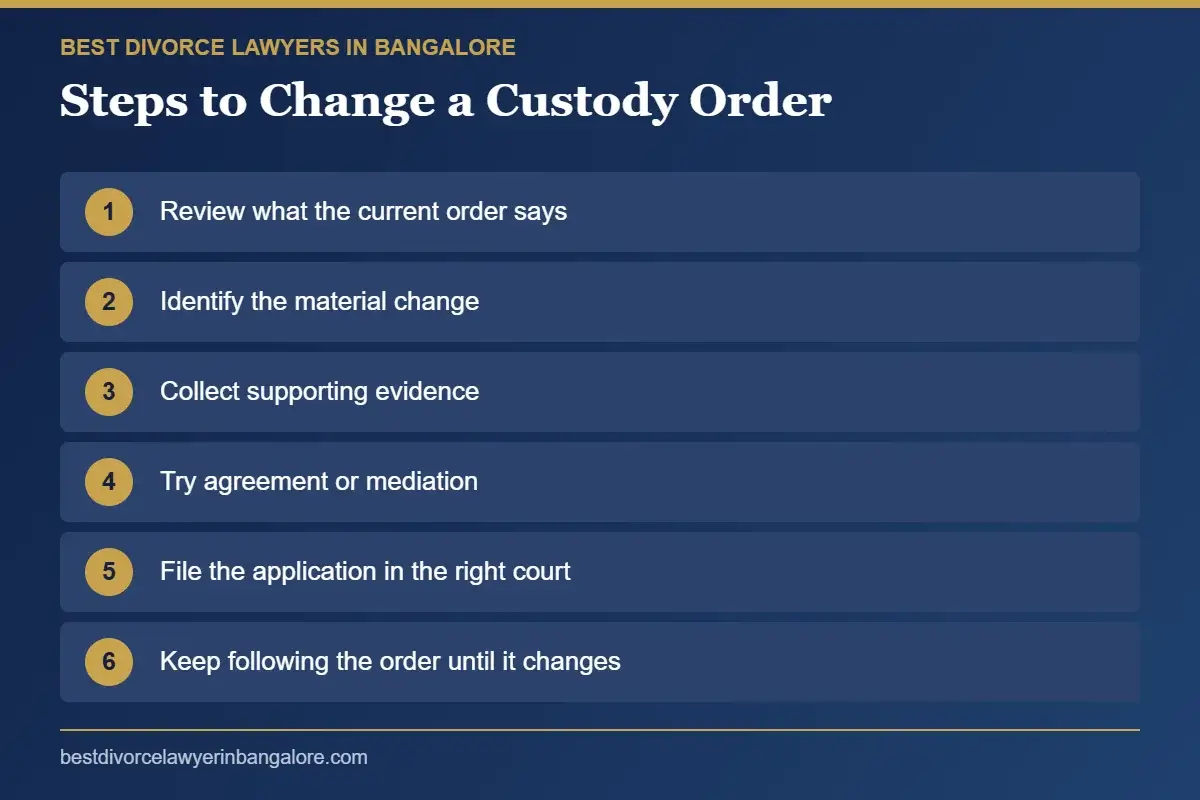
- Review the existing order: note exactly what it says about residence, visitation, holidays, schooling, travel and communication, and any conditions attached.
- Identify what has changed: explain the change clearly and how it affects the child. General dissatisfaction with the other parent will not succeed.
- Collect evidence: school reports, medical records, proof of relocation, messages between parents, and evidence of any safety concerns.
- Try agreement or mediation: if both parents agree on a change, it can be recorded through a joint application. Otherwise, the Family Court’s mediation centre can help.
- File the application with legal advice: your advocate will identify the right court and procedure and whether to ask for interim relief while the application is pending.
- Keep following the existing order: unless the court changes it or you obtain urgent protection, do not stop visits or move the child. If there is immediate danger, seek urgent orders.
What the court will consider
The court looks at the child’s safety, emotional stability, education, health and relationship with each parent, and at how disruptive a change would be. It may speak to the child. A proposal that improves the child’s welfare with minimal upheaval is more persuasive than one driven by parental conflict. Often the court makes a narrower change, such as revised visitation, more holiday time or video calls, rather than transferring custody. For the full set of factors, see how courts decide child custody.
Modifying visitation rather than custody
Many applications are about visitation rather than custody: adding overnight stays as a child grows, adjusting for a new school timetable, adding video calls after a move, or introducing supervision after a safety concern. These are usually quicker to decide than a full change of custody.
Relocation as a reason for modification
Relocation is the most common trigger. If the custodial parent wants to move with the child, they should apply first rather than move and seek approval later. The court weighs the reasons for the move, the child’s schooling and support network, and whether the other parent’s relationship can be preserved through longer holidays and regular calls. Moves abroad raise further issues; see international child custody cases.
How this guide was prepared
This guide is based on the bare acts published on India Code and on judgments of the Supreme Court of India and the Karnataka High Court. Section numbers, case citations and time limits were fact-checked in November 2026, and criminal-law references use the Bharatiya Nyaya Sanhita (BNS) and Bharatiya Nagarik Suraksha Sanhita (BNSS) in force since 1 July 2024. It is general information, not legal advice. For advice on your own case, speak to an advocate. Read our editorial standards and disclaimer.
Frequently Asked Questions
Can a custody order be changed after divorce in India?
Yes. Custody orders are never final. Either parent can apply to the court to vary them if circumstances change and a new arrangement would better serve the child.
What counts as a material change in circumstances?
Examples include relocation, a serious change in a parent’s ability to care, the child’s changing needs, safety concerns and repeated obstruction of visitation. Remarriage or higher income alone usually is not enough.
Can I stop following the custody order while my application is pending?
No. You must follow the existing order until the court changes it. If there is immediate danger to the child, ask the court for urgent interim orders.
Can parents change custody by agreement?
Yes. Parents can agree a change and record it through a joint application to the court, which checks that it serves the child.
Speak to a child custody lawyer in Bangalore
A custody order can be changed when the child’s circumstances change, but only through the court and only for the child’s benefit. Be ready to explain what has changed, why the current arrangement no longer works and how your proposal better meets your child’s needs. If you need advice on your own situation, consult an experienced child custody lawyer in Bangalore, or compare the top family and divorce lawyers in Bangalore on our list. The first consultation is free.