This divorce FAQ answers the questions people in India most often ask before they file: can one spouse get a divorce alone, does mutual consent always take six months, what happens to the children, and who pays maintenance. The honest answer usually depends on which law governs your marriage. Hindu, Sikh, Jain and Buddhist marriages fall under the Hindu Marriage Act, 1955 (HMA); inter-faith and civil marriages registered under the Special Marriage Act, 1954 (SMA) follow that Act; Christian marriages fall under the Divorce Act, 1869; Parsi marriages under the Parsi Marriage and Divorce Act, 1936; and Muslim marriages under Muslim personal law and the Dissolution of Muslim Marriages Act, 1939. The answers below explain the general position and point you to our detailed guides.
Filing for divorce: who can file and on what grounds
1. Can a husband or wife file for divorce alone?
Yes. A divorce does not always need both spouses to agree. If both want to end the marriage, they can file a joint petition for mutual consent divorce. If only one spouse wants it, that spouse can file a contested petition on a ground the law recognises, such as cruelty or desertion. The other spouse is served notice and can reply, and if they ignore the case after proper service, the court can proceed in their absence through an ex parte divorce. Our guide to one-sided divorce in India explains this route in detail.
2. What is a mutual consent divorce?
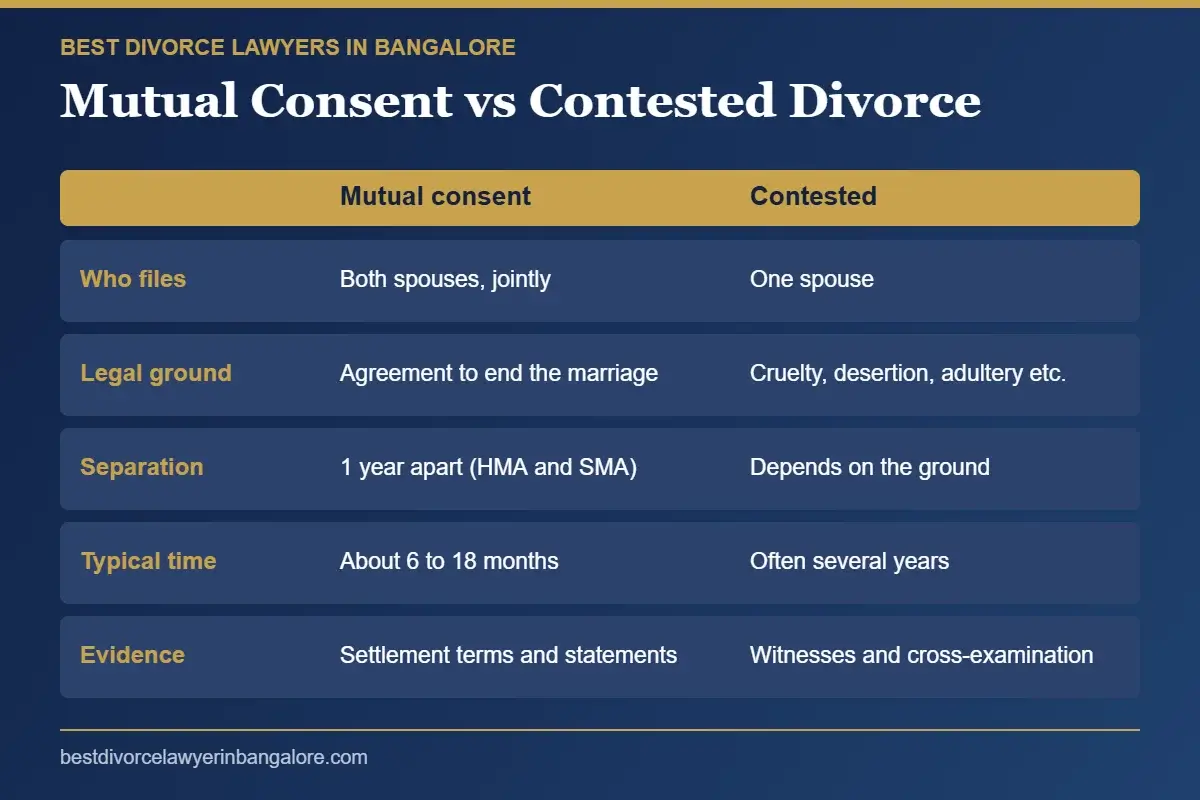
It is a joint decision by both spouses to end the marriage through the court. Under Section 13B of the HMA, the couple must have lived separately for one year or more, must be unable to live together, and must have agreed that the marriage should be dissolved. Section 28 of the SMA has the same one-year requirement. The couple files a joint petition (the first motion), the Family Court records their statements, and after the waiting period they confirm their consent in a second motion before the decree is passed. Mutual consent works best when the couple has already settled the children, maintenance, stridhan and property. See mutual divorce vs contested divorce for a side-by-side comparison.
3. What if my spouse refuses to give a divorce?
A refusal does not mean you are stuck in the marriage. Refusal only rules out mutual consent; you can still file a contested petition if you have a legally recognised ground and can prove the facts. The court hears both sides before deciding. Irretrievable breakdown of marriage is not, by itself, a ground a Family Court can use, but in Shilpa Sailesh v. Varun Sreenivasan (2023) the Supreme Court held that it can dissolve such marriages using its special power under Article 142 of the Constitution. If talks have failed, experienced contested divorce lawyers in Bangalore can assess whether your facts support a ground.
4. What are the grounds for a contested divorce?
They depend on the law that governs your marriage. Under Section 13(1) of the HMA, either spouse can seek divorce on grounds including adultery, cruelty, desertion for a continuous period of at least two years, conversion to another religion, incurable mental disorder, communicable venereal disease, renunciation of the world, and the other spouse not being heard of as alive for seven years. Section 13(2) gives a wife some additional grounds. Everyday words do not always carry legal weight: calling a marriage “toxic” does not prove a ground, but persistent conduct that makes it unreasonable to expect you to live together may amount to mental cruelty. Read our guides on grounds for divorce in India and cruelty as a ground for divorce before drafting any allegation.
5. Can I file for divorce in any city?
No. The court must have territorial jurisdiction. Under Section 19 of the HMA, you can file where the marriage was solemnised, where your spouse lives at the time of filing, where the two of you last lived together, or, if the wife is filing, where she lives on the date of the petition. Similar rules apply under other laws. In Bengaluru, divorce petitions are heard by the Family Courts. Filing in the wrong court causes avoidable delay, so check jurisdiction first; our guide to the divorce process in Bangalore walks through each step.
6. Can we divorce with a notarised agreement or a stamp-paper deed?
No, not for a marriage under the HMA or SMA. Only a decree of a competent court ends such a marriage. A notarised “divorce deed” or a settlement on stamp paper has no effect on your marital status, unless a recognised custom of divorce applies to your community, which is rare and must be proved. Remarrying on the strength of such a document can expose you to a charge of bigamy under Section 82 of the BNS. For Muslim marriages, instant triple talaq is void and an offence under the Muslim Women (Protection of Rights on Marriage) Act, 2019.
Timelines and the court process
7. Does a mutual consent divorce always take six months?
Not necessarily. This is one of the most common misconceptions about divorce in India. Under Section 13B(2) of the HMA, the second motion is ordinarily made not earlier than six months and not later than eighteen months after the joint petition is filed. In Amardeep Singh v. Harveen Kaur (2017), the Supreme Court held that the six-month cooling-off period is not mandatory and the court can waive it where the couple has already been separated for over eighteen months, mediation has failed, the parties have genuinely settled alimony and custody, and waiting would only prolong their distress. A waiver is not automatic; the court decides it on the facts. Our guide on how long divorce takes in India explains typical timelines.
8. Do we have to live separately before getting divorced?
For mutual consent, yes: one year of living separately under the HMA and SMA, and two years under the Divorce Act, 1869. “Living separately” means not living as husband and wife; couples sharing the same house can still be living separately in law. For a contested divorce, it depends on the ground. Desertion needs at least two years, while cruelty has no minimum period. Note also that Section 14 of the HMA ordinarily bars a divorce petition within the first year of marriage unless the court allows it for exceptional hardship.
9. What happens during a contested divorce?
A contested case has more stages than a mutual one. The petitioner files the petition setting out the facts and the ground; the court issues summons; the respondent files a written statement; interim applications for maintenance or custody may be decided; the court usually refers the couple to counselling or mediation; issues are framed; both sides lead evidence, typically through affidavits, followed by cross-examination; and after final arguments the court gives its judgment. This is why contested cases often take considerably longer than people expect. See how to file for divorce in India for the filing stage.
10. What documents are usually needed?
There is no universal checklist, but most cases need:
- Marriage certificate or other proof of marriage, such as wedding photographs or the invitation card
- Identity and address proof of both spouses
- Details and birth certificates of any children
- Income and financial records where maintenance is in dispute
- Property, loan and stridhan records where financial issues are involved
- Copies of any previous or pending court cases between the spouses
- The signed settlement terms in a mutual consent case
The court may ask for more depending on the facts. Our full list of documents required for divorce in India covers each type of case.
11. How much does a divorce cost in Bangalore?
Court fees for a divorce petition are modest; most of the cost is the advocate’s fee, which depends on whether the case is mutual or contested, how many hearings it needs, and whether maintenance, custody or property is disputed. A mutual consent divorce is usually far cheaper than a contested one. Our guide to the cost of divorce in Bangalore breaks this down, and the first consultation with the advocates on our list is free.
12. Can couples try mediation instead of fighting in court?
Yes. Section 9 of the Family Courts Act, 1984 requires the Family Court to make efforts at settlement, and Bengaluru’s Family Courts routinely refer couples to counsellors and the court-annexed mediation centre. Mediation is not only about saving a marriage; it also helps couples who have decided to separate agree on children, maintenance and property, which shrinks what the court has to decide. It is confidential and voluntary, and it is not suitable where there is violence or a serious imbalance of power. Read more about the divorce mediation process in India.
13. Can a divorce petition be withdrawn?
Yes. A petitioner can usually withdraw a contested petition with the court’s permission. In a mutual consent case, either spouse can withdraw consent at any time before the decree; the Supreme Court confirmed this in Sureshta Devi v. Om Prakash (1991). Withdrawing after signing a settlement can have consequences, so take advice first. See can a divorce petition be withdrawn for details.
Children, maintenance and property
14. What happens to the children when parents divorce?
Divorce ends the marriage, not either parent’s relationship with the child. The court can pass interim and final orders on custody, visitation, education and maintenance of children (Section 26 of the HMA), and custody disputes are also decided under the Guardians and Wards Act, 1890 and the Hindu Minority and Guardianship Act, 1956. The welfare of the child is the paramount consideration, so custody is not treated as a contest between parents. Often one parent has day-to-day custody and the other has regular visitation. Parents can agree on a parenting plan, and the court checks that it serves the child.
15. Can a spouse ask for maintenance?
Yes, depending on the facts and the applicable law. During the case, either spouse with insufficient income can claim interim maintenance and litigation expenses under Section 24 of the HMA; this is not limited to wives. Permanent alimony can be ordered under Section 25. Separate claims are possible under Section 144 of the BNSS (formerly Section 125 CrPC) and the Protection of Women from Domestic Violence Act, 2005. There is no fixed percentage. In Rajnesh v. Neha (2020), the Supreme Court made it mandatory for both parties to file an affidavit disclosing their assets and liabilities, so financial disclosure is central to any maintenance claim.
16. Does the wife automatically get half of the husband’s property?
No. This is another common misconception. India has no automatic equal division of property on divorce. Each spouse keeps what they own, jointly held property follows the ownership shares, and a wife’s stridhan (jewellery, gifts and other property given to her) belongs to her absolutely and can be recovered. Under Section 27 of the HMA, the court can also deal with property presented at or around the time of the marriage that belongs jointly to both. A settlement can, of course, transfer property by agreement. Anyone with significant property, investments or a business should take specific advice before signing.
17. Can we settle everything before the divorce is granted?
Yes, and many couples do. A good settlement covers maintenance (lump sum or monthly), the custody and visitation schedule, return of stridhan and personal belongings, property, loans, and what happens to pending cases. Vague wording such as “all disputes are settled” can cause trouble later if a house, bank account, loan or child’s expenses were left out. Criminal cases such as a dowry or cruelty complaint cannot simply be withdrawn by agreement; quashing usually needs an application to the High Court under Section 528 of the BNSS. Experienced mutual divorce lawyers in Bangalore can draft clear terms.
Special situations and life after the decree
18. Which law applies to Christian, Muslim and Parsi divorces?
Christian divorce is governed by the Divorce Act, 1869. Section 10 sets out the contested grounds, and Section 10A allows mutual consent divorce only after the spouses have lived separately for two years or more, double the HMA period. Parsi divorce is governed by the Parsi Marriage and Divorce Act, 1936, heard by special Parsi matrimonial courts. Muslim divorce follows personal law (talaq, khula and mubarat) and the Dissolution of Muslim Marriages Act, 1939, which sets out the grounds on which a wife can seek divorce through the court. Couples of any faith who married under the SMA follow that Act. Never assume one community’s procedure applies to another.
19. Can an NRI get a divorce without travelling to India?
Often in part. Courts in India increasingly allow a spouse living abroad to appear by video conference and to act through a power of attorney for some steps, but the court decides what it will allow, especially for recording consent. A foreign divorce decree is recognised in India only in limited situations, as the Supreme Court explained in Y. Narasimha Rao v. Y. Venkata Lakshmi (1991). Our guide to NRI divorce in India covers this in detail.
20. Can a person remarry immediately after filing for divorce?
No. Filing a petition does not end the marriage, and living apart for years is not a divorce. Under Section 15 of the HMA, you can lawfully remarry only after the decree and once there is no right of appeal, the time for appeal has expired without an appeal, or any appeal has been dismissed. Marrying earlier makes the second marriage void and can be prosecuted as bigamy. Read our guide to second marriage after divorce, and once you have the decree, see how to check your divorce certificate online and change your name in your passport.
Before you file: a short checklist
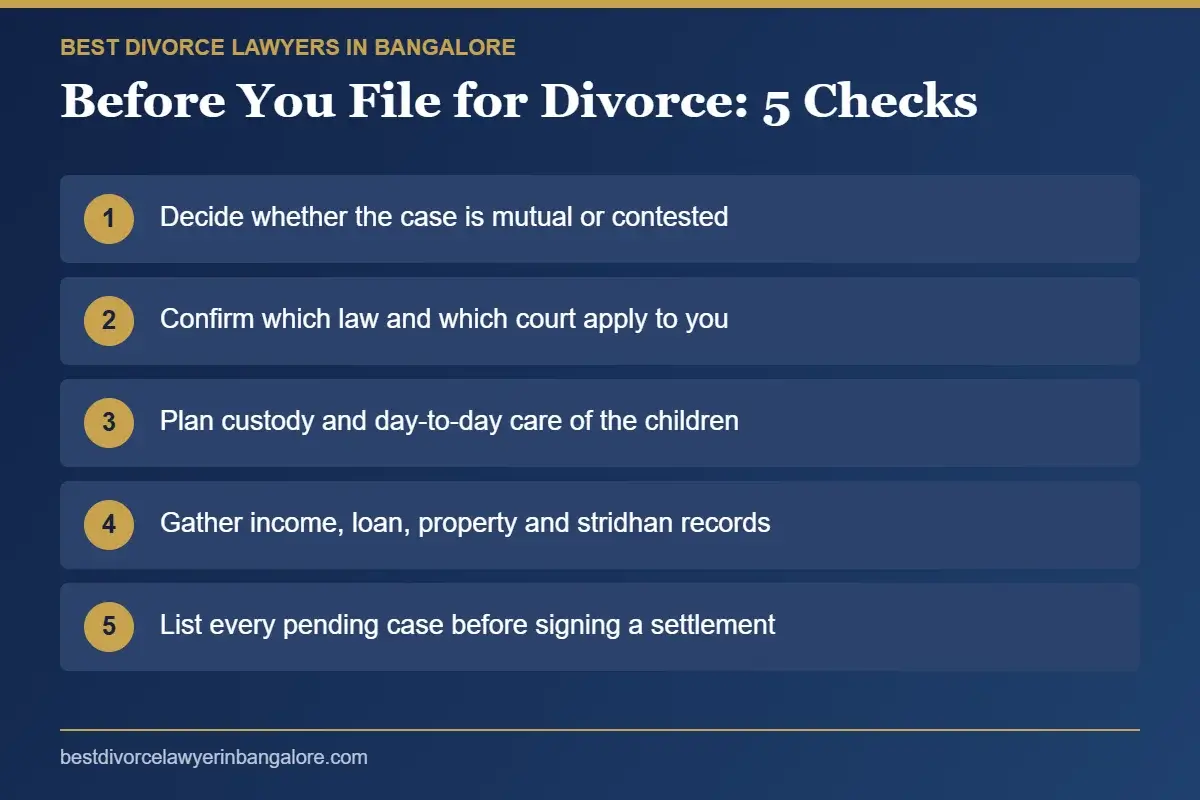
Look at the whole picture, not just the decree. Decide whether your case is likely to be mutual or contested. If there are children, think through custody and day-to-day care. If money is an issue, gather information on income, loans, property and stridhan. Identify every case already pending between you and your spouse before you sign any settlement. Above all, do not sign just to end things quickly; make sure you understand which rights you are giving up and what the other side is promising in return. Our guide to coping with divorce can help with the emotional side.
How this guide was prepared
This guide is based on the bare acts published on India Code and on judgments of the Supreme Court of India and the Karnataka High Court. Section numbers, case citations and time limits were fact-checked in November 2026, and criminal-law references use the Bharatiya Nyaya Sanhita (BNS) and Bharatiya Nagarik Suraksha Sanhita (BNSS) in force since 1 July 2024. It is general information, not legal advice. For advice on your own case, speak to an advocate. Read our editorial standards and disclaimer.
Frequently Asked Questions
Can one spouse file for divorce without the other agreeing?
Yes. If only one spouse wants a divorce, they can file a contested petition on a legal ground such as cruelty or desertion. Mutual consent needs both spouses.
Is the six-month waiting period in mutual divorce mandatory?
No. In Amardeep Singh v. Harveen Kaur (2017) the Supreme Court held that the court can waive it in suitable cases, for example where the couple has been separated for over eighteen months and has settled all issues.
Does a wife get half the property after divorce in India?
No. India has no automatic equal division of property. Each spouse keeps their own property, stridhan belongs to the wife, and joint property follows ownership shares unless a settlement says otherwise.
Is a divorce on stamp paper or a notarised deed valid?
No. For marriages under the Hindu Marriage Act or Special Marriage Act, only a court decree ends the marriage. A notarised deed has no effect on marital status.
When can I remarry after divorce?
Only after the decree, and once the appeal period has passed without an appeal or any appeal has been dismissed. Remarrying earlier can amount to bigamy.
Get advice on your own case
There is no one-size-fits-all divorce process in India. The law changes with the type of marriage, the personal law involved and the facts of the relationship. For some couples, mutual consent is a practical way to part without asking a court to decide every disagreement; for others, a contested case is unavoidable. Children, financial security, property and pending cases can all have lasting consequences, so look at the complete picture before you file or sign a settlement. Our hub on divorce laws in India explains every route, and you can compare the top divorce lawyers in Bangalore on our list and book a free first consultation.